October is a good time to prepare your apartment for the first cold spells. Radiators may still be cool, but hardware stores have a good selection of seals, humidifiers, warm textiles, and useful consumables without seasonal rush.
Don't wait until cold air starts seeping through the windowsill and blankets appear in every room. A few simple purchases help retain heat, maintain comfortable humidity, and avoid running a powerful heater at full blast.
It's better to create a shared shopping list in Pickt right away: add window measurements, necessary consumables, links to suitable models, and notes on who will buy what. This way, you'll cover everything in one trip to the hardware store instead of going back for forgotten tape or batteries.
Windows and Doors: Seals, Tape, and Curtains—Where Heat Escapes
Most often, an apartment cools down not because of weak radiators, but due to gaps around windows, balcony doors, and the entrance door. Even a small draft noticeably reduces comfort: you have to raise the temperature, although the problem can be solved by sealing.
Self-Adhesive Weatherstrip
For plastic and wooden windows, rubber, silicone, or foam weatherstripping works well. Before buying, check where exactly the draft comes from: run your hand along the frame or use a thin strip of paper. If it moves when the window is closed, the seal needs replacement or adjustment.
Measure the perimeter of the sashes in advance. It's better to buy weatherstripping with a small margin, especially if you need to seal the balcony door. It's important to clean and degrease the surface: on a dusty frame, the tape will peel off quickly.
Insulation Tape and Sealant
Gaps between the frame and the slope, cracks near the windowsill, and gaps around the entrance door are best sealed with special tape, acrylic sealant, or mounting foam. Don't cover ventilation openings: fresh air is necessary, even when you want to save every degree.
For temporary window protection, transparent thermal film is suitable. It creates an additional air layer and reduces the feeling of cold from the glass. This is especially useful in older apartments or rooms with large windows.
Thick Curtains and Door Protection
Thick drapes help retain heat in the evening and at night. During the day, open them: sunlight warms the room for free. Curtains should not completely cover the radiator, otherwise warm air will stay trapped between the battery and the window.
For the entrance door, a door seal, brush, or draft stopper under the door is useful. This is especially noticeable in the hallway: cold air from the stairwell quickly spreads throughout the apartment.
Dry Air: Humidifier or Budget Alternatives, Hygrometer
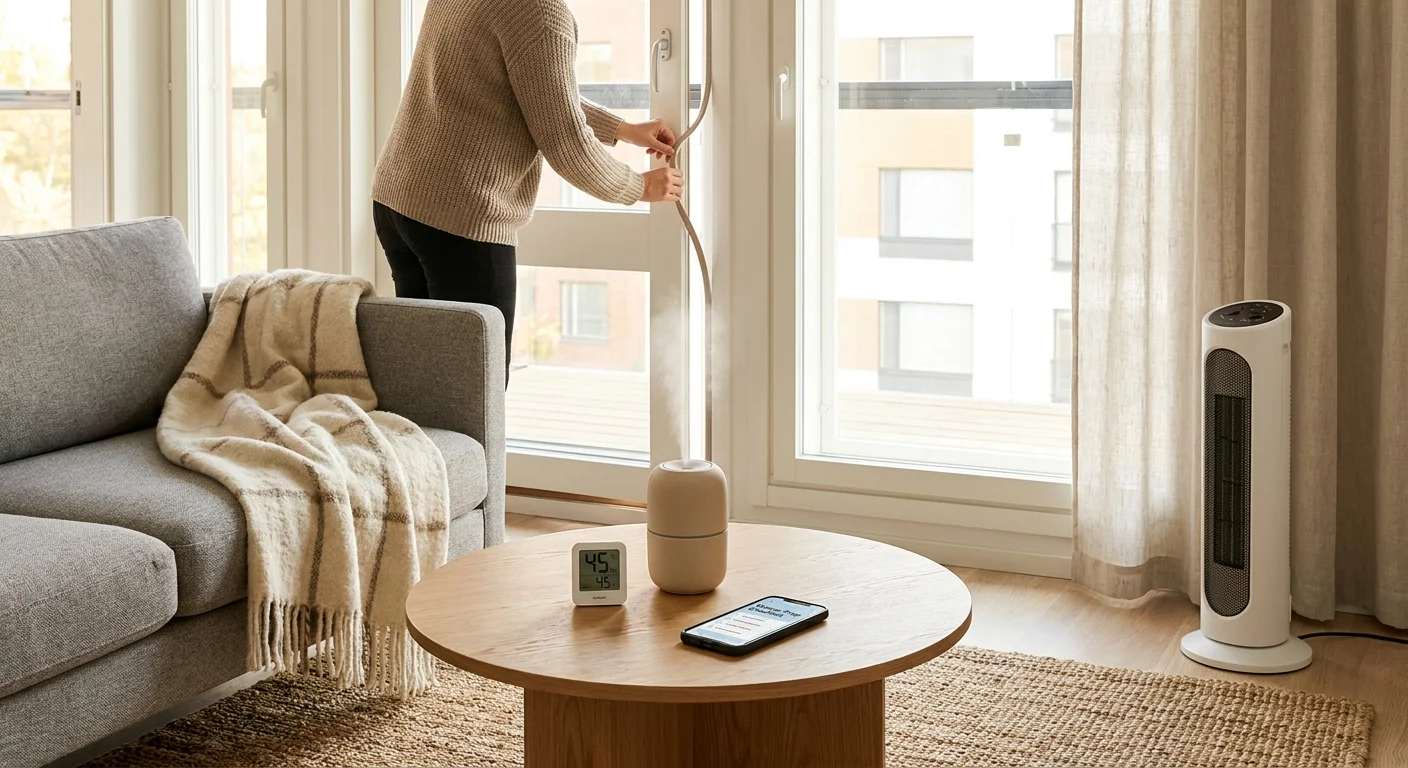
With the start of the heating season, the air in the apartment often becomes too dry. This causes dry mucous membranes, skin, and houseplants, and sleep may become less comfortable. Relying only on feelings is difficult, so the first useful device will be a hygrometer.
The optimal relative humidity for most apartments is about 40–60%. If the reading is consistently lower, consider humidification. Don't aim for tropical conditions: excess moisture can lead to condensation on windows and mold growth.
How to Choose a Humidifier
For a bedroom or children's room, a quiet ultrasonic humidifier with adjustable intensity, a timer, and automatic shut-off when the tank is empty is usually chosen. For a large room, look at the coverage area and tank capacity, not just the attractive design.
Consider maintenance. Ultrasonic models require regular cleaning and preferably filtered water; otherwise, white dust may appear on furniture. Traditional humidifiers work more gently but require filter replacement. Air washers both humidify and trap some large dust particles, but they usually cost more.
Budget Ways to Increase Humidity
If you don't want to buy a device yet, start with simple solutions: place a wide container of water near a heat source, dry laundry in a well-ventilated room, use plants with large leaves. You can hang a wet towel on a drying rack, but don't cover electric heaters or radiators with thermostats.
These methods won't replace a full-fledged humidifier in a very dry apartment, but they will help get through the first weeks of heating. A hygrometer will show whether they have a real effect.
Local Heating: Heater for the Task, Warm Textiles, and Rugs
When heating hasn't been turned on yet or one room is noticeably cooler, it's more economical to warm the needed area rather than the entire apartment. Local heating reduces electricity consumption and makes evenings at home more comfortable.
Which Heater to Choose
For quickly warming a small room, a fan heater is suitable, but it can be noisy and dry the air. A convector is convenient for maintaining a more even temperature: it works quieter and is suitable for prolonged use if instructions are followed.
An oil-filled radiator takes a long time to heat up but cools down slowly and provides gentle warmth. An infrared heater is useful when you need to warm a specific spot—a desk, chair, or relaxation area. Don't choose a device solely by maximum power: for a small bedroom, an excessive kilowatt reserve isn't always needed.
If it's only cold at night, it's sometimes wiser to buy an electric blanket, heating pad, or a warm throw with overheat protection. Such solutions consume significantly less energy than heating the entire room. However, never sleep with faulty electric heating pads or leave them on unattended.
Textiles That Work
Add a warm throw, mattress pad, wool or fleece socks, and house slippers to the list. The body loses a lot of heat through the floor, so a rug by the bed, in the children's room, or near the workspace noticeably increases comfort.
For tile in the bathroom and hallway, choose rugs with a non-slip backing. It's important that they can be washed regularly: damp textiles quickly accumulate dust and unpleasant odors.
Safety: What to Check on the Heater and Outlets
Before the season, inspect your existing heater. Do not use the device if the cord is damaged, the casing is cracked, it smells of burnt plastic, or the plug gets very hot. Such signs are a reason to contact a service center or replace the device.
For home use, choose models with overheat protection and automatic shut-off if tipped over. The heater should stand on a flat, hard surface, at least a meter away from curtains, furniture, laundry, long-pile carpets, and other flammable items.
Do not plug a powerful heater into a questionable extension cord, splitter, or surge protector rated only for chargers and lamps. Check the outlets: they should not spark, wobble, heat up, or emit an odor. If the apartment has old wiring, it's safer to consult an electrician in advance.
Separately, check smoke detectors, if installed, and replace their batteries. Use candles only in stable holders and never leave them unattended.
Seasonal Consumables: Filters, Batteries, and Candles for Outages
Preparing for cold weather isn't just about big purchases. In autumn, it's especially annoying to discover that the humidifier filter has run out, the thermostat battery is dead, and the flashlight doesn't work.
Add replacement filters for your humidifier, air purifier, vacuum cleaner, or ventilation—depending on your equipment. Check which specific part numbers fit your devices: universal consumables aren't always available.
A useful seasonal stock includes AA and AAA batteries, rechargeable batteries, a compact flashlight, a power bank, matches, or a lighter. Candles are useful in case of a brief power outage, but it's safer to supplement them with LED lamps or rechargeable lights.
Summary Checklist for Preparing Your Apartment for the Heating Season
- Measure the perimeter of window sashes and the balcony door.
- Buy weatherstripping, insulation tape, or sealant for gaps.
- Check thick curtains, door seals, and draft stoppers.
- Add a hygrometer and, if necessary, a humidifier.
- Buy suitable filters and cleaning agents for the humidifier.
- Choose a local heat source: convector, oil-filled radiator, fan heater, electric blanket, or heating pad.
- Prepare throws, warm slippers, and rugs with non-slip backing.
- Check the cable, plug, overheat protection, and installation location of the heater.
- Inspect outlets, extension cords, and surge protectors.
- Replenish the stock of batteries, flashlights, candles, and rechargeable batteries.
To avoid losing track, create a shared list “Heating Preparation” in Pickt. Divide purchases by category, attach photos of the needed filters, and mark items right in the store. A shared list is especially convenient if one person goes to the hardware store while another checks the home, measures windows, or selects appliances online.
A little preparation in October helps you meet the cold season calmly: without drafts, dry air, emergency purchases, or extra kilowatts on your utility bill.