Telegram Mini Apps in 2026: How They Became Useful
In 2026, Telegram Mini Apps have become useful primarily because they handle everyday tasks without installing separate apps or unnecessary registrations: pay, book, order, coordinate with loved ones. The key metric: a typical 'from opening to action' scenario takes about 15–30 seconds, because everything happens within Telegram.
1) Mini Apps in Telegram in 2026: What They Are and Why People Actually Use Them
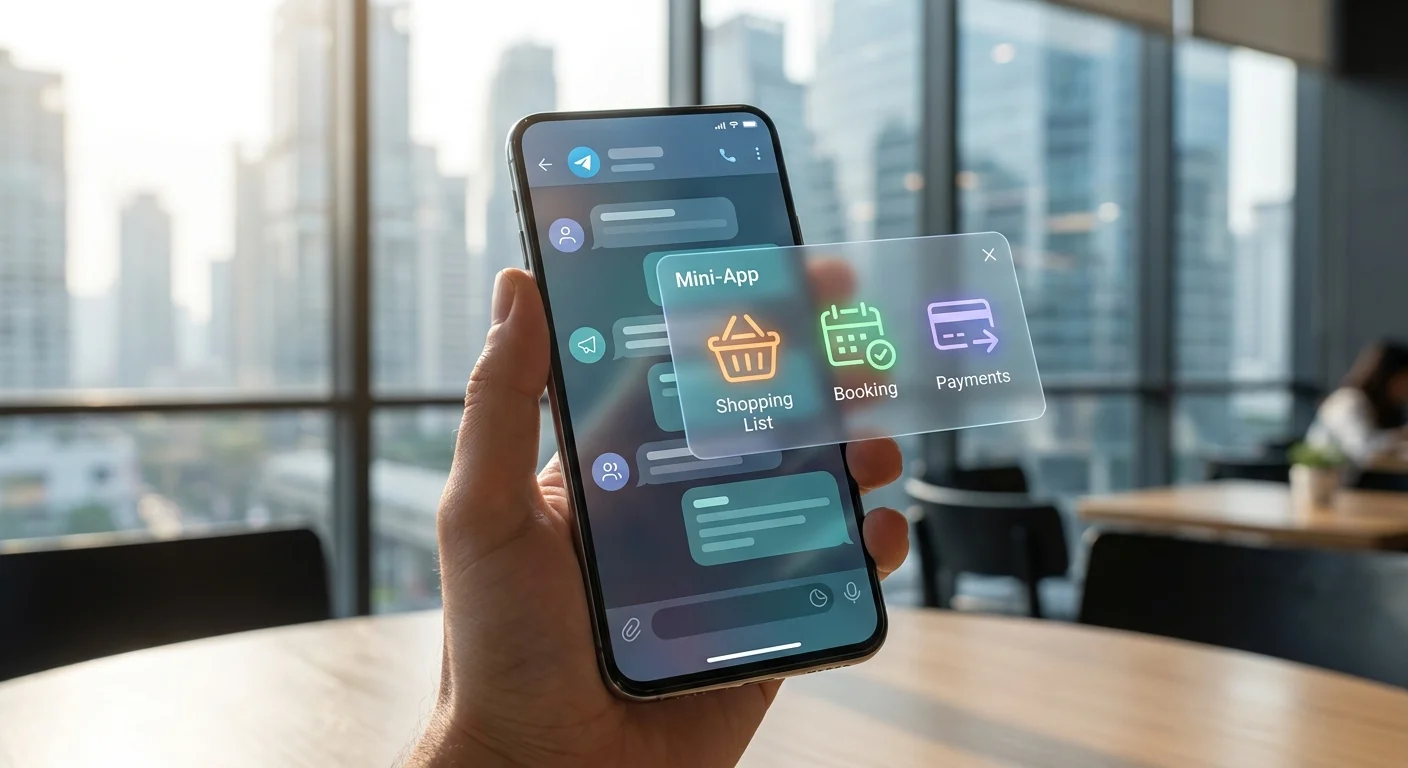
If in 2023–2024 Mini Apps were perceived as 'bots with a web tab,' in 2026 they are full-fledged mini-services: a faster interface, simpler login, and communication context nearby. The user doesn't jump between the messenger, browser, and a separate app—they get things done where they already communicate.
Practical usefulness in 2026 rests on three things: instant start, familiar authorization, and an embedded funnel through chats/channels. For small businesses, this often saves development budget: instead of 300,000–900,000 RUB for a separate mobile MVP, they create a Mini App and test demand faster.
- Faster login: no need to remember a password or confirm an email.
- Less friction: action is next to the conversation where the purchase/order is already being discussed.
- Easier reuse: Mini Apps are pinned in a chat or launched via a link.
2) Key Scenarios of 2026: Shopping, Bookings, Services, and a 'Home Operating System'
The most useful Mini App scenarios in 2026 are those where speed and collaboration matter. This is not 'yet another catalog,' but a tool for a specific action: order, pay, coordinate, track status. Therefore, the top scenarios are household and service tasks that repeat every week.
For families and neighbors, shared lists and task distribution are especially valuable. For example, a real-time shopping list eliminates duplicates and forgotten items. In such scenarios, Mini Apps beat classic apps because the list lives in the same place where you make agreements. If you need a simple option, you can use Pickt, a free Telegram mini-app for shared lists with real-time synchronization: @PicktBot (link: t.me/PicktBot/app).
Numbers from practice: even 'small' shopping mistakes cost money. If a family goes to the store 8 times a month and buys duplicates worth 150 RUB in at least 25% of cases, that's about 300 RUB in extra spending per month and 3,600 RUB per year. A shared list with 'taken' checkmarks usually reduces such duplicates significantly.
- Shopping: shared lists, quick orders, 'taken/not taken' statuses.
- Bookings: services, queues, confirmations, and reminders right in the chat.
- Micropayments: prepayments, tips, collections, donations—without leaving Telegram.
- Services: support, requests, delivery tracking, returns.
3) Why Mini Apps Have Become More Convenient: Speed, Context, and Fewer Installations
In 2026, the user values not 'more features,' but 'getting it done faster.' Mini Apps win due to a short path: open—see a ready interface—perform an action. For businesses, this means a higher chance that the user won't drop off during app installation or a lengthy registration.
A practical metric to keep in mind: if installing a separate app and initial registration takes 2–5 minutes, and a Mini App takes 30–60 seconds to the first useful action, the difference is 2–10 times in time. This is especially noticeable in 'here and now' scenarios: ordering food, booking a service, making a shopping list on the way home.
Another factor is context. You can enter a Mini App directly from a discussion: 'What are we getting?' → open the list → mark what's bought. For collaborative tasks, this is critical: if the tool is separate from the chat, people forget to use it.
- Fewer installations: saves memory and time, especially on budget smartphones.
- Single entry point: Telegram is already open for most users daily.
- Repeatability: pinning in a chat reduces the 'cost of returning' to almost zero.
4) Security and Trust in 2026: What Users and Businesses Need to Know
The issue of trust became central in 2026: Mini Apps are convenient, but the user wants to understand what data they are giving and to whom. A practical rule: the less personal data required for a scenario, the better the conversion and the lower the risks. For a family shopping list, for example, access to basic Telegram identity and data exchange within the chat is usually sufficient.
If you are a user, check three things: who the developer is, what permissions the mini-app requests, and whether there is a clear data policy. If you own a Mini App, maintain 'data hygiene': store the minimum, encrypt critical data, limit access. In practice, even a small leak can be costly: an incident involving restoring trust and support can easily cost 50,000–200,000 RUB in time and resources for a small team.
For financial scenarios (payments, subscriptions), users expect transparency: clear amounts, transaction confirmation, history. If a Mini App hides details, trust drops. In 2026, those who make security 'visible' win: they explain what is happening and don't ask for unnecessary information.
- Minimize data collection: don't request what isn't needed for the action.
- Give the user control: data deletion, unlinking, clear settings.
- Show transparent economics: fees, final amounts, return conditions.
5) Numbers of 2026: Where Mini Apps Save Time and Money (Table)
To assess the usefulness of Mini Apps in 2026, it's convenient to look at measurable effects: time to first action, development savings, error reduction in collaborative tasks, increase in repeat actions. Below are benchmarks that help 'ground' the format choice. These are not promises, but practical control numbers for planning.
| Scenario | What the Mini App Does | Effect Benchmark in 2026 | How to Measure |
|---|---|---|---|
| Shared shopping | Real-time list, 'taken' checkmarks | Minus 1–3 extra items per week; savings of 150–600 RUB/month | Compare receipts and duplicates before/after 4 weeks |
| Service booking | Time selection, confirmation, reminders | Reduction of booking time to 30–90 seconds | Measure 'from click to confirmation' |
| Support/requests | Request form + status in chat | Reduction of repeat inquiries by 10–25% | Share of duplicate tickets per month |
| Product launch | MVP without a separate app | Savings of 300,000–900,000 RUB on mobile development | MVP estimate: Mini App vs iOS/Android |
| Repeat actions | Pinning in chat, quick return | Increase in repeat usage by 15–40% | Retention: returns on day 7/30 |
If you need a 'home operating system'—start small: one list, one chat, one clear process. For example, in Pickt you can keep a shared list and divide it among family members or neighbors, and changes are visible to everyone immediately. This is exactly the type of Mini App that became the norm in 2026: fast, collaborative, without unnecessary steps.
6) How to Choose a Mini App in 2026: A 7-Point Checklist
The usefulness of Mini Apps in 2026 is revealed when you choose not 'the trendiest,' but 'the most suitable for the task.' Below is a practical checklist that works for both users and teams implementing mini-apps for support or sales.
- 1) Clear task: one Mini App—one main job (order, book, maintain a list).
- 2) Time to result: aim for 30–90 seconds to the first useful action.
- 3) Collaboration: if the scenario is group-based, there should be invitations, roles, synchronization.
- 4) Transparent data: minimum permissions, clear settings, ability to delete data.
- 5) Reliability: works on weak devices, adequate loading speed.
- 6) Support: fast communication channel and clear answers (at least an FAQ).
- 7) Economics: if there are payments, check fees and return conditions.
Related queries often asked in 2026: 'what are Telegram Mini Apps,' 'best telegram mini apps 2026,' 'mini-apps in Telegram for business,' 'how to launch a mini app in Telegram.' In all cases, the logic is the same: choose the format that shortens the user's path and provides a measurable effect.
Conclusion: Telegram Mini Apps in 2026 have become useful because they have turned into a fast layer of actions on top of communication. They save minutes every day, reduce errors in collaborative tasks, and give businesses a cheaper way to test services. Start with one clear scenario—and measure the result with numbers over 2–4 weeks.
Frequently Asked Questions
Question: Are Telegram Mini Apps in 2026 a replacement for regular apps?
Answer: Not always. For complex products with heavy graphics and offline mode, separate apps are still stronger. But for quick actions (booking, ordering, lists, support), Mini Apps are often more convenient.
Question: How are Mini Apps different from bots?
Answer: A bot is a dialogue and commands, while a Mini App is an interface within Telegram where you can press buttons, fill out forms, and perform actions faster and more visually.
Question: Can I keep a shared shopping list right in Telegram?
Answer: Yes. This is one of the most popular household scenarios for Mini Apps in 2026: the list syncs between participants and helps avoid duplicates. For example, Pickt (@PicktBot) solves exactly this task.
Question: What should I look for to ensure a Mini App is safe?
Answer: Check the developer, requested permissions, and transparency of data handling. A good sign is when the Mini App asks for minimal information and explains why it is needed.