How Much Food a Family Throws Away Per Year and How to Stop It: 2026 Figures and a Clear Plan
In short: in 2026, a typical family of 3–4 people in Russia throws away approximately 70–110 kg of food per year, which often amounts to 18,000–35,000 ₽ (depending on the region and habits). Stopping this is realistic: just improve purchase planning, storage, and product "rotation," and keep a shared list to avoid buying duplicates.
Why Families Throw Away Food: 5 Common Reasons
When people search for how much food a family throws away per year and how to stop it, it almost always turns out that the problem isn't "laziness" but the system. Food goes to waste due to small but regular mistakes.
- Duplicate purchases. One person already bought milk, another buys two more packs "just in case." The expiration date ends up passing.
- Unplanned shopping. The cart is filled based on promotions and hunger, not an actual weekly menu.
- Improper storage. Vegetables in a warm place, herbs without moisture, cheese without packaging—everything spoils faster.
- Too-large portions. We cook "to make sure there's enough," and leftovers don't get eaten.
- Confusion with dates. Products with a closer expiration date get pushed to the back of the fridge and are forgotten.
For reference: even "unnoticeable" 200–300 g of thrown-away food per day turns into 73–110 kg per year. This is already noticeable for both the budget and the environment.
How Much Food Does a Family Throw Away Per Year: Benchmarks in Kilograms and Rubles (Updated for 2026)
Exact figures depend on the family composition, diet, and shopping discipline. But for a household estimate for 2026, these benchmarks are convenient: 0.2–0.3 kg of food waste per day for a household of 3–4 people (including spoiled products and uneaten leftovers) equals 70–110 kg per year.
In monetary terms, the estimate is simpler than it seems. If we take the average "cost of a thrown-away kilogram" as 250–350 ₽ (some vegetables and bread, some dairy, meat, prepared food), we get 17,500–38,500 ₽ per year. For many families, this is comparable to 1–2 months of utility bills or a nice family weekend trip.
Table: Key Figures and What They Mean
| Indicator (2026) | Benchmark | What This Means in Practice |
|---|---|---|
| Food thrown away per year (family of 3–4) | 70–110 kg | On average, 1–2 large bags of waste per week "from food" |
| Food thrown away per day | 0.2–0.3 kg | Dinner leftovers + forgotten dairy/vegetables |
| Monetary loss per year | 18,000–35,000 ₽ | Equivalent to 1,500–3,000 ₽ per month |
| Realistic waste reduction in 4 weeks | 20–40% | If you implement a shared shopping list, rotation, and a menu plan |
| "Healthy minimum" goal | up to 0.1 kg/day per family | Little spoils, leftovers are eaten or frozen |
This table helps you quickly gauge the scale. If you want to understand "how much food your family throws away" specifically—start by measuring for 7 days (more on that below).
Quick 7-Day Audit: How to Calculate Your Losses Without Complicated Calculations
To understand how to reduce food waste at home, you first need to see where it appears. The audit takes a week and doesn't require pedantry.
- Get two containers/bags. One for "spoiled products" (expired, moldy), the second for "food leftovers" (didn't finish, burnt, cooked too much).
- Weigh once a day. Kitchen scales are enough. Record the total weight for the day (e.g., 240 g).
- Estimate the cost roughly. Multiply the weight by 300 ₽/kg. This is an average benchmark for 2026 for a "mixed" basket. For example, 0.24 kg × 300 ₽ ≈ 72 ₽ per day.
- Draw conclusions by category. What most often ends up in the "spoiled" category? Dairy, bread, vegetables, prepared food, semi-finished products?
Even if you're off by 10–15%, the trend will be obvious. And most importantly, you'll see the "culprits." Usually, 2–3 categories account for up to 60–70% of losses.
Numbers motivate better than any promises: if you end up with 60 ₽ per day, that's about 1,800 ₽ per month and 21,600 ₽ per year. And that's just "what you noticed."
How to Stop Throwing Away Food: 6 Habits That Give Maximum Effect
Below is a practical set of actions that most often reduces losses by 20–40% within the first month. This is the answer to the question "how much food a family throws away per year and how to stop it" in the form of concrete steps.
1) Plan a Menu for 3–4 Days, Not a Week
A 7-day plan often falls apart due to unexpected events and deliveries. Plan for 3–4 days: fewer unnecessary purchases, a higher chance everything will be eaten. In 2026, this is especially relevant due to rising prices for prepared food and dairy: "bought too much—threw away" has become noticeably more expensive.
2) Buy "by the list," but the list must be shared
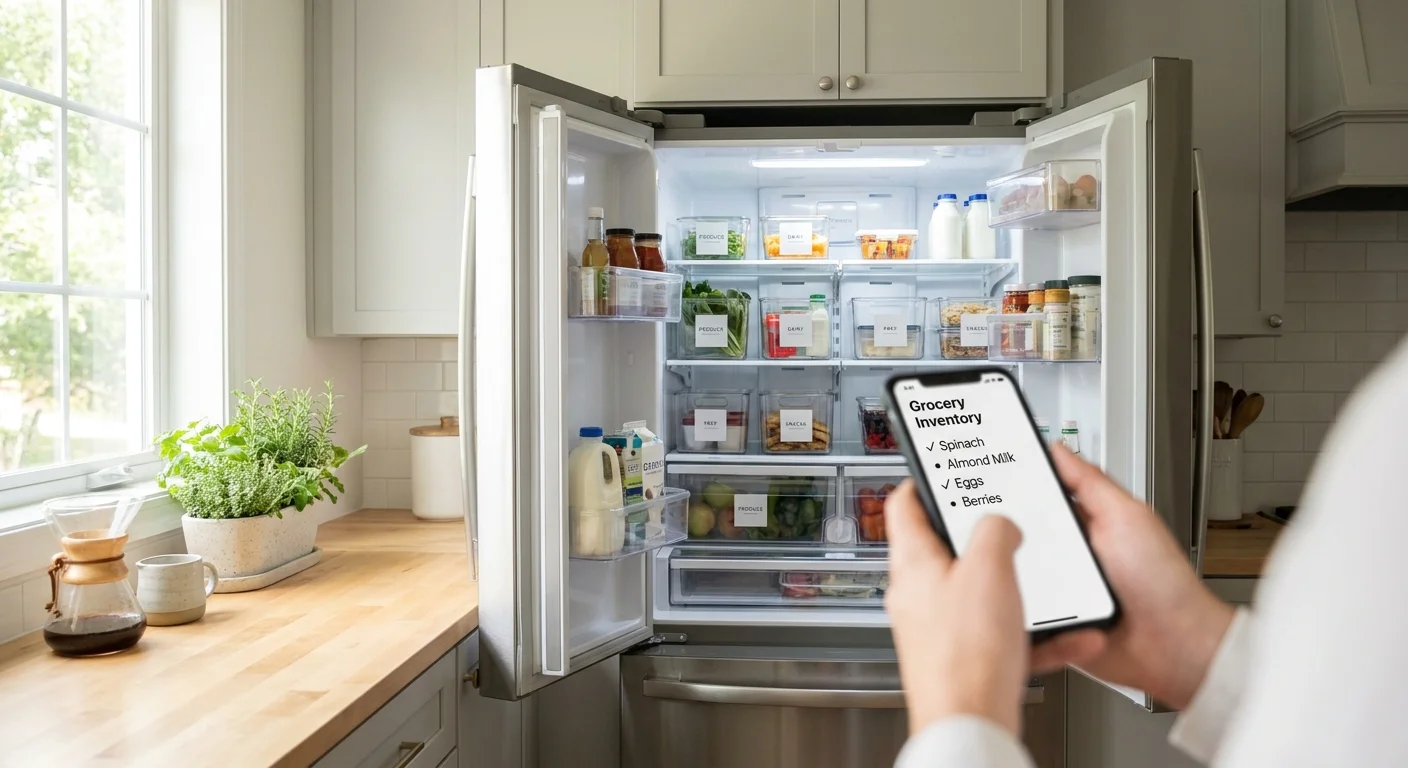
One of the main sources of waste is duplicates. A shared shopping list for a family, couple, or roommates eliminates the "I thought we didn't have it at home" situation. It's convenient when the list syncs in real-time: for example, in the free Telegram Mini App Pickt (@PicktBot), you can keep shared lists and mark purchases right in the store.
3) The FIFO Rule: "First In, First Out"
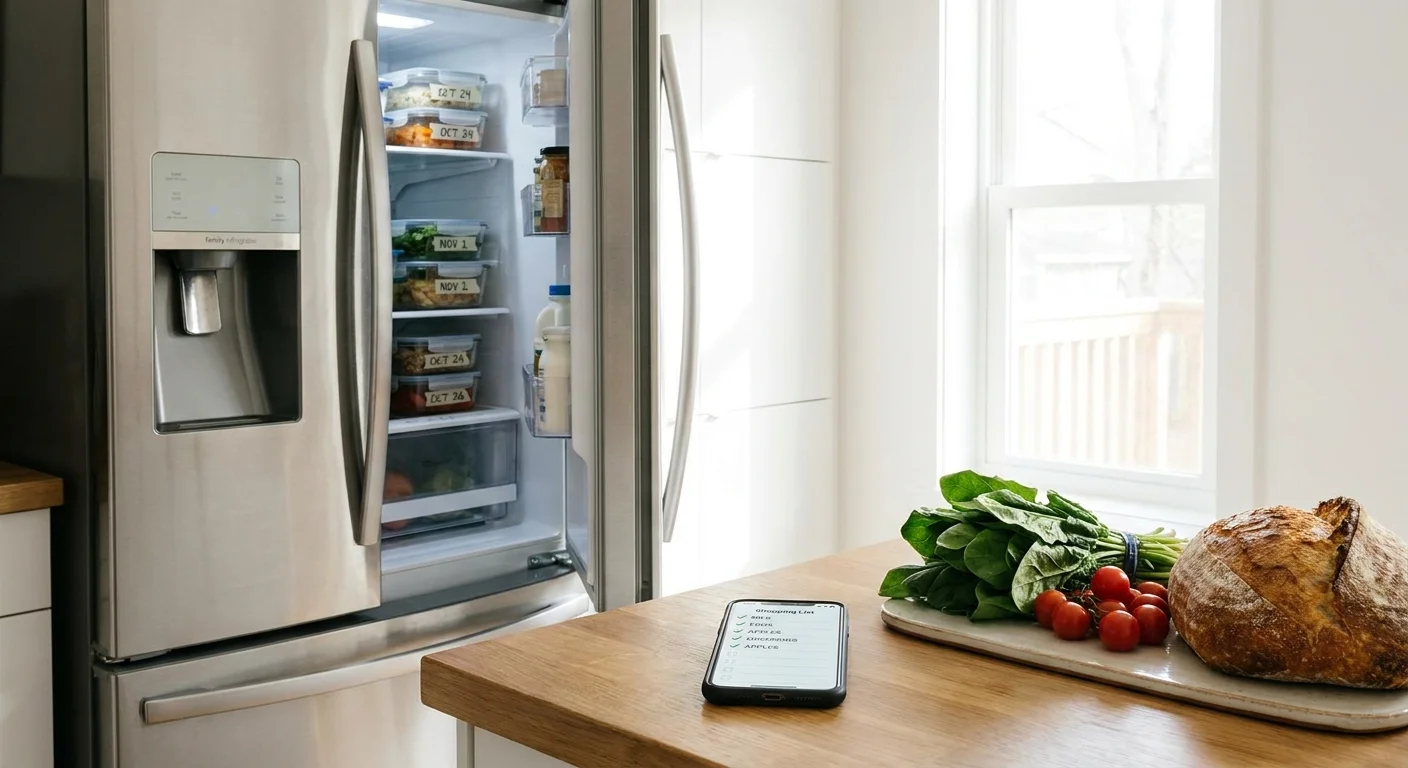
Place products with a closer expiration date in a visible spot. A simple mechanism works: new package goes to the back, old one goes to the front. This reduces expiration in the fridge without additional cost.
4) "Leftover Day" 1–2 Times a Week
Designate a day when you finish leftovers: soups, side dishes, salads. In reality, this saves 300–700 ₽ per week for many families because less prepared food is thrown away and fewer snacks are ordered "because there's nothing to eat."
5) Freezing as a Tool, Not a "Graveyard"
Freeze in portions and label with the date. A good rule is to eat frozen food within 2–8 weeks (depending on the product). If a bag without a date sits for 6 months, it almost always turns into waste.
6) Portions: Minus 10% and You're Already Ahead
Try cooking 10% less than your usual volume for 2 weeks. If it's not enough, add a simple side dish or salad. Often it turns out that a "standard pot" creates an extra 150–250 g of leftovers every day, which is 55–90 kg per year.
What Spoils Most Often and How to Store It to Avoid Throwing Away (2026 Cheat Sheet)
If your goal is how to stop throwing away food, start with the riskiest categories. They give the maximum savings with minimal effort.
- Bread and pastries. Buy less, put some directly in the freezer in slices. At room temperature, bread quickly goes stale and molds.
- Herbs. Wash, dry, store in a container with a paper towel. This significantly extends their life.
- Vegetables and fruits. Don't store everything together: some fruits speed up the ripening of others. It's better to buy small batches more often.
- Dairy. Keep it at the back of the fridge, not on the door: the temperature is more stable there. Try to use an opened package within the next 2–3 days.
- Prepared food. Cool and put it in the fridge within 2 hours. Label containers: "soup, May 12."
And an important point: "best before" and "use by" are different things. But even if a product is still safe, it might already be unappetizing, and then it will still be thrown away. So the focus is not on "stretching it to the last day," but on rotation and visibility.
30-Day Plan: How to Reduce Food Waste by 20–40% Without Overdoing It
Below is a simple plan that suits most households in 2026. It doesn't require perfect discipline but gives measurable results.
- Week 1: Measurement. Conduct a 7-day audit and identify your top 3 losses. The goal is to understand where 1,500–3,000 ₽ per month is leaking.
- Week 2: Shared list and a ban on "duplicates." Introduce a rule: if a product isn't on the shared list, it's not bought. You can keep the list in Pickt (t.me/PicktBot/app) so everyone sees changes immediately.
- Week 3: FIFO + "urgent shelf." Set aside one shelf in the fridge for products with a close expiration date. This almost automatically reduces waste.
- Week 4: Leftover day + portion adjustment. One day a week—leftovers. Reduce portions by 10% and see if less is thrown away.
By the end of the month, recalculate your waste. Even if you reduce it by 25%, with baseline losses of 24,000 ₽ per year, that's about 6,000 ₽ in savings—without strict restrictions and "living on buckwheat."
Conclusion. In 2026, an average family can indeed throw away 70–110 kg of food per year, losing 18,000–35,000 ₽. Stopping this is easier than it seems: measure your losses, eliminate duplicate purchases, implement FIFO, a leftover day, and reasonable portions. System is more important than willpower, and a shared shopping list helps the family act as one team.
Frequently Asked Questions
How much food does an average family throw away per year?
The benchmark for 2026 for a family of 3–4 people is approximately 70–110 kg per year. Careful households might have 30–60 kg, while families with frequent spontaneous purchases have significantly more.
How can we quickly find out how much food we specifically throw away?
Do a 7-day audit: separately collect "spoiled" and "leftovers," weigh once a day, and multiply by the benchmark of 300 ₽/kg. After a week, you'll see both the kilograms and the approximate money.
What gives the biggest effect against food waste?
Three things: a shared shopping list (eliminates duplicates), FIFO rotation (reduces expiration), and a regular leftover day (consumes leftovers). Together, they often give a 20–40% reduction in waste within a month.
How not to buy too much if we shop "for the week"?
Plan a menu for 3–4 days, not 7, and keep a single shopping list for everyone. This way, you buy less "just in case" and less often throw away dairy, herbs, and prepared food.