
How Much Can You Save by Shopping with a List: Calculations for 2026
If you go grocery shopping with a list, in 2026 you can realistically save an average of 10–20% on your total bill by making fewer impulse purchases and planning more precisely. For a family spending 35,000–60,000 ₽ per month on groceries, this translates to roughly 3,500–12,000 ₽ in monthly savings (42,000–144,000 ₽ per year) once the habit is consistent.
Why a List Saves Money: 3 Mechanisms That Work for Most People
A shopping list saves money not through "magic discipline," but through specific mechanisms. The first is reducing impulse purchases: you are less likely to grab "something for tea" or a second sauce "just in case." Even 2–3 extra items at 200–350 ₽ each can easily add 600–1,000 ₽ to your bill.
The second mechanism is fewer duplicates. When you already have buckwheat, oil, or cleaning supplies at home but forget about them, you end up buying them again. Duplicate purchases often lead to expired goods, which is a direct loss: roughly 300–700 ₽ per product that you didn't get to use.
The third is more precise meal planning for 2–4 days and buying "for specific dishes." This reduces the share of convenience foods and last-minute deliveries. The difference between "I need to eat quickly" and pre-purchased ingredients can be 150–400 ₽ per person per meal, adding up to a significant amount over a month.
How Much Can You Save by Shopping with a List: Figures by Scenario (2026)
To answer the question "how much can you save by shopping with a list" without generalities, it's helpful to calculate based on your actual spending. Below are benchmarks for 2026, assuming you buy groceries 1–3 times a week and usually pick up some items spontaneously.
Scenario 1: Single person. Average grocery spending 18,000–28,000 ₽/month. A list typically yields 8–15% savings, i.e., 1,400–4,200 ₽/month. Annually, this is 16,800–50,400 ₽.
Scenario 2: Couple. Spending 30,000–45,000 ₽/month. Savings of 10–18%: 3,000–8,100 ₽/month. Annually: 36,000–97,200 ₽.
Scenario 3: Family of 3–4 people. Spending 45,000–70,000 ₽/month. Savings of 12–20%: 5,400–14,000 ₽/month. Annually: 64,800–168,000 ₽.
Why is the range so wide? In 2026, the difference depends on how often you shop, your habit of buying ready-made food, whether you have children (more "treats" in the cart), and how often purchases are made by different people without coordination.
Table: Quick Calculation of Savings with a List (in Rubles and Percentages)
Use the table as a calculator. Take your average monthly grocery spending and multiply it by the expected savings percentage. For most people who previously shopped "from memory," a realistic starting point is 10–15%.
| Monthly Grocery Spending | 10% Savings | 15% Savings | 20% Savings |
|---|---|---|---|
| 20,000 ₽ | 2,000 ₽/month (24,000 ₽/year) | 3,000 ₽/month (36,000 ₽/year) | 4,000 ₽/month (48,000 ₽/year) |
| 35,000 ₽ | 3,500 ₽/month (42,000 ₽/year) | 5,250 ₽/month (63,000 ₽/year) | 7,000 ₽/month (84,000 ₽/year) |
| 50,000 ₽ | 5,000 ₽/month (60,000 ₽/year) | 7,500 ₽/month (90,000 ₽/year) | 10,000 ₽/month (120,000 ₽/year) |
| 65,000 ₽ | 6,500 ₽/month (78,000 ₽/year) | 9,750 ₽/month (117,000 ₽/year) | 13,000 ₽/month (156,000 ₽/year) |
A practical benchmark for 2026: if you haven't been using a list at all, the first 2–4 weeks usually yield the maximum effect (sometimes up to 20%), after which savings stabilize at 10–15% — this is normal and still beneficial.
Where Money "Leaks" Without a List: 6 Typical Traps and Their Cost
To make savings sustainable, it's important to understand exactly what you're removing from your bill. Below are the most common sources of overspending and their approximate "price tags" in 2026.
- Impulse sweets and snacks. 1–2 items at 120–250 ₽ each = +240–500 ₽ per trip.
- Drinks "on the go." Soda/energy drink/juice = 100–220 ₽, often bought without planning.
- Duplicates of grains, sauces, spices. +150–400 ₽ per item, and then some goes to waste.
- Ready-made food instead of ingredients. The difference is 200–600 ₽ for one dinner for a couple, compared to cooking at home.
- Shopping "on an empty stomach." On average, adds 5–10% to the bill due to extra snacks and "treats."
- Uncoordinated purchases by different family members. Two people buy the same thing: easily +500–1,500 ₽ per week.
Note: a list doesn't necessarily make purchases "cheap." It makes them predictable. This is more important for your budget than a one-time lucky discount.
How to Make a List to Save 10–20%: A Step-by-Step Guide
Below is a scheme that works best in everyday life: quick, without complex spreadsheets, and suitable for 2026, when prices change noticeably and time for planning is limited.
- Plan for 2–4 days. Choose 3–5 dishes and 1–2 quick "standby" options. This way, you don't buy too much "just in case," but you also don't run out of food.
- Check your pantry (3 minutes). Take a photo or just look at your grains, oil, eggs, dairy, and freezer. This eliminates duplicates worth 300–1,000 ₽ per trip.
- List in a "category → specifics" format. Not "dairy," but "milk 2, kefir 1, cottage cheese 2." The more specific, the less "let's add something else."
- Set a limit for impulse purchases. Allow yourself 1 "want" item per bill, but decide in advance: for example, up to 250–300 ₽. This reduces slip-ups and keeps the budget in check.
- Check your list before the checkout. A quick scan: is everything in your cart on the list? 30 seconds can sometimes save 200–600 ₽.
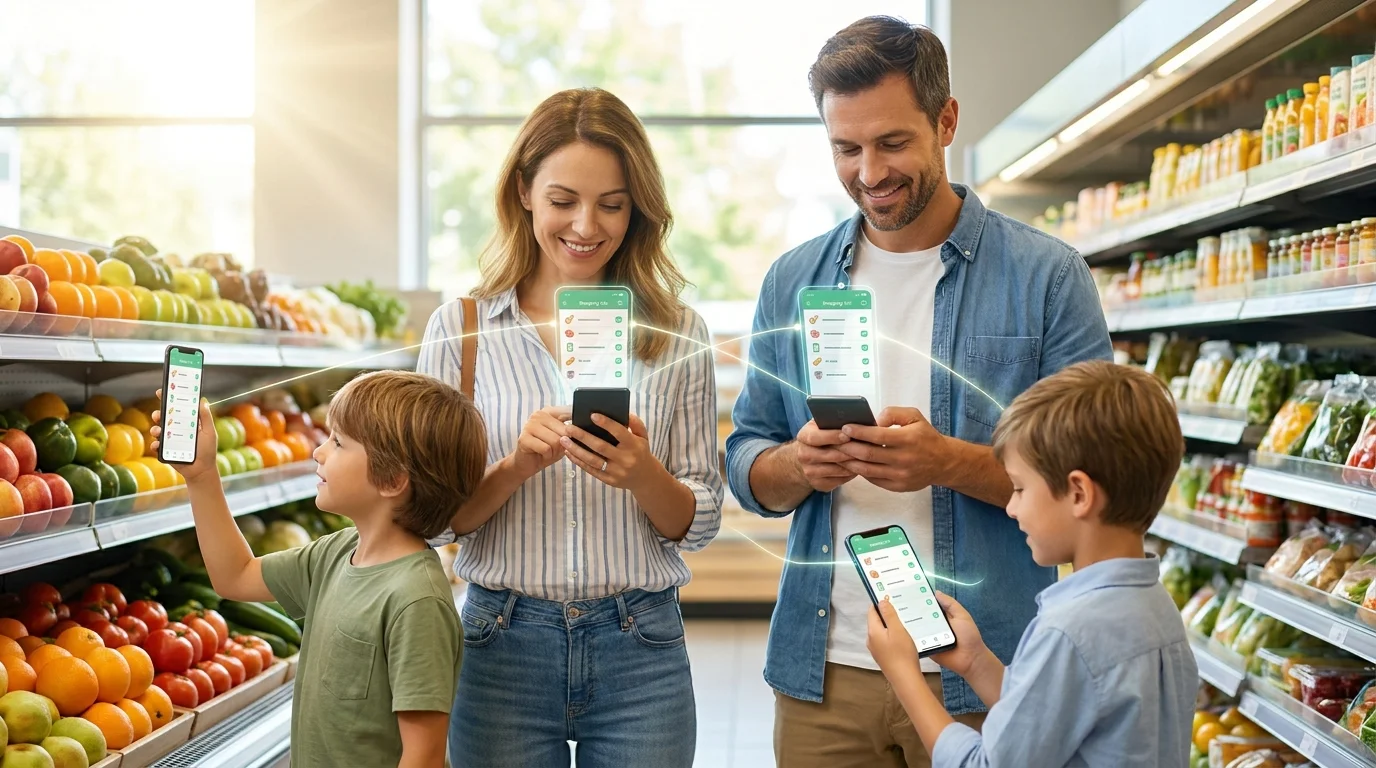
If you're shopping for a family, the list should be shared. Otherwise, savings are "eaten up" by uncoordinated purchases. It's convenient to keep a shared list in Telegram so it updates for everyone in real time.
Shared Shopping Without Duplicates: How to Maintain Savings When Different People Shop
In families and couples, the main enemy of savings is not a lack of discounts, but a lack of synchronization. One person buys milk, the other doesn't know and buys more. Over the course of 2026, this turns into regular extra spending of 500–2,000 ₽ per month.
The solution is a shared list where you can see what has already been bought and what hasn't. For example, in Pickt, you can do this directly in Telegram: the mini-app synchronizes the list in real time between family members, a couple, or roommates. Just open t.me/PicktBot/app and mark items as you buy them.
A practice that saves money: agree on rules for marking. Whoever takes the last yogurt adds it to the list. Whoever buys something marks it immediately. It's a small thing, but it's what turns one-time savings into a stable 10–15% every month.
How to Measure Results in 30 Days: A Simple Method Without Complex Accounting
To understand if your shopping list is working, you need to track it. You don't have to keep detailed records of every item — just compare one month to the next using a clear method.
- Establish a baseline. Calculate your average grocery spending over the last 2–3 months. For example, 48,000 ₽/month.
- Shop with a list for 30 days. Don't radically change your diet, or the comparison won't be fair.
- Compare the result. If it drops to 41,500–43,000 ₽, your savings are 5,000–6,500 ₽, or roughly 10–13.5%.
- Check the quality. If the savings came from "not buying what you needed" and then making urgent orders, the result needs adjustment.
A good benchmark for 2026: if after implementing a list you consistently save at least 3,500 ₽ on a budget of 35,000 ₽ (i.e., 10%), that's already a strong financial effect, comparable to a small income increase.
Conclusion. A shopping list is one of the simplest ways to reduce grocery spending without feeling like you've "tightened your belt too much." In 2026, realistic savings are 10–20%: for most people, this means 3,500–12,000 ₽ per month, depending on their budget and family size. The key is a specific list, a short meal plan, and shared access if multiple people are shopping.
Frequently Asked Questions
Is it true that a list saves everyone the same amount?
No. The maximum effect is for those who often bought spontaneously and shopped without a plan. If you are already disciplined, savings may be closer to 5–10%, but they are still noticeable over the course of a year.
How many times a week is it better to go to the store to save money?
It's usually more profitable to do 1–2 large shops per week, plus 1 short "top-up" for fresh items (bread, fruit, dairy). Frequent daily trips increase the likelihood of impulse purchases and add 5–15% to your spending.
How can I avoid slipping up and buying extra, even with a list?
Set a "treat limit" in advance — 250–300 ₽ per trip or 1 item. Psychologically, this is easier than a complete ban, and it protects your bill from ballooning by 600–1,500 ₽.
What's better: a paper list or an app?
For a single person, paper works fine. For a couple, family, or roommates, a shared list with synchronization is more convenient to avoid duplicates. In Telegram, this can be organized through the Pickt mini-app, where changes are visible to everyone instantly.