It seems like we spend "about this much" on groceries, but the figure on the bank statement at the end of the month is often surprising. The problem isn't that you're bad at math, but that purchases happen regularly: on the way home, "to grab some milk," for a snack, to buy something on sale.
To understand how much we spend on food, you don't need to become an accountant. It's enough to choose a clear method for tracking expenses, agree on rules (especially if you shop for a family), and keep records for at least 2–4 weeks. Then grocery expenses become transparent, and decisions become calm and precise.
Below are practical methods that will help you calculate grocery expenses, see where the money is going, and set up a system that won't fall apart after three days.
1) What Exactly to Count: "Groceries" Isn't Just the Supermarket
The first step is to define the boundaries. When someone says "grocery expenses," they often mean supermarket purchases. But in practice, this also includes snacks, coffee, deliveries, and even water from a vending machine—everything related to food.
If you want to honestly know how much we spend on food, decide in advance what goes into the calculation. Otherwise, some expenses will be missed, and the total will be underestimated.
A convenient option is to divide into 3–4 categories to avoid getting bogged down in details:
- Home groceries: supermarket, market, basic stock-ups.
- Snacks and coffee: pastries, drinks, snacks.
- Delivery and prepared food: apps, deli food, ready meals.
- Eating out: cafeteria, cafe, fast food.
You can start with two baskets: "supermarket" and "everything else." This alone is enough to see the real picture and understand where it's easiest to cut costs without pain.
2) A Quick Way to Calculate Monthly Grocery Expenses
If you need to understand the ballpark figure right now, use the "bank statement method." It's not perfect, but it gives a result in 20–30 minutes.
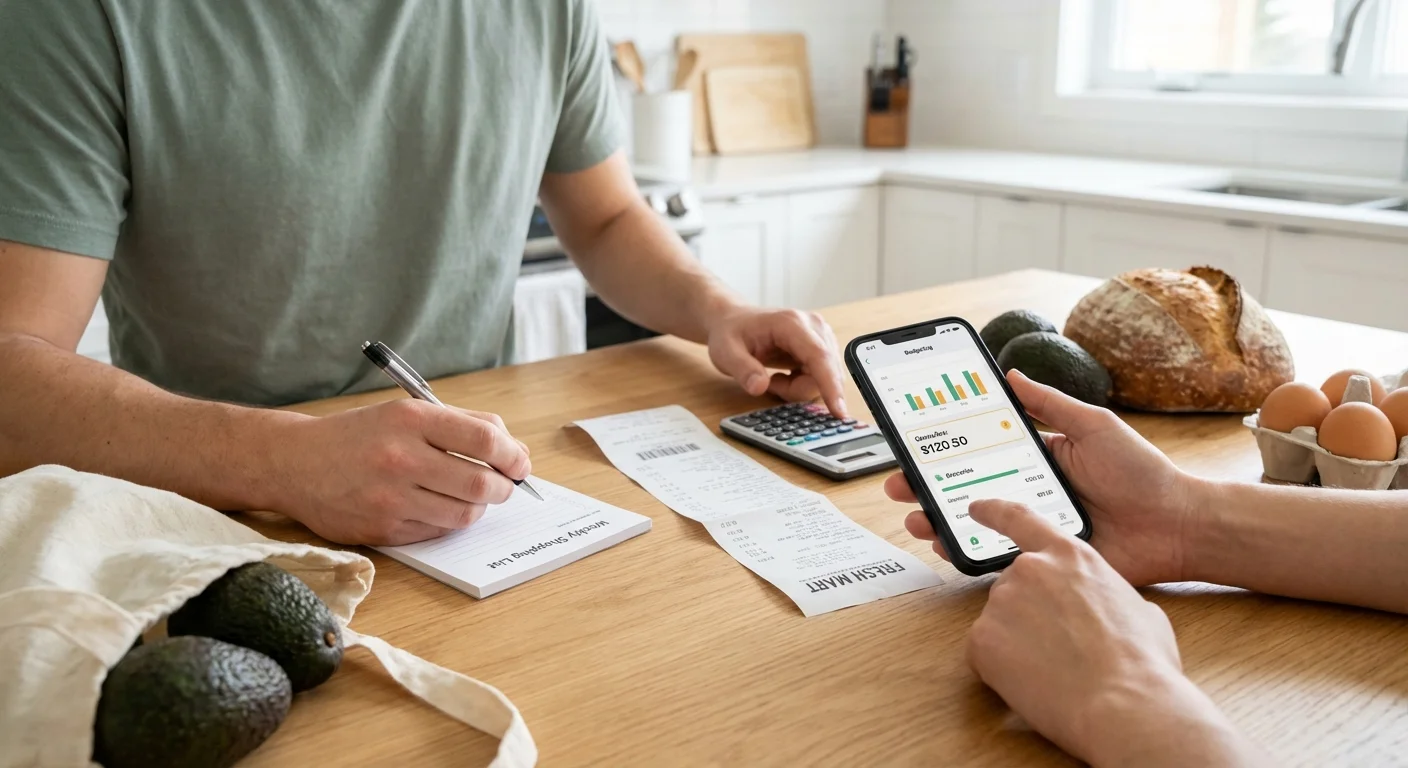
Open your banking app and export last month's spending. Then filter or manually mark transactions related to food. Yes, some purchases will be mixed (e.g., "groceries + household items"), but for the first pass, you can leave them as is or estimate the share roughly.
Next—a simple formula:
Monthly grocery expenses = sum of all food-related spending for the month
To understand the daily level, divide by 30. To assess the burden on your budget—divide by your income or total family income.
A mini-checklist for a quick calculation:
- Choose a period: 30 days or a calendar month.
- Gather expenses from all cards/wallets (don't forget cash, if used).
- Mark categories: supermarket, delivery, cafe, snacks.
- Add up the amounts and write down the total.
- Compare with the previous month if you have data.
This method answers the question "how much do we spend on food" overall. But it won't show why it turns out that way. For that, you need regular expense tracking, at least for a short period.
3) Regular Expense Tracking: 3 Systems That Actually Work
Regular expense tracking relies on simplicity. If a system requires 10 minutes per receipt, you'll quit within a week. Below are three options—choose based on your personality and habits.
Option A: Write down the amount immediately after purchase
The fastest way: after paying, record the amount and category (e.g., "supermarket 1450," "coffee 220"). You can keep track in notes, a budgeting app, or a spreadsheet.
Plus—minimal effort. Minus—you need to remember and not put it off "for later."
Option B: Enter all purchases once a day/every two days
If you find it annoying to write things down on the go, set aside 5 minutes in the evening. Open your bank notifications or receipts and enter everything at once.
Plus—fewer interruptions during the day. Minus—sometimes it's hard to remember what was paid for in cash.
Option C: "Envelope" (limit-based) tracking
Suitable if the goal is not perfect accuracy, but control. You set a weekly limit for home groceries and a separate one for cafes/deliveries. Once the limit is exhausted, you either stop or consciously transfer money from another category.
Plus—quickly builds discipline. Minus—requires honesty and periodic review of limits.
4) How to Calculate If You Shop for a Family or as a Couple
In a couple or family, grocery expenses often get "blurred": someone buys on the way, someone orders delivery, someone pays with their card. As a result, expense tracking becomes a guessing game, and budget conversations turn into arguments about who "spends more."
To calculate correctly, agree on rules for one month. Not forever—just for a trial period. The goal is to collect data, not achieve perfect fairness.
Practical rules that reduce tension:
- Unified categories: supermarket / delivery / cafe / snacks.
- One recording point: where you write down the amounts (spreadsheet, app, note).
- Mixed receipts: either split them roughly, or assign them entirely to "home groceries" and mark as "mixed."
- Weekly reconciliation: 10 minutes once a week, no accusations—just numbers.
If shopping is done jointly, the habit of planning purchases in advance is especially helpful: a list reduces impulse spending and minimizes duplicates (when two people buy the same thing).
5) How to Understand Where You're Losing Money and What to Do About It
When you have data for at least 2–4 weeks, it becomes clear what exactly is inflating your grocery expenses. Usually, it's not "expensive buckwheat," but recurring small items.
Here are the most common "leaks" and simple actions:
1) Frequent small purchases
Coffee, snacks, "something for tea"—individually unnoticeable, together significant. Solution: allocate a separate limit for snacks and see how much goes per week.
2) Delivery as a habit
One delivery can cost as much as 2–3 home-cooked dinners. Solution: plan 2–3 simple meals for the week and keep "standby" products (pasta, eggs, frozen food).
3) Spoilage and thrown-away food
You buy in bulk, some goes bad. Solution: once a week, do a "fridge inventory" and plan meals based on what you already have.
4) Shopping without a list
Without a list, the brain buys "from the display," not based on need. Solution: list + rule "list first, wants later."
A useful mini-checklist to reduce grocery expenses without feeling like you're economizing:
- Make a list for 3–4 days ahead (not necessarily a whole week).
- Separate purchases: "essential" and "if budget remains."
- Limit delivery to a specific number of times per week.
- Compare prices for 5–7 regular items—that's enough.
- Once a week, review totals by category, not every receipt.
Conclusion
To understand how much we spend on food, what matters are not complex formulas, but clear rules: what we count, how we record it, and how often we summarize. Start with a quick calculation using your bank statement, then add simple regular expense tracking for 2–4 weeks—and you'll see the real structure of your grocery expenses.
After that, everything becomes simpler: you're not "cutting back on life," but managing specific categories—delivery, snacks, unplanned purchases. If shopping is done jointly, a shared list that's always at hand helps. For example, in the free mini-app Pickt on Telegram, you can maintain shared shopping lists with real-time synchronization—convenient when different people go to the store: t.me/PicktBot/app.