
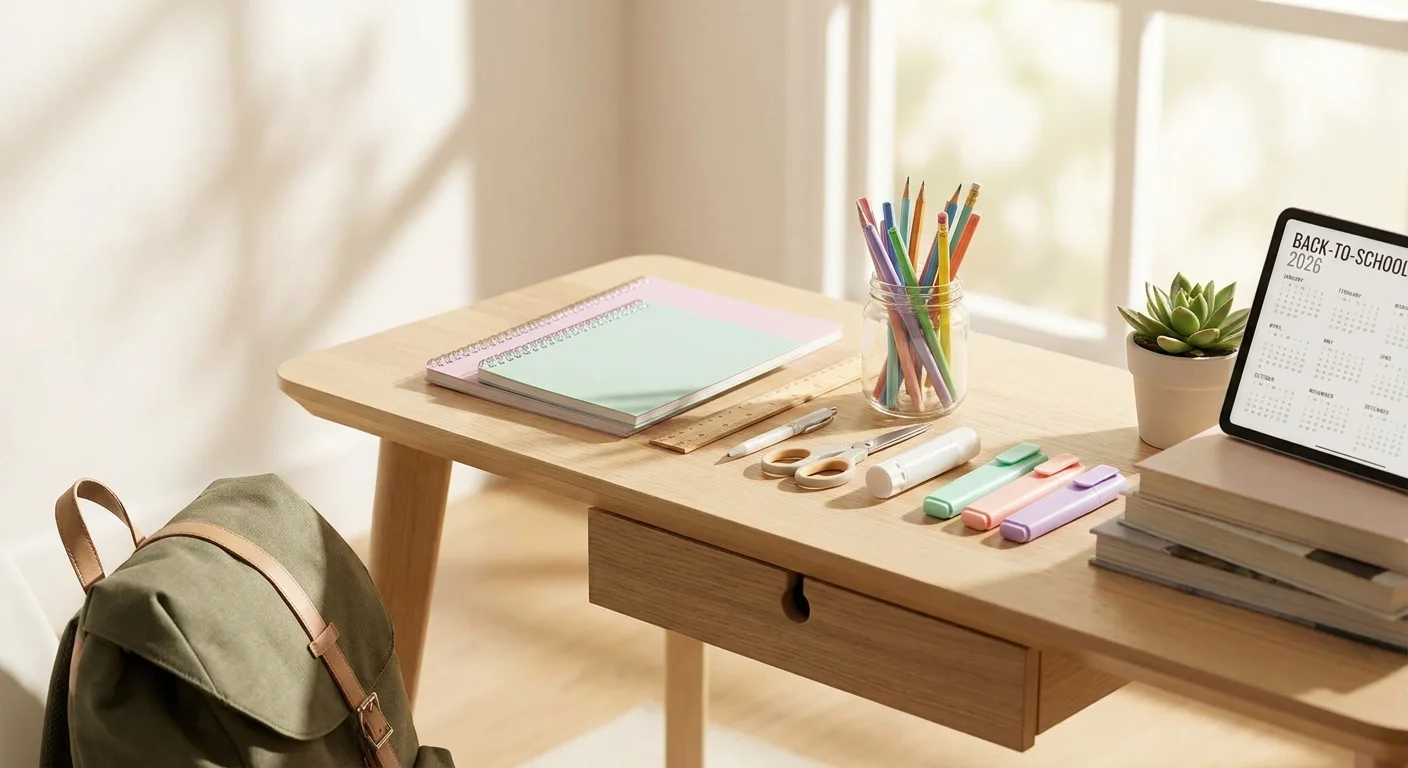
School supplies list by grade (1–11) for 2026: below is a basic set for any school and separate items by level (elementary, middle, high school). It is suitable for parents, students, and those buying for the whole family. Only mark what you need—requirements may vary by teacher and subject.
The end of summer and beginning of fall is the peak of back-to-school shopping, and it's during this season that it's easiest to overspend on unnecessary items. Use the checklist: start with the basics, then add subject-specific items based on your grade and schedule.
Basics for All Grades (1–11): Universal School Supplies Set
This section is the 'backbone' of the list. It suits almost everyone and covers daily tasks: writing, drawing, storing, and organizing.
- Notebooks: grid and ruled (usually 12–24 sheets), 2–3 general notebooks of 48–96 sheets for core subjects.
- Covers: for notebooks and textbooks (it's best to check sizes based on actual books).
- Writing: 2–4 blue pens, black pen (if needed), 2–3 pencils, eraser, sharpener with container.
- Highlighting and Marking: 1–2 highlighters, set of colored pens or pencils (based on the child's preference).
- Drawing Tools: ruler 20–30 cm, set square, protractor (usually needed from grades 5–6, but sometimes earlier).
- Glue and Scissors: 1–2 glue sticks, scissors with rounded tips (mandatory for younger students).
- Paper and Organization: diary/planner (if the school doesn't use only an electronic one), sticky notes, bookmarks, folder or button-fastening folder for A4 sheets.
- Storage: pencil case, 1–2 folders/binders, plastic sleeves (10–30 pcs.).
Tip: if you're buying for future use, don't buy everything in large sets at once. It's better to buy as needed—especially markers, paints, and specific notebooks.
Grades 1–4 (Elementary School): What to Add to the Basic List
In elementary school, safety, simplicity, and art supplies are important. Separate folders for 'crafts' and 'art' are often requested here.
- For Writing: pens with comfortable grips, HB pencils (triangular ones are fine), grip aids (if the child has difficulty holding a pen).
- Notebooks and Copybooks: notebooks with slanted lines (if the teacher requires), covers for specific formats.
- Art: sketchbook, watercolors (12–24 colors), gouache (if required), 2–4 brushes (thin/medium/wide), non-spill cup, palette, desk cover.
- Paper and Cardboard: colored paper, colored cardboard, white cardboard, craft set (optional).
- Crafts: plasticine, modeling board, modeling tools, PVA glue (if allowed), safety scissors, set of colored felt/pom-poms (as per teacher's list).
- Organization: folder for art and folder for crafts (A4 format), labels for notebooks and supplies.
If you need a 'school supplies list for grade 1', follow the teacher's requirements: even notebook formats and types of paints can differ between schools.
Grades 5–7 (Middle School): Supplies for Workload and Subjects
In grades 5–7, there are more subjects and homework. The main goal is for the child to quickly find what they need and not carry unnecessary items every day.
- Subject Notebooks: it's more convenient to get several general notebooks of 48–96 sheets (math, Russian, literature, history/social studies, biology, etc.).
- Drawing Set: ruler 30 cm, set square, protractor, compass (often needed from grade 5), spare leads/pencil for compass.
- Folders and Sleeves: ring binder or binder for printouts, 20–40 plastic sleeves.
- Writing and Notes: 2–3 blue pens, correction tape (if allowed), set of sticky notes/bookmarks for textbooks.
- Technology/Crafts: depends on the school (sewing, cooking, wood/metal). Check in advance to avoid buying unnecessary items.
Practice: divide purchases into 'always in the backpack' and 'stays at home/in the classroom'. This reduces weight and loss of small items.
Grades 8–9: Preparation for the OGE and More 'Adult' Organization
In grades 8–9, the volume of notes increases, and systematic preparation for the OGE begins. Structuring and ease of review are important here.
- Notebooks/Notepads for Preparation: 1–2 separate notebooks of 96 sheets or notepads for the OGE in key subjects.
- Folder for Printouts: ring binder + dividers (by topic), 40–60 sleeves.
- Writing and Highlighting: several pens, 2–3 highlighters (no more—otherwise everything gets highlighted).
- Math/Geometry: compass, protractor, ruler 30 cm—preferably high-quality to avoid a 'wobbly' scale.
- Time Management: planner or planning sheets (weekly/monthly), sticky notes for deadlines.
If you're putting together a 'school supplies list for grade 9', add consumables for practice tests: spare pens and a separate folder for test versions and graded work.
Grades 10–11: Supplies for the Unified State Exam, Notes, and Specialized Subjects
In high school, supplies should help you study faster: take notes, review, and store materials by topic. Buy functionally, not as a 'set of everything'.
- Storage System: 1–2 ring binders (by profile) + dividers, 60–100 sleeves for printouts and notes.
- Notebooks: one general notebook of 96–120 sheets per specialized subject (math/physics/chemistry or humanities block).
- Writing: 3–5 identical comfortable pens (to avoid getting used to different ones), spare refills.
- Marking: 2–3 highlighters, index stickers for topics, bookmarks for collections.
- Drawing Tools: relevant for the profile (physics/math, drafting/geometry): compass, ruler 30 cm, protractor.
For the query 'school supplies list for grade 11', the main thing is not quantity, but a convenient system: a folder with dividers + regular updating of notes and printouts.
How to Avoid Buying Unnecessary Items in 2026: Checking Requirements and a Shared List
No two schools are the same: some require gouache, others only watercolors; some need notebooks of a specific format. Before buying, do a quick check to make the school supplies list by grade accurate for you.
- Check the teacher's list/class chat and mark the mandatory items.
- Check what's left at home: notebooks, covers, sleeves, glue often remain from last year.
- Divide into 'now' and 'later': specific items (e.g., for technology) can be bought after the first lessons.
- Create a shared checklist: it's convenient to keep one list for the family and mark purchases as they are made.
To avoid duplicate purchases and see what has already been bought, you can keep a shared list in the Pickt mini-app in Telegram: open t.me/PicktBot/app and add items to the list for each child. Real-time synchronization helps when different family members are buying.
Frequently Asked Questions
How many notebooks should I buy per subject for the year?
Usually, 1–2 general notebooks of 48–96 sheets per subject in grades 5–11 are enough, while in elementary school, thin notebooks are often taken as per the teacher's requirement. It's better to start with a minimum and buy more after 1–2 months when the actual workload becomes clear.
Are expensive sets (pens, markers, ready-made 'school boxes') necessary?
Often not: sets contain a lot of unnecessary and uncomfortable items. It's more practical to choose 2–3 truly comfortable pens, one good eraser and sharpener, and buy the rest as needed.
What must be labeled?
In grades 1–7, it's better to label the pencil case, ruler, scissors, art/craft folders, and even the sharpener—small items are lost most often. In high school, labeling folders and notebooks is usually enough.
How to quickly put together a school supplies list if several people are buying?
Make one shared checklist and divide categories: 'notebooks', 'writing', 'art', 'folders'. In Pickt, this is convenient: there is one list, and all participants can mark purchases, so you immediately see what has already been bought.
Summary: use the basic set, then add items for your level (1–4, 5–7, 8–9, 10–11) and be sure to check the school's requirements. This approach saves money and time during the back-to-school season in 2026—and helps you buy exactly what you really need.