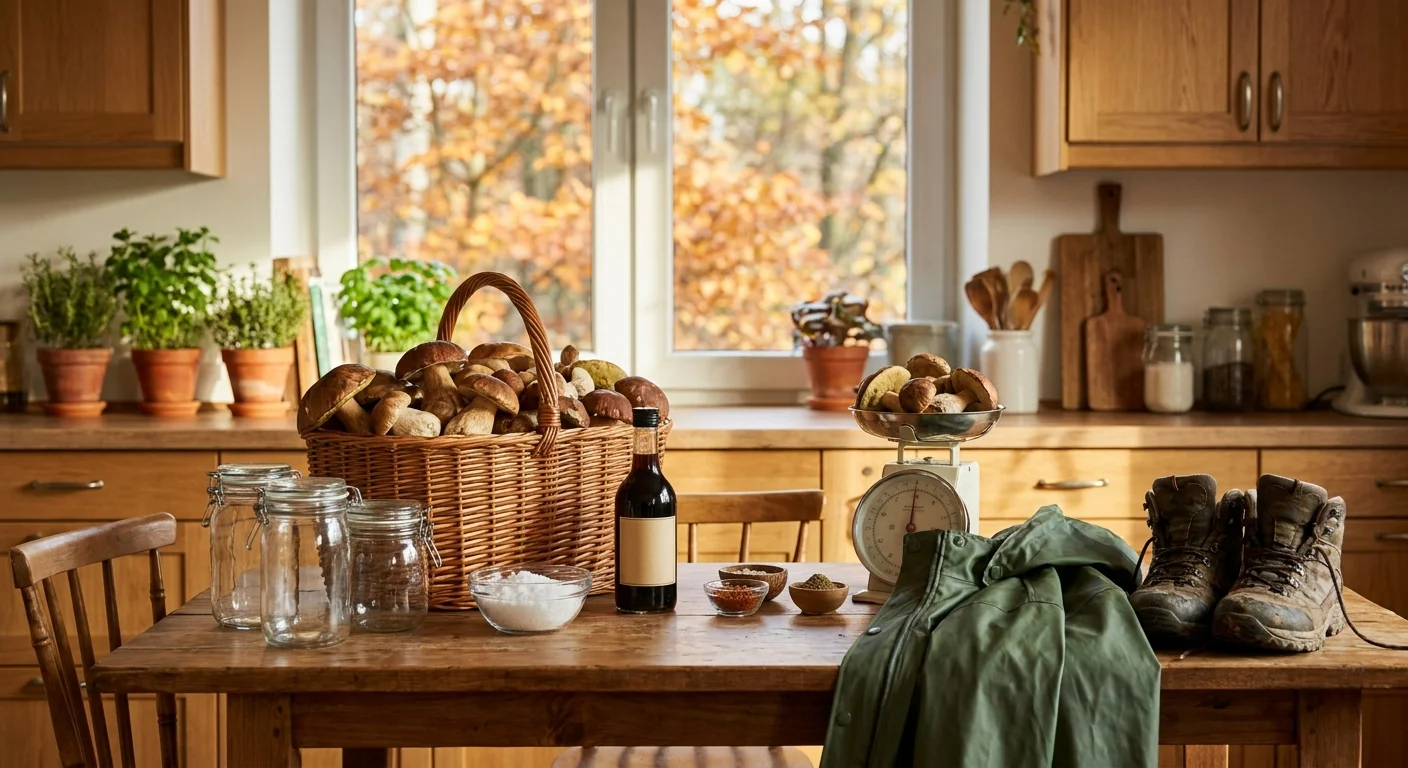
October is the final chord of the 2026 mushroom season. You can still find sturdy late-season mushrooms in the forest, and markets are especially full of fresh harvests. But a successful trip starts not with the first porcini you find, but with preparation: you need to pack your forest gear, clear space in the kitchen, buy jars, salt, vinegar, and freezer bags.
It's convenient for a family to split the task into two directions: one list is 'for the forest,' the other is 'for preserving.' In Pickt, a service for shared shopping lists in Telegram, you can keep both lists separately: while someone checks boots and the first aid kit, another family member buys jars, lids, and spices on the way. This way, you won't come home to find you have plenty of mushrooms but no suitable containers.
October Plan: What to Prepare Before the Trip
Before heading out, assess not only the weather forecast but also your home resources. Fresh mushrooms can't be left unprocessed for long: it's best to sort them on the day you pick or buy them. So, clear the table in advance, make room in the fridge, and decide which part of the harvest will go to drying, freezing, pickling, or brining.
- Check if you have 0.5- and 0.7-liter jars, new lids, and labels for dates at home.
- Buy coarse non-iodized salt, 9% table vinegar, sugar, bay leaves, peppercorns, garlic, and dill umbels if you plan to brine.
- Prepare zip-lock bags or containers for freezing.
- Check your vegetable dehydrator or baking sheets and the oven setting.
- Free up at least one drawer in the freezer: frozen mushrooms are best stored in small portions.
If you buy mushrooms at the market, take as many as you can process in one evening. For the first batch, a family usually finds it convenient to start with 2–3 kilograms: that's enough to make a few jars and figure out which preservation method you like best.
What to Bring to the Forest Besides a Basket?
The main answer to the question of what to bring for mushroom picking is not just a basket. A woven basket remains the best container: mushrooms don't get crushed and stay ventilated. Plastic bags are not suitable for collecting: the harvest quickly heats up, breaks, and spoils in them.
- A knife with a short blade. It's handy for carefully cutting the mushroom and immediately removing any clinging dirt.
- A basket or rigid container. For a family, it's better to take two small baskets than one heavy one.
- Weather-appropriate clothing. A waterproof jacket, comfortable pants, closed-toe shoes with non-slip soles, and a hat.
- Water and a snack. Plan for at least 0.5–1 liter of water per person, especially if you're going for several hours.
- A charged phone. Download an offline map of the area in advance, bring a power bank, and let loved ones know your route.
- A first aid kit. Band-aids, antiseptic, insect repellent, and personal medications.
- Wet and dry wipes. They'll come in handy for your hands, knife, and quick basket cleaning.
- Repellent and tick repellent. Use them as directed and check your clothes after the walk.
A useful habit is to sort your finds into categories right away: firm mushrooms for pickling separately, large and brittle ones for drying, and young clean specimens for freezing. This will noticeably speed up work at home.
How to Prepare the Kitchen for Mushroom Processing?
Mushrooms require space and a systematic approach. First, you sort them, then clean, sort again, wash if necessary, and only then proceed with the chosen preservation method. Don't plan a big family dinner at the same time: it's better to dedicate the kitchen to mushrooms for a few hours.
Basic Cleaning Kit
- 2–3 large basins or deep bowls: for initial sorting, washing, and boiling.
- Soft brushes, sponges, and a small knife for cleaning caps and stems.
- A large sieve or colander for rinsing and draining water.
- Paper towels or clean kitchen towels: especially important before freezing.
- Cutting boards and a wide stainless steel or enamel pot without chips.
- Kitchen scales: salt and spices are better measured in grams rather than 'by eye.'
- A slotted spoon, ladle, tongs for hot jars, and a wide-mouth funnel.
First, discard wormy, overgrown, soft, or damaged mushrooms. Remove leaves, pine needles, and dirt with a brush. Don't soak all mushrooms unnecessarily: many types absorb excess water and lose firmness. It's convenient to rinse quickly in small batches, and then be sure to dry them thoroughly.
Preserving Mushrooms for Winter: What You Need for Each Method
It's best to distribute the harvest among several methods. This way, in winter you'll have aromatic dried mushrooms for soup, a ready base for frying, and festive pickled jars.
Drying
For drying, you need clean, firm mushrooms, a knife, a dehydrator or oven, racks or baking sheets, and airtight glass jars for storage. Mushrooms are not soaked in water for long: they are cleaned with a brush, sliced into pieces about 5–7 mm thick, and dried until brittle. Store the finished product in a dry, dark cupboard.
Freezing
You'll need zip-lock bags or containers, paper towels, a marker, and free space in the freezer. Clean mushrooms can be frozen raw if the chosen type and a proven processing method allow it, or you can pre-boil them and cool completely. Divide into portions of 250–500 g: this way, you won't have to thaw more than you need.
Pickling
For those wondering what's needed for pickling mushrooms, you'll need jars, new lids, a large pot, salt, sugar, 9% vinegar, bay leaves, peppercorns, cloves to taste, and precise scales. Boil the mushrooms and pickle them strictly according to a proven recipe for the specific type. Don't arbitrarily reduce the amount of acid and salt: this affects not only the taste but also the safety of storage.
Brining
For brining, you'll need coarse non-iodized salt, an enamel pot, glass jars or a suitable food-grade container, garlic, dill, and optionally horseradish or currant leaves. Different types of mushrooms require different techniques—cold or hot. Follow a proven recipe, maintain cleanliness, and adhere to storage conditions.
How Many Jars and How Much Salt Do You Need for a Bucket of Mushrooms?
A ten-liter bucket of fresh mushrooms usually holds about 3–5 kg, but the weight varies greatly depending on size, moisture, and packing density. So, it's more reliable to plan your preserves by kilograms after sorting. The table below provides guidelines for pickling and brining; always check the exact proportions with a recipe for your specific mushrooms.
| Fresh Mushrooms | 0.5 L Jars | Salt for Marinade | Salt for Brining | 9% Vinegar for Marinade | Spices |
|---|---|---|---|---|---|
| 1 kg | 2 jars | 20 g | 50–60 g | 40–60 ml | 2 bay leaves, 8–10 peppercorns |
| 3 kg | 5 jars | 60 g | 150–180 g | 120–180 ml | 5–6 bay leaves, 25–30 peppercorns |
| 5 kg | 8–10 jars | 100 g | 250–300 g | 200–300 ml | 8–10 bay leaves, 40–50 peppercorns |
It's better to buy jars with a 15–20% surplus. Some mushrooms may go for testing, some will shrink in volume after cooking, and a few small jars are always more convenient than one large one. Label each preserve with the date, preparation method, and contents.
A Note on Safety
Only collect mushrooms you can identify with absolute certainty. Don't take questionable, old, damaged, or specimens growing near roads and industrial areas. Don't taste raw mushrooms and don't rely on folk 'tests' with onions, silver, or the color of the broth—they don't determine edibility.
When buying mushrooms at the market, choose trusted sellers and fresh, whole produce without an unpleasant odor. This article is a preparation checklist, not a species identifier: if in doubt, it's better to leave the mushroom in the forest or skip the purchase. For joint family preparation, you can mark in Pickt in advance who is responsible for baskets, who for the first aid kit, and who for jars and lids—then the October trip will go smoothly, and your home supplies will delight you all winter.