Minimalism in Shopping: How to Buy Only What You Need
Shopping minimalism isn't about 'denying yourself everything.' It's about clarity: what you truly need, what brings value, and what simply takes up space in your home and mind.
When shopping becomes mindful, impulsive spending decreases, budgeting becomes easier, and maintaining order is simpler. There's also a sense of control: you choose things, not the other way around.
Below are practical steps that help you buy less while living comfortably. No extremes, no moralizing.
Why We Buy Unnecessary Things (and How to Notice It)
Unnecessary purchases rarely happen 'just because.' More often, they're a reaction to fatigue, stress, boredom, or a feeling of 'urgent need.' Marketing amplifies this effect with discounts, limited offers, and endless 'must-have' lists.
The first step toward mindful consumption is noticing your triggers. Don't forbid purchases, but catch the moment your hand reaches for the cart.
Try a simple question before checkout: 'Am I buying this out of need or emotion?' If it's emotion—pause. Often, the desire weakens after 10–15 minutes.
The 'Pause' Rule: How to Reduce Impulse Buys
Minimalism is well-supported by the habit of pausing between desire and purchase. This doesn't complicate life; it gives you back your right to choose.
Choose a suitable pause format:
- 24 hours — for small purchases (cosmetics, accessories, household items).
- 7 days — for more expensive items (clothing, electronics).
- 30 days — for major decisions (furniture, 'convenience' gadgets).
If after the chosen time you still need the item, you'll buy it more calmly—without feeling 'pushed.' And often, you'll find the need was met differently: you found a substitute at home, rented it, or realized it was a fleeting desire.
The List: The Main Tool to Buy Less
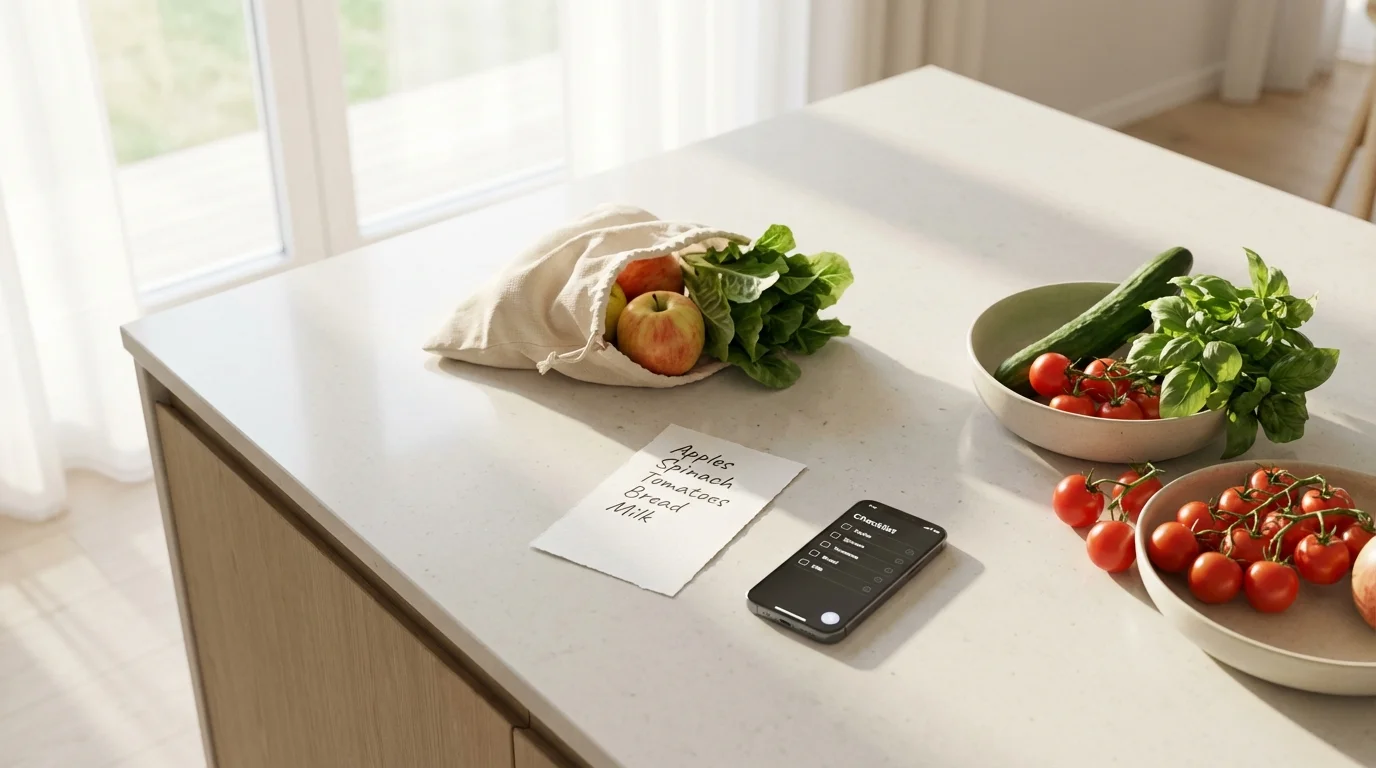
A shopping list is simple protection against impulses. It shifts shopping from 'browsing for what I like' to 'completing specific tasks.'
For the list to work, it's important to make it beforehand, not in the store aisle. Then you rely on real need, not bright packaging and promotions.
Here's a short 'smart list' checklist that helps you buy less:
- Check your stock: what you already have at home (grains, household chemicals, frozen goods).
- Plan for 3–5 days: write down meals or staple foods you'll definitely use.
- Divide the list into categories: vegetables, dairy, groceries, household—less chaos, less excess.
- Leave 1–2 'flexible items': e.g., seasonal fruit or a snack—to avoid spontaneous splurges.
- Don't shop hungry: it's cliché, but works better than any life hack.
If you shop for a family or with a partner, the list is especially important: it prevents duplicates ('I bought milk too') and reduces the 'let's grab everything, just in case' mentality.
How to Distinguish 'Need' from 'Want': Practical Questions
Mindful consumption starts with honest criteria. Not 'can I buy this,' but 'why am I buying this and what will change afterward.'
Before buying, ask yourself 5 questions. It takes less than a minute but is very sobering:
- What problem does this item solve? Phrase it in one sentence.
- Do I have an alternative? If yes—how is the new option genuinely better.
- How often will I use this? If less than once a month—consider an alternative.
- Am I ready to maintain/store it? Things require space, time, and attention.
- If there were no discount, would I still buy it? A discount is not a reason, only a bonus.
Minimalism doesn't forbid 'wants.' It suggests making 'wants' mindful: choosing one quality item instead of three random ones and understanding why exactly that one.
Minimalism in the Grocery Cart: Less Waste, More Value
Excess most often appears with groceries: bought 'just in case,' forgotten, thrown away. It's money wasted, guilt, and extra clutter.
To buy less and waste less, stick to simple principles:
1) Rely on a base. Make a short list of 'staple foods' you definitely eat: grains, eggs, vegetables, cottage cheese, chicken/fish, bread, oil. The base provides stability and reduces the temptation to grab exotic items without a plan.
2) One new product at a time. Want to try a new sauce or grain—take one item and immediately plan how to use it. This way experiments don't turn into a stockpile.
3) The 'open first' rule. Before buying a new yogurt/sauce/grain, check what's already open. Use what's started first—then replenish.
4) Realistic quantities. A large package is only cheaper if you'll definitely finish it. Otherwise, the 'savings' become overpayment.
How to Cement the Habit: Small Steps That Work
Trying to become a perfect minimalist in a week is a sure path to relapse. It's better to adopt one habit at a time and cement it to automaticity.
Here's a small 7-day plan to gently transition to more mindful consumption:
- Day 1: remove 1 impulse buy from your cart and note what it was.
- Day 2: make a list before the store and stick to it.
- Day 3: check your home stock and note what you most often buy 'out of habit.'
- Day 4: introduce a 24-hour pause for any non-urgent purchases.
- Day 5: plan 3–4 meals and shop exactly for them.
- Day 6: sort through one 'junk drawer' and note what you bought needlessly.
- Day 7: summarize: what helped you buy less and what's worth keeping.
Minimalism isn't a goal, but a process. The simpler the system, the longer it lasts.
Conclusion. Buying only what you need is helped by combining three things: a pause before buying, clear 'need/want' criteria, and a list made in advance. This is practical mindful consumption: buying less without feeling restricted, and spending on what truly improves life.
If you don't shop alone, it's convenient to keep a shared list that updates for everyone instantly. For this, you can use Pickt—a free mini-app in Telegram for shared shopping lists with real-time sync: t.me/PicktBot/app.