
How to Make a Grocery List Together Without Arguing Over Little Things
To understand how to make a grocery list together without arguing over little things, just 6 steps and 10–15 minutes are enough. First, agree on the rules (who decides what), then gather needs, organize purchases by category, specify brands and quantities, set a budget, and assign responsibility. Finish with a quick check of the list before the checkout to avoid 'I thought you were buying that.'
Below is a step-by-step guide that works for couples, roommates, and families. Each step can be done in one shared list so both have the same version and no disputes arise from different notes.
Step 1. Agree on the List Rules: What Counts as 'Need' and What as 'Want'
This step eliminates half the conflicts before you even get to the store. It's important to divide purchases into mandatory and optional in advance so that negotiations don't start in the cart.
- Define the purpose of the trip: 'weekly stock-up,' 'getting dinner,' 'restocking basics.'
- Introduce two labels: 'Need' (non-negotiable) and 'Want' (discuss based on budget).
- Agree on a change rule: for example, anything over N rubles is added only after confirmation from the other person.
If you often argue about 'extras,' use a simple principle: first cover the basics (breakfasts, dinners, snacks), then treats and experiments.
Step 2. Gather Needs: Menu, Stock, Restrictions
For a calm shared grocery list, it should be based on facts: what you'll actually eat and what you already have at home. This saves money and eliminates mutual complaints like 'why did you buy this?'
- Check your stock: go through the fridge and cabinets for 2–3 minutes and note what's running low.
- Create a mini-menu for 3–5 days: 2–3 dinners, 1–2 quick breakfasts, snacks.
- Consider restrictions: allergies, fasting, sports nutrition, 'no spicy food,' 'lactose-free.'
A related query that helps avoid arguments: how to save on groceries without stress. The answer is almost always to buy according to a plan and based on leftovers.
Step 3. Write Specifically: Quantity, Format, Acceptable Substitutions
Most arguments arise from vague wording. 'Milk' – what kind: 1 L or 2 L, 2.5% or 3.2%, regular or lactose-free? The more specific the entry, the less chance of offense.
- Write units: 'yogurt 4 pcs,' 'chicken 1.2–1.5 kg,' 'tomatoes 600 g.'
- Specify the format: 'toast bread,' 'ground coffee,' 'sliced cheese.'
- Add substitutions in parentheses: 'milk 2 L (can be 1.5% or 2.5%).'
If one of you does most of the shopping and the other tends to 'nitpick,' do the opposite: the shopper suggests 1–2 substitutions, and the other agrees in advance. This sharply reduces conflict.
Step 4. Organize the List by Category and Store Route
Categories aren't about 'aesthetics' but about speed and peace of mind. When you go through the aisles, there's less fatigue, fewer impulse purchases, and fewer reasons to argue.
- Divide into blocks: vegetables/fruits, dairy, meat/fish, dry goods, frozen foods, beverages, household items.
- Set priorities: first perishables, then the rest – this makes it easier to control the budget and volume.
- Agree on 'danger zones': for example, sweets and snacks. Decide on a limit or a rule like 'we take 1 item for both' in advance.
A related query: how to maintain a shared grocery list. The best option is one list that both update, not two different ones in notes.
Step 5. Set a Budget and a 'Buffer' for Spontaneous Purchases
Money is a common source of tension, especially when one thinks 'we can afford it' and the other thinks 'it's unnecessary.' The budget shouldn't be a strict cage, but it should set boundaries.
- Determine the amount: for the week/for a specific trip.
- Create a buffer: for example, +10% for unforeseen items (a discount on something needed, suddenly out of paper).
- Divide spending: 'basics' (essentials) and 'joy' (dessert, coffee, something new).
If you often argue about the price of a specific brand, agree on rules: 'we buy the mid-range,' 'premium only for 1–2 items,' 'if the difference is more than X, choose an alternative.'
Step 6. Assign Responsibility and Sync the List in Real Time
The phrase 'I thought you were buying that' appears when tasks have no owner. Divide responsibility and use a shared list that both can see simultaneously – then little things don't turn into conflict.
- Assign zones: one is responsible for 'vegetables/fruits and bread,' the other for 'dairy and household items' (or whatever works for you).
- Mark purchased items immediately, right in the store, so the other doesn't pick up a duplicate.
- Leave short comments: 'took an alternative because it wasn't available,' 'sale – took 2.'
For this mode, it's convenient to use the free mini-app in Telegram Pickt: the shared list syncs in real time between you, and you can immediately see what's been bought and what's left. You can open it via the bot @PicktBot or the link t.me/PicktBot/app.
Mini-Check Before Checkout: 60 Seconds That Save the Evening
This short ritual reduces the chance of 'forgetting the most important thing' and subsequent accusations. Do it always, even if you're in a hurry.
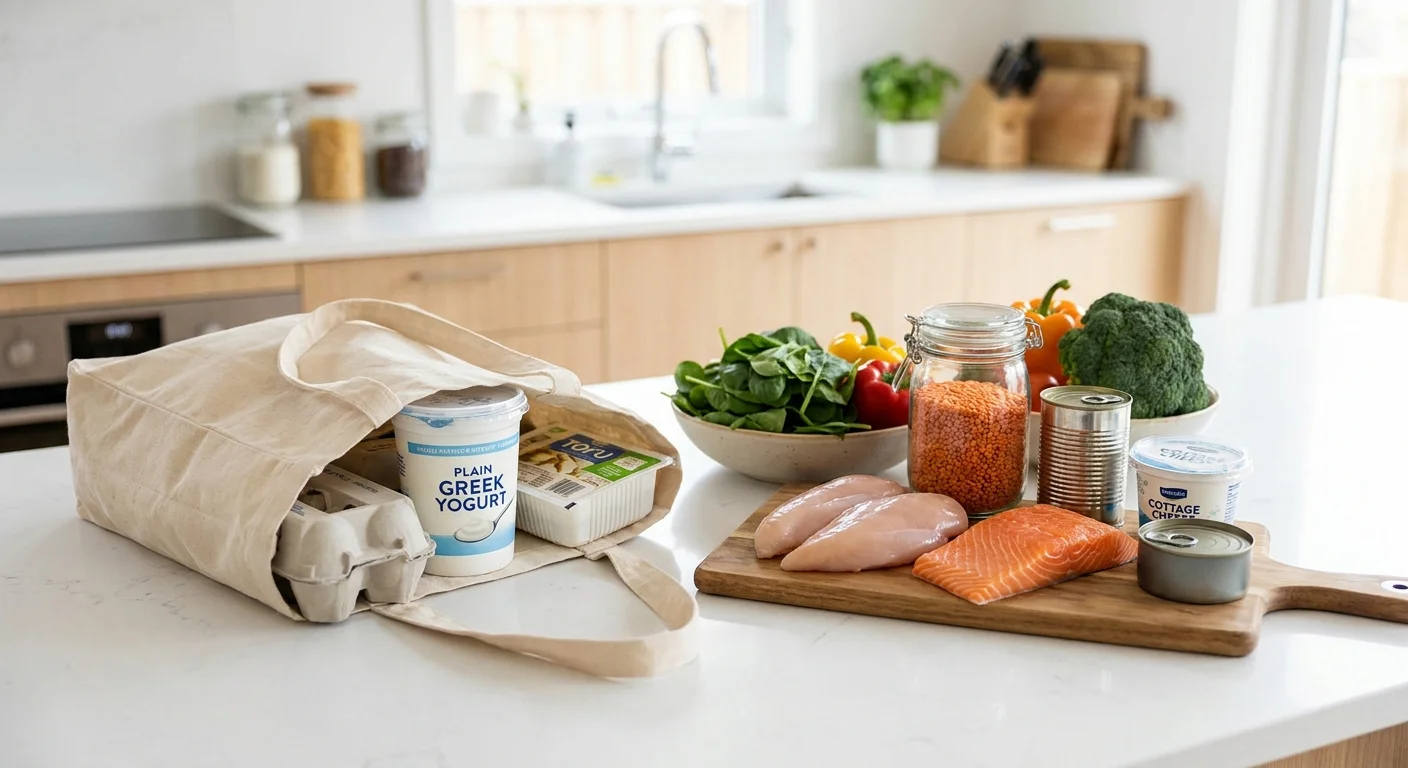
- Scan the essentials: protein (meat/fish/legumes), sides, vegetables, breakfast.
- Check household items: trash bags, paper, dish soap – these are most often forgotten.
- Verify substitutions: everything okay with brand/fat content/volume.
If you go to the store separately, this check is especially important: it covers the 'blind spots' that usually go unnoticed.
Conclusion
In short: to understand how to make a grocery list together without arguing over little things, you need to agree on rules, gather needs, write specifically, organize by category, set a budget, and assign responsibility. The most valuable thing is one shared list and transparent decisions about 'wants' and 'needs.'
Try implementing at least steps 1, 3, and 6 – usually that's enough to make grocery trips faster and calmer. Then you'll just refine the habit to fit your rhythm.
Frequently Asked Questions
How to make a weekly grocery list for two without forgetting anything?
Start with a mini-menu for 3–5 days and a stock check. Then write down products with quantities and organize them by category (vegetables, dairy, dry goods, household items). Finally, do a 60-second 'basics + household' check before checkout.
What to do if your partner constantly adds extras to the list?
Divide items into 'Need' and 'Want' and set a limit for 'Want' in advance (amount or 1–2 items). Another helpful rule: anything over a certain price is added only after confirmation from the other person.
How to maintain a shared grocery list if we take turns going to the store?
You need a single synced list where you can see what's already been bought. That way, you avoid duplicates and arguments over missed items. In Telegram, you can keep such a list in Pickt so changes are instantly visible to both.
How to agree on brands and quality without arguing?
Specify 'mandatory brand' in the list for only 3–5 truly important items, and for the rest, indicate acceptable substitutions. If the dispute is about price, agree on a segment (economy/mid-range) and on situations where premium is allowed.