Shopping is not just about "buying milk and bread"; it's also excellent training for independence. When a child in the store understands the task, keeps the goal in mind, and acts according to plan, they learn responsibility, attention, and basic financial literacy.
The main difficulty is that the store is overwhelming: bright packaging, promotions, sweets at the checkout, music, people. Therefore, teaching children is better built not on prohibitions, but on clear rules and a convenient shopping list for kids — short, visual, and achievable.
Below is a practical scheme that helps a child gradually transition from "I'm just walking alongside" to "I can go shopping with a list by myself."
What Age to Start and What Tasks to Give
You can start as early as 5–6 years old, but with micro-tasks. What matters is not age, but readiness: the child is able to listen to instructions, maintain attention for 5–10 minutes, and not get lost in a new place.
At 5–7 years old, "find and bring" tasks with 1–3 items work well. At 8–10 years old, you can add comparing price tags, choosing based on parameters (fat content, volume), and controlling quantity.
At 11–13 years old, a child can already be trusted to go to the nearest store independently, but only after several "training" outings together. Start with a safe route and a simple list.
Preparation at Home: A Shopping List for Kids That Really Works
Most failures happen not in the store, but at home. A list that's too long, unclear names, and a lack of priorities turn the task into chaos.
A good shopping list for kids is short, specific, and visually understandable. If the child is still reading unconfidently, use simple words and familiar brands/packaging.
Checklist: How to Create a Kids' Shopping List
- 3–7 items to start, then gradually increase.
- Write specifically: "milk 2.5% 1 liter," not just "milk."
- Add quantity: 2 bananas, 1 loaf of bread, 3 yogurts.
- Mark priority: "essential" and "if money is left."
- Group by departments: vegetables, dairy, bread.
- Agree on substitutions: "if no apples — pears," "if no 1 liter — 2×0.5 liters."
Another life hack is to discuss in advance "what counts as success." For example: "You brought everything essential, stayed within the budget, and didn't disappear from sight."
In the Store: Teaching a Child to Navigate and Stay Focused
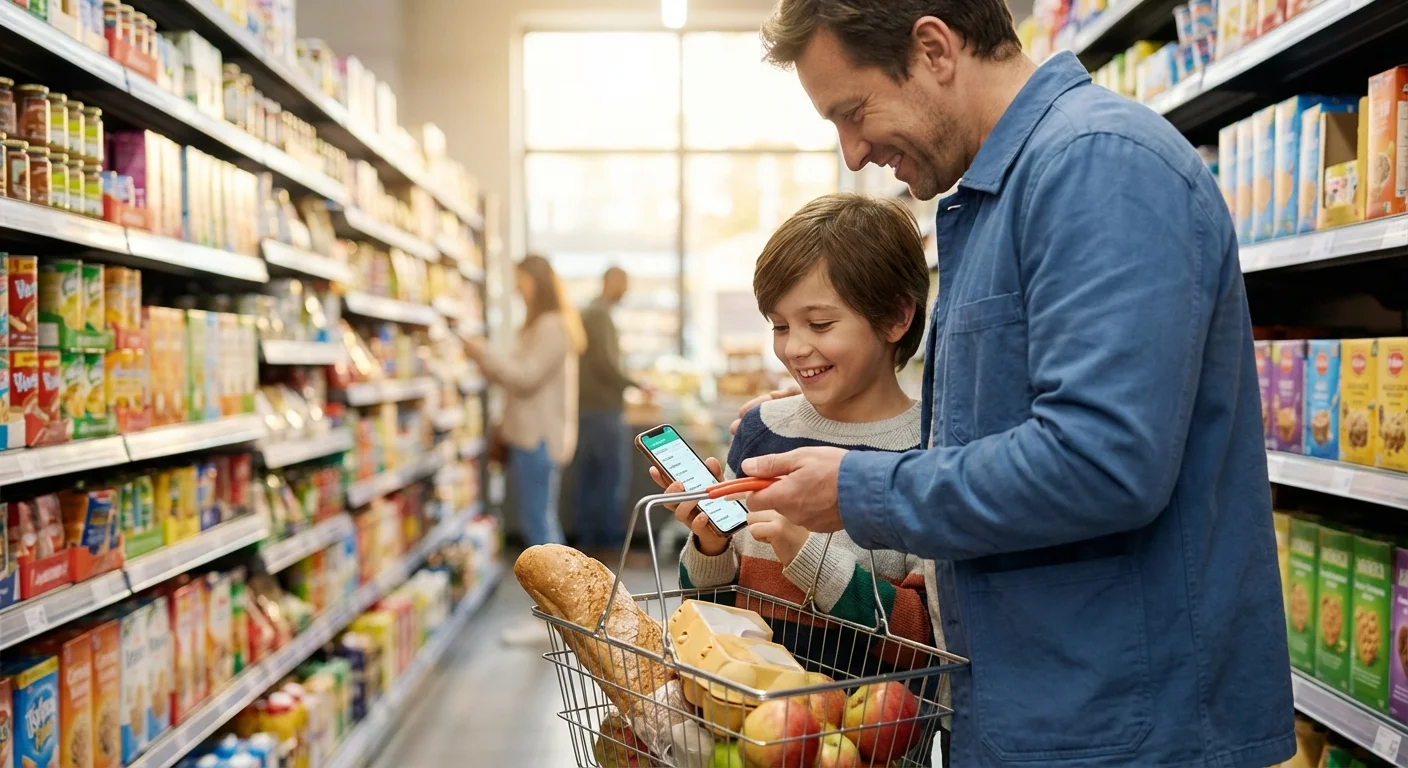
In the first few times, your goal is not speed, but a calm process. Give the child a role: they are responsible for 2–3 items and mark what's done, and you handle the rest.
To prevent the child in the store from "dissolving" in impressions, agree on a route. For example: first vegetables and fruits, then dairy, then bread, and only at the end — "something tasty," if it's on the list.
Mini-rules that help maintain focus
- First, look for the product by department, then by shelf and price tag.
- Take only what's on the list (all "wants" go on a separate wish list).
- If lost — stop in place and call an adult/employee.
- If unsure — ask a question, don't choose randomly.
A useful exercise for teaching children: ask the child to find the "cheapest" and "mid-priced" option of one product and explain the difference. This trains reading price tags and critical thinking.
Money and Responsibility: How to Explain Budget Without Pressure
The phrase "we don't have money" rarely teaches anything good. It's much more effective to give a clear budget and rules on how to handle it.
Start with a fixed amount for a small purchase: for example, "buy bread and milk, bring back the change." Then move on to a budget for the entire list. It's important for the child to understand that a budget is not a punishment, but a tool for choice.
A working scheme: divide purchases into "essential" and "possible if there's enough." This way, the child learns to prioritize and doesn't perceive a refusal as personal injustice.
If the child makes a mistake (takes the wrong size or something extra) — use it as a situation analysis. Calmly ask: "How did you understand this was suitable? What can you check next time?" This way, teaching children becomes sustainable, without shame or conflicts.
Gradual Independence: Training in 4 Steps
An independent shopping trip is a skill built gradually. A sudden "go alone and buy everything" often ends in stress for both the child and the parents.
Plan for 2–4 weeks (can be faster if it's easy for the child)
- Step 1. You are together, the child chooses 1–2 items from the list.
- Step 2. You are together, the child handles the entire list, you only monitor safety.
- Step 3. The child walks through the store alone, you wait at the entrance/at a designated point.
- Step 4. A short independent trip to a familiar store with a clear list and budget.
After each step, do a brief 2–3 minute "debrief." Don't evaluate the person ("you're inattentive"), evaluate the actions ("next time we'll check the volume and expiration date").
And don't forget about safety: route, time, communication, what to do in an unforeseen situation. This is part of the responsibility that a child in the store masters no worse than choosing products.
Common Parent Mistakes and How to Avoid Them
The most common mistake is a list that's too complex. The child loses track, starts improvising, or abandons the task. Simplify and add complexity gradually.
The second mistake is constant corrections at every step. When an adult interrupts and does it "the right way," the child stops thinking. It's better to ask guiding questions: "What's next on the list? Where is this usually located?"
The third mistake is turning a shopping trip into an exam. Teaching children works better when there is a right to make mistakes and clear rules. Then the child learns not to fear tasks, but to solve them.
Conclusion
Teaching a child to shop with a list means giving them the skill of planning, choosing, and self-control. Start with a short list, clear rules, and small independent steps. In a few weeks, the child in the store will feel more confident, and it will become easier for you to delegate some household tasks.
To always have the list at hand and not lose it, it's convenient to keep it in Telegram. For example, in the free mini-app Pickt, you can create shared shopping lists with real-time synchronization — the child marks what's bought, and you see the changes immediately: t.me/PicktBot/app.