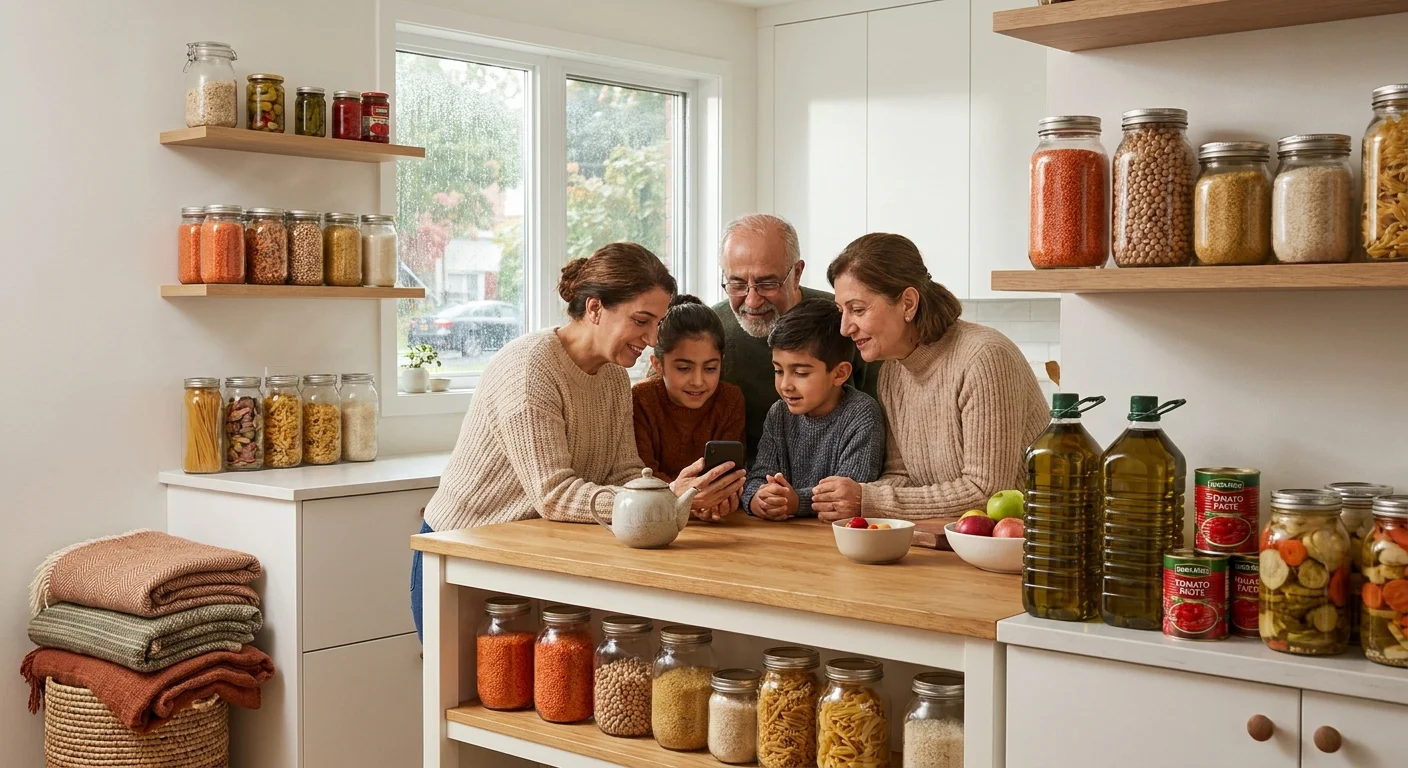
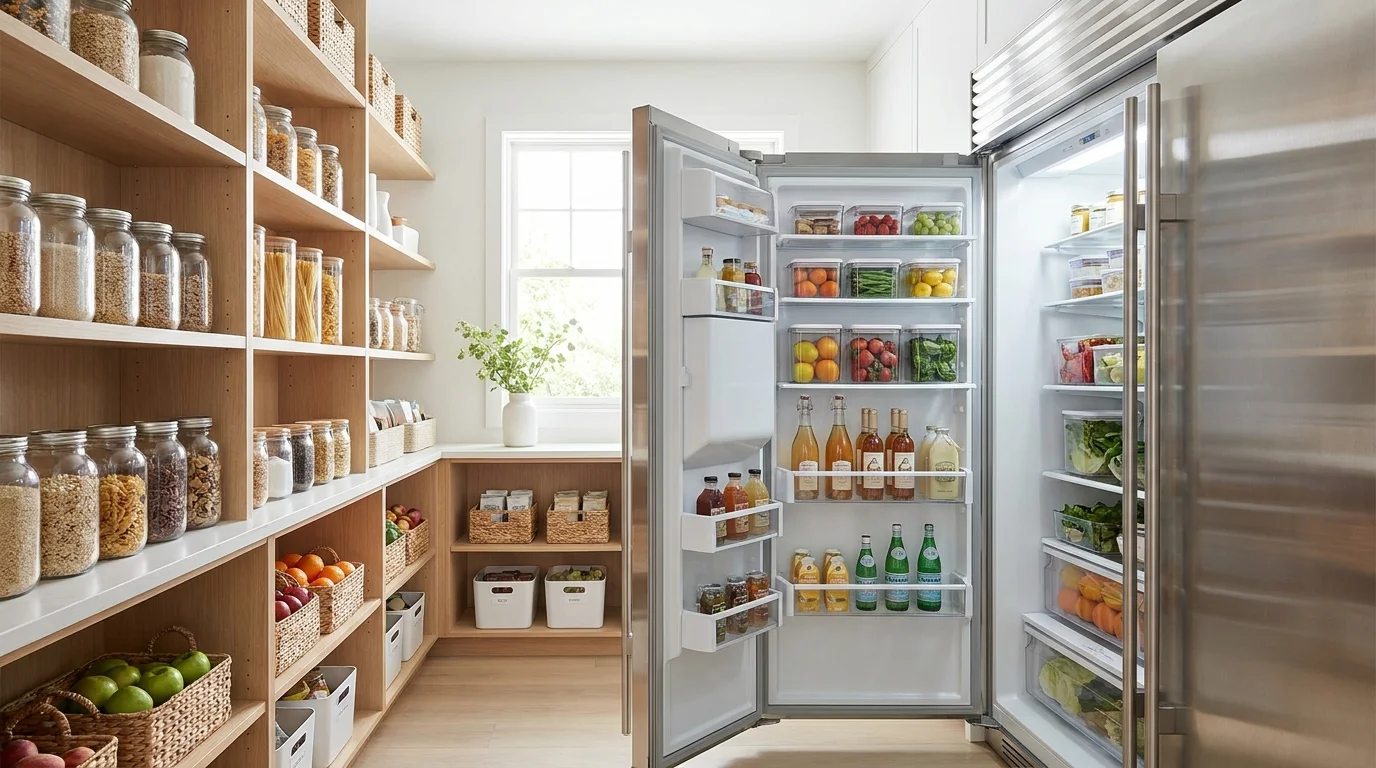
The optimal home supply for 2026 is an average of 10–14 days of food 'for emergencies' plus 3–5 days of fresh produce. For a family of two adults, this usually means 18–30 kg of food in total (including water and drinks) and a 'pantry' budget of about 8,000–15,000 RUB, if you buy without excess and regularly rotate your stock.
Why 'More' Isn't 'Better': Waste, Money, and Space
When you have too much food at home, you pay twice: first at the checkout, then by throwing away spoiled items. In reality, the biggest losses come not from grains and canned goods, but from 'seems useful to have' items — sauces, dairy, deli meats, fruits, and semi-prepared foods that didn't get eaten in time.
A practical rule for 2026: keep your stock so that 90–95% of purchases are eaten before their expiration date. If you regularly throw away at least 1 bag of groceries per week, you are almost certainly storing too much or buying without a plan.
In terms of money, this is noticeable: even a 'modest' weekly waste of 400–700 RUB turns into 20,000–36,000 RUB per year. That's the price of good appliances, a vacation, or a tangible safety net — and all of it can be recovered by simply adjusting your stock.
Basic Stock Formula: 3 Levels That Work for Most People
To understand how much food you really need at home, it's helpful to divide everything into three levels. Each level is self-sufficient and easy to check in practice.
Level 1: 'Fresh' for 3–5 Days
This is what you eat daily and what spoils fastest: vegetables, fruits, dairy, eggs, bread, herbs, chilled meat/fish. A 3–5 day supply reduces trips to the store but doesn't turn your fridge into a warehouse.
Level 2: 'Core' for 7–10 Days
Grains, pasta, legumes, frozen foods, canned goods, basic sauces, tea/coffee. This layer saves you when there's no time to cook something complex or when plans suddenly change.
Level 3: 'Safety Net' for 10–14 Days
This isn't 'a month's supply,' but a reasonable minimum for cases of illness, work emergencies, delivery delays, or unexpected expenses. This level includes long-shelf-life products and simple meals that can be assembled in 15–25 minutes.
If you live in a city and stores are accessible, your total stock should generally not exceed 14 days. Exceptions include remote areas, unstable supply chains, special diets, and large families.
How Much and What to Keep: Norms by Category (Per Adult)
Below are practical guidelines that are easy to scale. These aren't 'medical norms' but household quantities that are comfortable to live with in 2026: not hungry, not cramped, and without constant expiration.
- Grains/Pasta: 1.5–2.5 kg (e.g., rice 0.7 kg, buckwheat 0.7 kg, pasta 0.8 kg).
- Legumes: 0.5–1 kg (lentils/chickpeas/beans) — cheap protein and quick soups.
- Canned Goods and Ready Bases: 6–10 units (fish, tomatoes, beans, corn, peas, broth/passata).
- Frozen Foods: 1.5–3 kg (vegetable mixes, berries, dumplings/patty 'for emergencies' if you eat them).
- Protein (not frozen): 0.8–1.5 kg for 3–5 days (chicken/fish/cottage cheese/yogurt/eggs).
- Vegetables and Fruits: 3–5 kg for 3–5 days (some 'long-lasting': carrots, cabbage, apples).
- Bread/Lavash: 1–2 units + optionally 1 pack in the freezer.
- Water and Drinks: 1.5–2 liters of water per person per day + a reserve of 3–6 liters 'just in case'.
If you often search for queries like 'what food supply to keep at home' or 'what should always be in the fridge,' start with these categories. They cover most scenarios — from a quick dinner to a week without grocery shopping.
Table: Minimum Reasonable Supply for 14 Days (Family of 2 Adults)
This table is a convenient 'assembly point.' It's calculated for 2026 and urban conditions: store accessibility, delivery, a standard kitchen. Adjust for appetite, sports, and diets.
| Category | Quantity for 14 Days (2 Adults) | Why Keep It | Budget Estimate, RUB (2026) |
|---|---|---|---|
| Grains + Pasta | 4–6 kg | Base for side dishes and 'quick' meals | 600–1,500 |
| Legumes | 1–2 kg | Protein, soups, salads | 250–700 |
| Canned Goods/Tomatoes/Bases | 12–18 pcs. | Assemble a dinner without going to the store | 1,200–3,500 |
| Frozen Foods (Vegetables/Berries/Semi-prepared) | 3–6 kg | Reserve for busy days | 1,200–3,800 |
| Eggs | 20–30 pcs. | Quick protein, breakfasts | 350–900 |
| Dairy (Yogurt/Kefir/Cottage Cheese/Cheese) | 3–6 kg total | Snacks and protein, but important not to 'overdo it' | 1,500–4,500 |
| Meat/Fish (some can be frozen) | 3–5 kg | Main dishes | 2,500–7,500 |
| Vegetables and Fruits (some long-lasting) | 8–14 kg | Fiber and side dishes | 1,800–6,000 |
| Bread/Lavash/Crispbread | 3–6 units | Breakfasts, snacks | 300–1,200 |
| Water | 6–12 L reserve + daily consumption | In case of outages/illness | 150–600 |
Total 'pantry' for 2 adults usually falls within approximately 8,000–15,000 RUB (excluding delicacies and alcohol). If it's significantly higher, check if you are duplicating products (e.g., 5 types of pasta, 4 sauces, and 3 packs of cereal at the same time).
How to Tailor Your Stock to Your Rhythm: 3 Scenarios for 2026
The same set of numbers doesn't fit everyone. Below are three typical scenarios to quickly determine your 'normal' volume.
1) You Often Order Delivery (2–4 Times a Week)
Reduce the fresh layer to 2–3 days, and keep the safety net at 7–10 days. In terms of money, this often saves 10–20% of your food budget due to less waste and impulse purchases.
2) You Cook at Home Almost Every Day
Keep the fresh layer at 4–5 days and the core at 10 days. But strictly limit 'extras': sauces, snacks, desserts. These are the ones that quietly add 1,500–3,000 RUB per week for a family.
3) Unstable Schedule (Business Trips, Shift Work, Children)
Focus on frozen foods and canned goods: a safety net of 14 days, but fresh still at 3–4 days. This reduces the risk of 'everything spoiled, let's order food' — usually the most expensive scenario.
If you're looking for 'how much food is needed for a week,' for most adults it's about 6–10 kg of products per person (including vegetables, dairy, and drinks). Accuracy is achieved not through calculations, but by the habit of checking your stock once a week.
Practice: How to Keep Stock Without Creating Expired Items (5 Rules)
These rules work regardless of whether you live alone or in a large family. They are simple but provide maximum effect.
- One In, One Out: Bought a new pack of cereal? The old one moves to the front. This reduces the likelihood of expiration by 30–50% without extra effort.
- Category Limits: For example, no more than 2 sauces at a time and no more than 3 types of sweets. Limits save space and money.
- Weekly '7-Minute Inventory': Quickly scan your fridge and pantry and write down 5–7 items that need to be eaten first.
- Plan for 3 Dinners: Don't schedule your week down to the minute. Just choose 3 dishes you will definitely make and buy the missing ingredients.
- Shared Shopping List: When several people live in the house, duplication is the main source of excess. It's convenient to keep a shared list with real-time synchronization, for example in the free mini-app Pickt in Telegram (t.me/PicktBot/app), so no one buys 'another' pack of coffee when there are already two at home.
If you live with a partner, children, or roommates, a shared list isn't just 'an organizer for the sake of an organizer,' but a way to maintain exactly the volume you actually eat. In Pickt, it's easy to divide the list by categories and mark purchases on the go — and as a result, it's easier to maintain your 10–14-day supply without chaos.
Conclusion: Your Ideal Stock is Predictability, Not Maximalism
In 2026, the reasonable answer to the question 'how much food do you really need at home' is 10–14 days of basic stock plus 3–5 days of fresh products. This approach protects against emergencies, saves space, and reduces waste, thus preserving your budget. Start with the table, set limits on 'extra' categories, and keep a shared list — so your stock works for you, not against you.
Frequently Asked Questions
How much food do I really need at home if I live alone?
Usually 7–10 days of core stock and 2–4 days of fresh products are enough. In kilograms, this is often 10–18 kg total (including drinks), so you don't have to go to the store every day and don't accumulate expired items.
What food supply should I keep at home if I have children?
Add 'quick' and predictable items: grains, frozen foods, eggs, long-lasting fruits. In terms of time, aim for the same 10–14 days, but increase the share of snacks and simple breakfasts; the pantry budget usually increases by 20–40% depending on age.
What should always be in the fridge and pantry?
Minimum: eggs, 1–2 types of dairy, 'long-lasting' vegetables (carrots/cabbage), 1–2 sources of protein (chicken/fish/legumes), grains, pasta, tomatoes/canned goods, oil, salt/spices. This is a set from which you can assemble a meal even without going to the store.
How to know if your stock is too large?
Three signs: you regularly throw away food; you have more than 2 open packages of the same category (e.g., 3 sauces and 2 jams); you can't answer in 1 minute what's for dinner. In this case, reduce fresh purchases to 3 days and have a 'use-it-up week'.