In 2026, a month of food for a family at the start of the school year averages 45,000–55,000 ₽ for a family of 3 (2 adults + 1 schoolchild) when shopping at supermarkets and cooking at home. For a family of 4, the benchmark is 58,000–72,000 ₽. Below is a clear breakdown by category, per-person norms, and a budget table to quickly estimate your own amount.
What Determines How Much a Month of Food Costs for a Family at the Start of the School Year
The August–September season is almost always more expensive than an average month: spending on school supplies rises simultaneously, and the grocery basket includes more 'convenient' items—snacks, yogurts, sliced products, and semi-finished products for quick dinners.
The final figure is most strongly influenced by 6 factors: region, shopping format (discounter/supermarket/delivery), share of meat and fish, habit of coffee/sweets, frequency of home cooking, and the number of 'school snacks' per week.
- Region: the difference between large cities and small towns often amounts to 10–25%.
- Home cooking: if 80–90% of meals are cooked at home, the budget is usually 15–30% lower compared to regular delivery and ready-made meals.
- Diet: more fish, cheese, berries, nuts—adds 5–20% to the monthly total.
- School snacks: add an average of 150–300 ₽ per day per child (bars, fruit, yogurt, juice/drink).
Quick Budget Guide for 2026: 3 Typical Families
If you need to quickly understand how much a month of food costs for a family at the start of the school year, use the benchmarks below. They are calculated for 2026 under the conditions: home cooking, 1–2 shopping trips per week, no restaurants, with basic school snacks.
Family of 2 (couple or adult + teenager): 30,000–40,000 ₽/month. The lower end—discounters and simple dishes; the upper end—more fish, cheese, and ready-made products.
Family of 3 (2 adults + 1 schoolchild): 45,000–55,000 ₽/month. This amount usually includes breakfasts at home, partially school lunches, dinners at home, and snacks.
Family of 4 (2 adults + 2 children): 58,000–72,000 ₽/month. The range depends on the children's ages and the share of 'fast food' on weekdays.
For reference: the average per-person expense in this mode often falls within the range of 12,000–18,000 ₽/month (in 2026). If your figure is noticeably higher, the cause is almost always drinks/sweets, semi-finished products, and frequent unplanned purchases without a list.
Table: Structure of the Monthly Grocery Budget (Example for a 2+1 Family)
Below is a practical table to use as a starting point. This is not an 'ideal diet' but a realistic grocery basket for 2026 for a family of 3 at the start of the school season (including snacks and basic dairy products).
| Category | Budget Share | Monthly Amount, ₽ | What's Usually Included |
|---|---|---|---|
| Meat, Poultry, Eggs | 22–28% | 10,000–14,000 | chicken/turkey, ground meat, 30–50 eggs |
| Fish and Seafood | 6–10% | 2,700–5,000 | fish 2–4 times/week |
| Dairy Products | 14–18% | 6,300–9,000 | milk, kefir, yogurt, cottage cheese, cheese |
| Vegetables and Fruits | 16–22% | 7,200–11,000 | seasonal vegetables, fruits, herbs |
| Grains, Pasta, Bread | 8–12% | 3,600–6,000 | rice/buckwheat/oatmeal, bread, lavash |
| Pantry Staples and 'Kitchen Basics' | 7–10% | 3,000–5,000 | oil, flour, sugar, spices, sauces |
| Snacks and School Lunch | 8–12% | 3,600–6,000 | fruit, bars, cookies, nuts |
| Drinks and 'Treats' | 5–9% | 2,200–4,500 | tea/coffee, cocoa, sweets |
| Total | 100% | 45,000–55,000 | benchmark for 2026 |
If there are two schoolchildren in the family, the 'snacks and lunch' line usually increases by approximately +2,500–4,000 ₽ per month, even if the main dishes remain the same.
Norms and 'Basket Math': How to Estimate Your Budget in 10 Minutes
To avoid guessing, it's convenient to calculate based on consumption norms. For 2026, you can use a simple model: 400–600 g of vegetables and fruits per day for an adult and 300–500 g for a child, plus protein (meat/fish/eggs/legumes) almost daily.
Quick calculation for a 2+1 family for 30 days:
- Vegetables and Fruits: 1.2–1.6 kg/day per family → 36–48 kg/month. At an average price of 180–230 ₽/kg in season, this is 6,500–11,000 ₽ (the range depends on the share of berries, grapes, avocados, etc.).
- Meat/Poultry: 3.5–5.5 kg/week → 14–22 kg/month. At an average of 380–550 ₽/kg (including chicken and more expensive items), this is 5,300–12,000 ₽.
- Fish: 0.8–1.5 kg/week → 3–6 kg/month. At 650–900 ₽/kg, this is 2,000–5,400 ₽.
- Dairy: 12–20 L/month of milk/kefir + cottage cheese/yogurt/cheese → usually 6,000–9,000 ₽.
- Grains, Bread, Pasta: 6–10 kg/month total → 3,500–6,000 ₽ including bread and pastries.
Add up the categories and include 'extras' for pantry items, sweets, sauces, and unexpected purchases—usually another 12–18% of the total. This way, you'll quickly get a realistic budget without complex tables.
How to Reduce Expenses by 10–20% in August–September 2026 Without Strict Frugality
Budget reduction works best not by giving up 'all the tasty things,' but by managing recurring expenses. In the pre-school season, impulse purchases 'for a snack' and 'something for tea' are especially noticeable.
- Plan 12–15 dinners for the month and repeat them. Practice shows this eliminates 2–3 unnecessary deliveries and saves 3,000–8,000 ₽/month.
- Snacks—by the norm, not 'just in case'. Allocate, for example, 20 school snacks per month (according to the number of school days) and buy for that amount. Savings on 'extra' snacks often yield 10–15% in this category.
- Seasonal vegetables—as the basis of the menu. In August–September, it's more profitable to build side dishes and salads around what is cheaper and more stable in quality, rather than around rare fruits/berries.
- Optimize protein: 1–2 legume-based meals per week (lentils, chickpeas) usually reduce the bill by 1,000–2,500 ₽ per month without sacrificing satiety.
- One big shopping trip + one 'buy fresh' trip. When you reduce the number of store visits from 5–6 to 2–3 per week, impulse purchases drop, and savings often amount to 5–10% of the total budget.
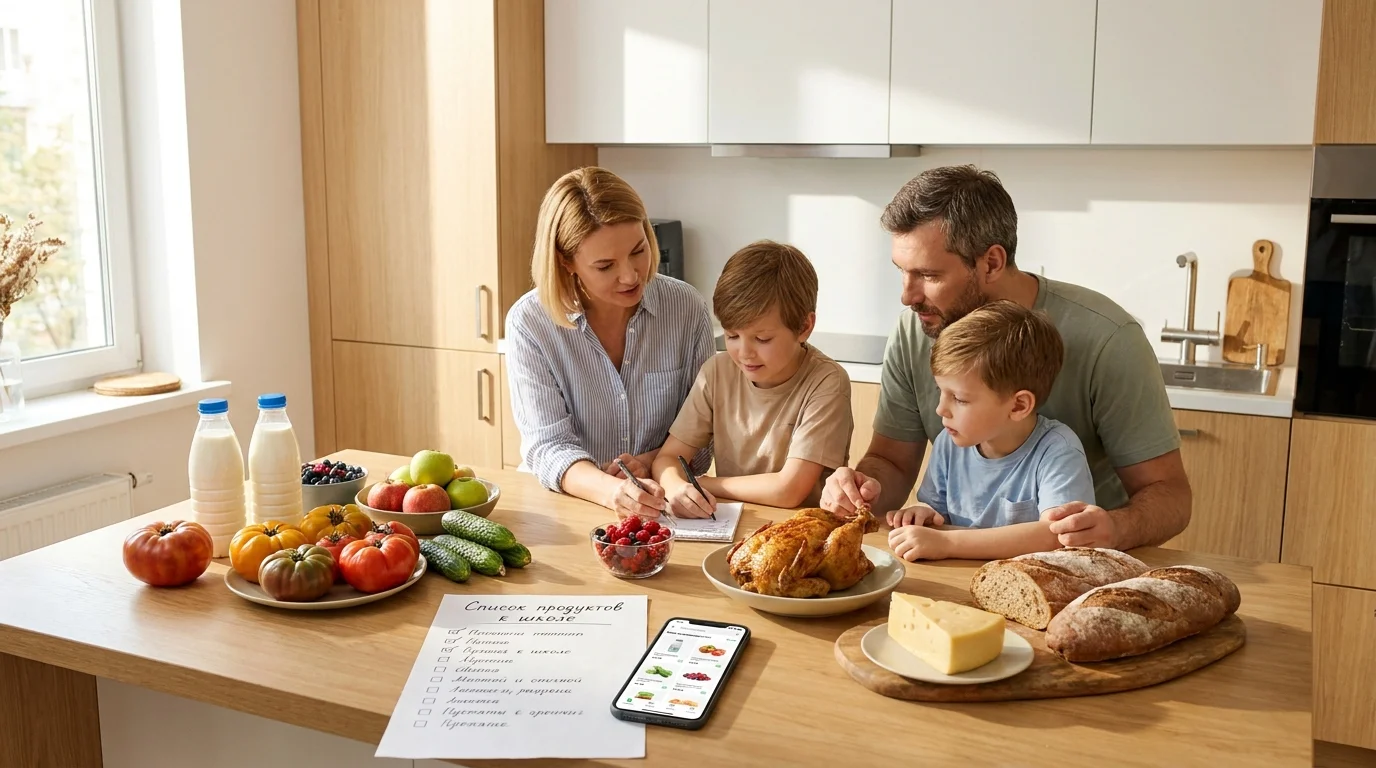
For this to work in a family, it's important that the list is unified and accessible to everyone. It's convenient to keep a shared list in the Pickt mini-app in Telegram: you add items throughout the day, and they sync in real-time for everyone at home (bot @PicktBot, link: t.me/PicktBot/app).
Sample Weekly Menu and Its Cost (Benchmark for 2026)
This section is needed to 'ground' the numbers: what a week of eating looks like that fits within the average budget at the start of the school year. The example is for a 2+1 family, without restaurants, with simple dishes and school snacks.
Basic Set of Dishes
- Breakfasts: oatmeal/eggs/cottage cheese, 5–6 times a week.
- Dinners: chicken with vegetables, pasta with sauce and salad, fish with a side dish, soup/stew, 5–6 times a week.
- Snacks: fruit + yogurt/cheese/nuts, 5 school days.
Weekly Cost Benchmark
In 2026, such a set averages 11,000–14,000 ₽ per week (depending on the share of fish, cheese, and sweets). Multiply by 4 weeks—we get 44,000–56,000 ₽, which aligns well with the monthly range for a 2+1 family.
If you notice that 'everything seems the same,' but the week consistently comes out to 16–18 thousand, check three lines: drinks (coffee/juices), cheeses/sausages, and ready-made meals. These are most often the ones that quietly add +20–30% to the basket.
How to Accurately Calculate Your Budget and Stay Within It During the School Season
Accuracy comes not from perfect calculations, but from regular tracking. In practice, 2 habits are enough: record purchases and check once a week which category has 'ballooned.'
- Set a weekly limit. For example, with a goal of 52,000 ₽/month, set 13,000 ₽/week. This makes it easier to adjust spending throughout the month.
- Divide the list into categories: 'essentials,' 'school snacks,' 'treats,' 'frozen foods.' This immediately shows where you are overspending.
- Agree on rules for 'treats'. For example, 2 sweet items per week for the family. In monetary terms, this often keeps the category within 2,500–4,500 ₽/month instead of 7–9 thousand.
If multiple people do the shopping, a shared list is especially important: it eliminates duplicates (milk, eggs, bread) and reduces 'random' purchases. In Pickt, it's convenient to mark what has already been bought and see changes instantly—this helps keep the budget in check without excessive mutual monitoring.
Conclusion: in 2026, the answer to the question 'how much does a month of food cost for a family at the start of the school year' most often falls within the range of 45,000–55,000 ₽ for a 2+1 family and 58,000–72,000 ₽ for a 2+2 family when cooking at home. The exact figure is determined by norms + basket structure and one shared shopping list, which reduces impulse spending during the busiest season.
Frequently Asked Questions
How much does a month of food cost for a family at the start of the school year if shopping at discounters?
In 2026, savings compared to supermarkets often amount to 8–15%. For a 2+1 family, this could reduce the budget from 50,000 ₽ to approximately 43,000–46,000 ₽, if you don't make up the difference with expensive 'treats.'
How to account for school lunches and the cafeteria?
If a child eats lunch at school 5 times a week, allocate an additional 2,500–5,000 ₽/month (depending on the region and payment format). In this case, the home portion of 'snacks' may decrease slightly, but rarely drops to zero.
How much to allocate for vegetables and fruits in August–September 2026?
For a 2+1 family, a reasonable benchmark is 7,000–11,000 ₽/month. In season, you can stay closer to the lower end if berries and exotic fruits are not a daily habit.
How to quickly understand where money is 'leaking' in the grocery basket?
Compare the shares of categories: if 'snacks/sweets/drinks' take up more than 20% of the budget, this is the main source of overspending. The second common factor is ready-made meals and semi-finished products, which easily add +5,000–12,000 ₽ per month.