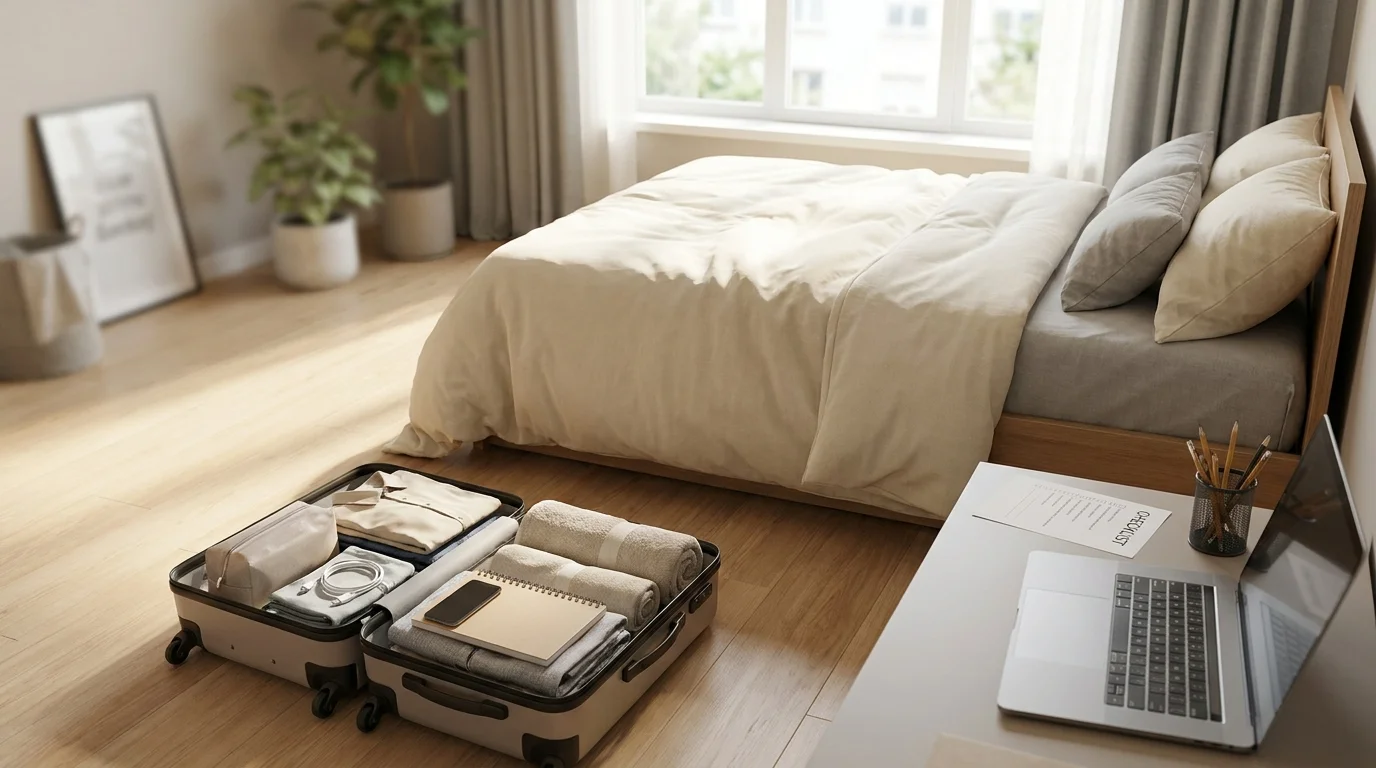
Need a freshman dorm checklist for 2026? Below is a ready-to-use list: documents and money, seasonal clothing, bedding and household items, kitchen and food, hygiene and first aid, tech and study supplies. It's perfect for those moving into a dorm for the first time (alone, with a partner, or with roommates) and want to forget nothing.
Seasonal note: in summer and early fall 2026, move-in usually happens in "warm" weather, but dorms are often cool in the evenings and hallways. So the list below covers both the initial season and the first cold spells—so you don't have to make panic purchases in the first week.
Documents, Money, and "Move-In Papers"
This section can be checked at home. It's best to organize documents and copies in separate files: one for "originals" and another for "copies and certificates."
- Passport + 2–3 photocopies of the main pages.
- Health insurance card (mandatory or voluntary) + copy.
- Social security number card + copy.
- Student ID/enrollment order (if issued before move-in) or confirmation from the university.
- Dorm contract, payment receipts/checks, pass/application (if required).
- Medical documents as required by the dorm (certificates, chest X-ray, vaccinations—check your university's specific rules).
- Bank card + some cash for the first few days (transport, small purchases, key deposit).
- Folder/file A4, pen, marker for labels.
Tip: take photos of your documents and save them in a secure cloud. This won't replace the originals but can help in an emergency.
Bedding, Household Items, and Room Organization
Dorms often provide the bare minimum (bed and mattress), and the quality of textiles and availability of pillows/blankets depend on the specific place. This checklist covers comfort and sleep hygiene.
- Bedding 2 sets (one in the wash, one on the bed).
- Blanket for the season (a mid-season one is versatile) and a throw for cool evenings.
- Pillow + 1–2 spare pillowcases.
- Mattress protector (very helpful in a dorm).
- Towels: bath towel, face/hand towel, kitchen towel.
- Slippers for the room + flip-flops for the shower.
- Laundry basket/bag, clothespins, a small collapsible basin.
- Storage organization: 2–4 vacuum bags or boxes, hangers, a small organizer.
- Mini cleaning kit: sponges, microfiber cloths, all-purpose cleaner, trash bags.
If you're moving in with roommates, agree in advance who brings what from the shared items (e.g., trash can, drying rack, basic cleaning supplies). It's convenient to keep a shared shopping list for everyone—for example, in the free mini-app Pickt in Telegram: you add items, and they sync in real-time between roommates.
Seasonal Clothing and Footwear (Relevant for Fall 2026)
Pack capsule-style: fewer items, but everything should match. For the start of the 2026 academic year, it's important to account for temperature fluctuations and rain.
- Everyday clothes for 7–10 days: t-shirts/long sleeves, 1–2 hoodies or sweaters, jeans/pants, loungewear.
- Warm layer: thermal long sleeve or thin turtleneck, warm socks.
- Outerwear: windbreaker/raincoat and a mid-season jacket.
- Footwear: comfortable sneakers for classes, waterproof pair for rain, house slippers.
- Sports: workout clothes, sneakers for the gym, water bottle.
- Accessories: umbrella, hat/buff, gloves (for the first cold spells), belt.
Life hack: if closet space is limited, bring "heavy" warm clothes closer to the cold weather. But a raincoat and warm layer are better to have right away.
Dorm Kitchen: Dishes, Food, and What Actually Comes in Handy
The kitchen area in a dorm is where things most often "get lost." Take the minimum that's easy to label and store in a container.
Dishes and Storage
- Plate (deep and flat), mug, glass (optional).
- Utensils: spoon, fork, knife; plus a small spoon for tea.
- Kitchen knife + small cutting board.
- Containers 3–5 pcs. (various sizes), zip bags.
- Thermal mug or bottle—convenient for classes.
- Sponge, dish soap, towel/napkins.
Basic Food for the First 7–10 Days
- Grains/pasta, oatmeal, rice.
- Canned goods (tuna/beans/corn), tomato paste.
- Tea/coffee, sugar/sweetener.
- Salt, pepper, 1–2 spices, vegetable oil.
- Snacks: nuts, granola bars, dried fruit.
- Quick breakfasts: yogurt, cottage cheese, eggs (if there's a fridge).
Related searches often made together: what to buy for a freshman dorm, list of things for a dorm, what to bring to a dorm for the first time. If you're shopping with roommates, make a shared list and mark who brings what: this way you won't buy three dish soaps and forget trash bags.
Hygiene, Laundry, and First Aid: The Minimum That Saves the Day
In the first days after move-in, time is scarce, and small household items run out unexpectedly. This set covers basic needs without excess.
Hygiene
- Toothbrush, toothpaste, floss/water flosser (if you use one).
- Shampoo, body wash, loofah.
- Deodorant, hand/face cream (skin dries out during heating season).
- Shaving supplies.
- Comb, hair ties/clips.
- Feminine hygiene products (with a 1–2 month supply).
Laundry and Clothing Care
- Laundry detergent/pods, stain remover stick.
- Collapsible drying rack (if allowed) or clothesline/hooks.
- Mini lint roller, shoe brush.
Freshman First Aid Kit
- Band-aids (regular and for blisters), antiseptic.
- Fever reducer/pain reliever (as tolerated).
- Cold/sore throat remedy, saline nasal spray.
- Antihistamine (if prone to allergies).
- Thermometer.
- Personal prescription medications with a supply + prescription/note.
Important: if you have chronic conditions, find out in advance where the nearest clinic and pharmacy are, and save their contacts in your phone.
Study Supplies and Tech: To Avoid Running to Stores in the First Week
In 2026, many academic processes rely on online services, but basic stationery is still needed. The main thing is to ensure connectivity, charging, and backup storage.
- Laptop/tablet (if you use one) + charger.
- Phone + long cable (2–3 m) and/or extension cord.
- Power strip with 4–6 outlets (dorms usually have few outlets).
- Power bank 10,000–20,000 mAh.
- Headphones (preferably closed-back for quiet) + earplugs (optional).
- USB drive or external SSD, cloud storage.
- Backpack, document folder, pencil case.
- Stationery: 2–3 pens, pencil, eraser, markers, sticky notes, notebooks/notepad.
- Mini tools: small screwdriver, electrical tape, duct tape, scissors (often come in handy).
If you're sharing purchases with roommates (extension cord, tape, bags, cleaning supplies), it's easier to keep a shared checklist in one place. In Pickt (a mini-app in Telegram), you can quickly create a list and mark purchases right in the store: t.me/PicktBot/app.
Final "Move-In Plan": What to Do in the First 24 Hours
This short algorithm helps a freshman adapt and avoid wasting energy on chaos. Keep it handy on move-in day.
- Check the room: condition of furniture, outlets, windows, lock. If necessary, take photos and inform the dorm manager.
- Set up the basics: bedding, towels, slippers, chargers—so you can live right away.
- Assemble a "quick kit" in a separate bag: documents, water, snack, napkins, antiseptic.
- Label kitchen items (marker/stickers) and designate a storage spot.
- Make a shopping list for the next 2 days: cleaning supplies, food, small storage items.
Conclusion: A good freshman dorm checklist isn't about "bringing everything," but covering sleep, hygiene, food, study, and safety in the first few weeks. In the 2026 move-in season, it's better to have a mid-season set right away and buy the rest as needed once you understand how your specific dorm works.
Frequently Asked Questions
What should I bring to a dorm for the first time if I'm traveling light?
Minimum: documents, bedding/towel, slippers and flip-flops, basic hygiene, chargers, extension cord, mug/utensils, 2–3 containers, and food for 2–3 days. Everything else is easier to buy after move-in.
Do I need to bring a kettle, slow cooker, or hot plate?
It depends on the dorm's rules: sometimes personal heating appliances are prohibited. Check in advance. If allowed, agree with roommates and bring one appliance per room to avoid overloading the circuit.
How many sets of bedding do I actually need?
Two is optimal. One in use, the other in the wash/spare. If you have space, a third set is useful during cold and flu season and frequent washing.
How can I avoid buying too much in the first few days?
First, cover the basics: sleep, hygiene, food, charging/connectivity. Then live for 3–5 days and buy only what's needed. A shared shopping list with notes helps—so you don't duplicate items with roommates.