October is the classic month for home preserving. Late cabbage becomes juicier and sweeter, markets are full of inexpensive vegetables, and the cool weather helps fermentation proceed calmly and predictably. But today, fermenting is not just a familiar winter tradition: food fermentation is experiencing a renaissance in restaurants and home kitchens. Salty, sour, and spicy flavors have become a gastronomic trend, and a jar of crunchy vegetables easily turns an ordinary dinner into something more interesting.
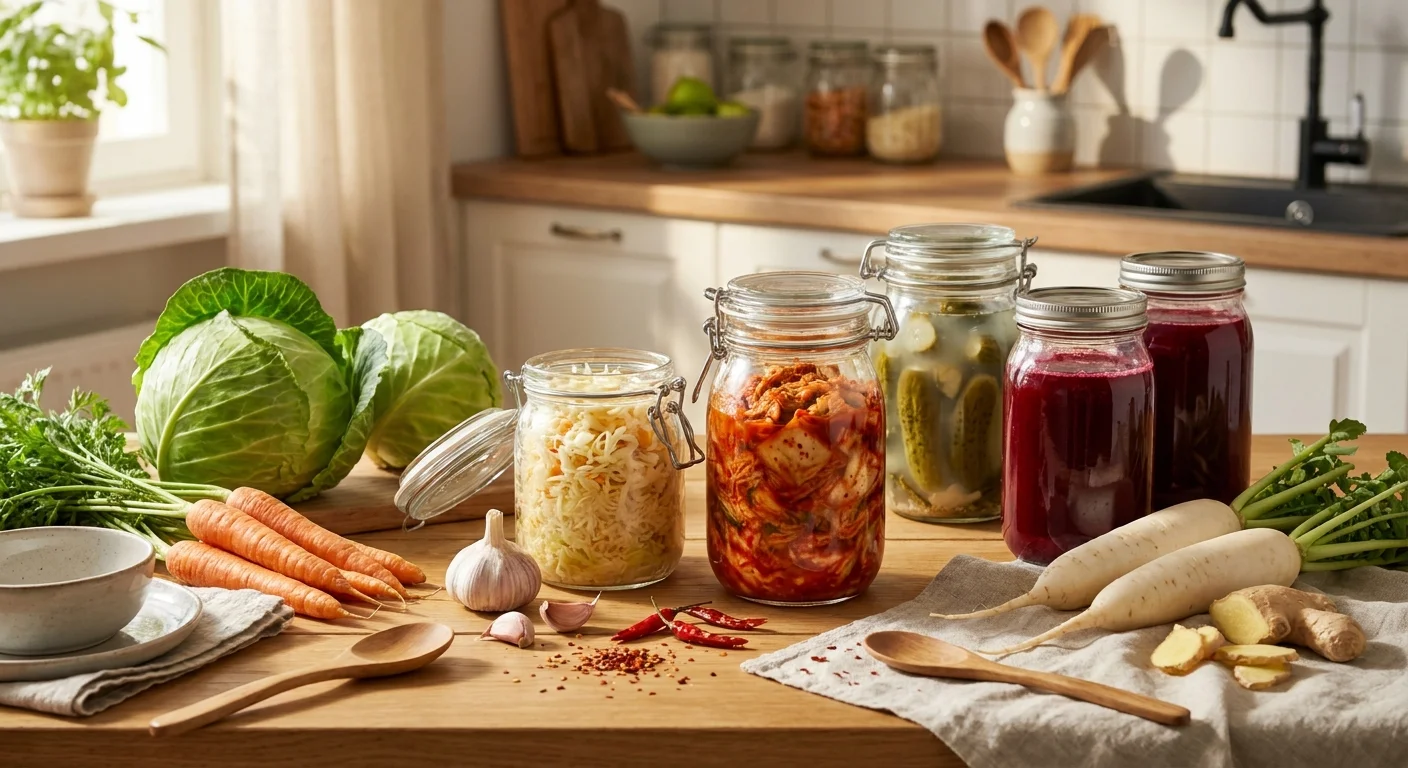
You can start with the most straightforward preserve—cabbage. Then add salted cucumbers, spicy kimchi, or vibrant beet kvass. The main rule for any recipe: work with clean hands, use thoroughly washed utensils, and don't forget to keep the vegetables submerged below the brine level.
Why ferment specifically in October?
Traditionally, cabbage was fermented after the first light frosts. By this time, late varieties have accumulated sugars: these are what the lactic acid bacteria feed on, creating that characteristic tang. Such cabbage is usually dense, white, crunchy, and stores well.
There's also a practical reason. For the active fermentation phase, moderate room temperature—around 18–22 °C—is comfortable, and after readiness, the preserves need cold. In October, it's easier to find a cool spot: a refrigerator, an insulated loggia without sub-zero temperatures, a cellar, or a cold pantry. That's why preserves made in October are especially convenient: the product starts quickly in the kitchen and then stores without problems.
What do you need to buy to start from scratch?
You don't need to buy a special ceramic crock or an expensive fermentation station. For your first attempts, simple, acid-neutral equipment is enough. Glass jars, an enameled pot without chips, or a food-grade plastic container will work. It's better not to use aluminum cookware: acid can react with it.
- Jars or a pot — for cabbage, a container of 1.5 to 3 liters is convenient.
- Weight — a small plate matching the pot's diameter and a clean jar filled with water; in a jar, you can press the cabbage down with a cabbage leaf or a special glass weight.
- A mandoline or sharp knife — thin, even slicing helps the cabbage release its juice faster.
- Kitchen scale — the most reliable way to measure salt proportions for fermenting.
- Salt without additives — coarse rock or sea salt, without iodine, anti-caking agents, flavorings, or herbs.
- Clean towels and a spoon — for working and checking the ferment daily.
Before starting, wash the jars and lids with hot water and soda or dish soap, rinse thoroughly, and dry. Sterilization isn't necessary for every recipe, but the utensils must be free of food residue, grease, and foreign odors. Vegetables also need a good wash—remove damaged leaves and soft spots.
Classic cabbage and salted cucumbers: where to start
If you're looking for what you need for sauerkraut, the list is short: cabbage, carrots, salt, and a little patience. For 1 kg of shredded cabbage, take 20 g of salt and 100–150 g of carrots. You can skip the carrots, but they add a slight sweetness and a nice color. Mix the vegetables with salt in a large bowl, knead well with your hands until juice appears, then pack tightly into a jar or pot. The brine should rise to the top.
Leave the cabbage at room temperature for 3–5 days. For the first two days, pierce the mass with a clean wooden stick or a long spoon down to the bottom: this helps release accumulated gas and removes any potential bitterness. Start tasting from the third day. When the flavor becomes pleasantly sour-salty, move the ferment to the cold.
Salted cucumbers are even simpler. For a kilogram of small, firm cucumbers, prepare 1 liter of water, 25–30 g of salt, dill umbels, garlic, and optionally blackcurrant or horseradish leaves. Pour cold brine over the cucumbers so they are fully submerged. At room temperature, they'll be ready in 2–4 days, then they should go into the refrigerator. For a cleaner taste, use filtered water.
How is fermenting different from pickling?
In fermenting, the acid appears naturally: bacteria convert sugars from the vegetables into lactic acid. Salt creates an environment where unwanted microorganisms struggle to develop, while the beneficial bacteria thrive. That's why fermented foods have a complex, lively flavor, crunch, and characteristic aroma.
Pickling works differently: vegetables are covered with a solution that already contains acid—usually vinegar, sometimes citric acid. The marinade can be very tasty, but it's a different method and a different flavor profile. Pickled vegetables achieve results quickly, while fermented ones depend on time, temperature, and precise salting.
Table: basic proportions and timelines
| Product | Salt per kilogram | Fermentation time | Where to store |
|---|---|---|---|
| Shredded cabbage | 20 g | 3–5 days at 18–22 °C | After readiness: refrigerator or cellar, 0–5 °C |
| Cucumbers | 25–30 g per 1 L water for 1 kg cucumbers | 2–4 days at 18–22 °C | Refrigerator, 2–6 °C |
| Kimchi from napa cabbage | 20–30 g for pre-salting 1 kg cabbage | 1–2 days at room temperature | Refrigerator, 2–6 °C |
| Beet kvass | 10–15 g per 1 kg beets | 3–5 days at 18–22 °C | Refrigerator, 2–6 °C |
Kimchi and beet kvass: expanding your repertoire
Kimchi is a great next step after cabbage if you want spice, garlic, and bright umami. For a simple version, take 1 kg of napa cabbage, 1 small daikon, green onions, 1–2 tablespoons of gochugaru, 1–2 tablespoons of fish sauce, a piece of fresh ginger, and 4–5 cloves of garlic. Cut the cabbage into large pieces, sprinkle with salt, leave for 1.5–2 hours, then rinse and squeeze out. Mix with a paste of gochugaru, fish sauce, ginger, and garlic, add the daikon and onions, and pack tightly into a jar.
If you're putting together a how to make kimchi at home checklist, note that gochugaru and fish sauce aren't always available nearby. It's convenient to split the shopping in Pickt—a shared shopping list in Telegram: one person can visit an Asian store, while another buys cabbage, daikon, and greens at a regular supermarket. Leave 3–4 cm of headspace at the top of the jar: kimchi actively releases juice and gas. After a day, taste it, then move it to the refrigerator.
Beet kvass is a simple drink with an earthy, slightly salty flavor. Cut 1 kg of peeled beets into cubes, place them in a clean jar, add 10–15 g of salt, and pour in 1.5–2 liters of cold filtered water. Cover with cheesecloth or a loose lid. After 3–5 days, strain and chill. You can drink it in small amounts, add it to borscht, or mix it with apple juice.
How to store your ferments and know when something's gone wrong
During fermentation, vegetables must stay submerged in brine. Pieces that float above the surface are more prone to mold, so check the liquid level and the cleanliness of the weight daily. If there's too little brine in the cabbage, you can add a little 2% solution: 20 g of salt per 1 liter of water.
Normal signs of fermentation are bubbles, slight hissing, cloudy brine, and a tangy fresh aroma. A thin white film on the surface is sometimes yeast: you can carefully remove it, but it's better to evaluate the taste of the ferment carefully. However, fluffy mold of any color, a putrid or sharply unpleasant smell, sliminess, unusually soft vegetables, and pink-orange spots are reasons to discard the entire contents. Don't try to save a suspicious product by just skimming off the top layer.
Once the desired acidity is reached, always move the jars to the cold. Use a clean fork or spoon, don't return leftover food to the jar, and close the lid tightly. This way, cabbage, kimchi, and cucumbers will keep their flavor and crunch much longer.
Final shopping list to get started
- 1–2 heads of late white cabbage;
- carrots, garlic, dill, and cucumbers for your first pickles;
- beets for kvass;
- coarse salt without additives;
- glass jars or an enameled pot;
- kitchen scale, mandoline, or sharp knife;
- a plate and a jar of water, or a glass weight;
- for kimchi: napa cabbage, gochugaru, fish sauce, daikon, ginger, garlic, and green onions.
Start with one jar of cabbage and note how many days it sat and which flavor you liked best. Home food fermentation quickly becomes not an autumn chore but a delicious habit: your refrigerator will always have a ready sour, salty, and crunchy addition to potatoes, rice, meat, sandwiches, and vegetable dishes.