In autumn, vegetables are cheapest: the harvest has just been collected, the selection is large, and seasonal prices allow you to significantly cut costs. But buying vegetables for winter is only truly beneficial in one case—if the supplies last at least until the end of January without sprouts, mold, or soft spots. Buying two bags of potatoes is easier than properly placing them in a city apartment.
The main rule of a thrifty stockpile: don't buy vegetables "by eye." You need to estimate in advance how much the family actually eats, choose firm and dry root vegetables, prepare a place, and do a check-up once a month. Then potatoes won't sprout in November, and you won't have to throw away onions in bags.
How Many Vegetables Actually Make Sense to Buy?
For most families, it's reasonable to plan a stock for 4–6 months: from October or November to March. Buying for the whole year in an apartment is usually not profitable: by spring, temperatures rise, vegetables sprout more actively, and lose quality. The exception is a dry, cold cellar with a stable climate.
The norms below are calculated for a typical home menu: soups, side dishes, roasting, salads, and preserves without daily potato consumption. If the family often cooks mashed potatoes, potato pancakes, and vegetable dishes, add 20–30% to the potatoes.
| Number of People | Potatoes per Season | Onions per Season | Carrots per Season | Beets per Season |
|---|---|---|---|---|
| 1 person | 25–35 kg | 6–8 kg | 8–10 kg | 5–7 kg |
| 2 people | 50–70 kg | 12–16 kg | 15–20 kg | 10–14 kg |
| 3 people | 75–100 kg | 18–24 kg | 23–30 kg | 15–20 kg |
| 4 people | 100–130 kg | 24–32 kg | 30–40 kg | 20–28 kg |
Don't buy everything in one batch if conditions are questionable. A practical option: get the main stock of potatoes and beets in autumn, and buy onions and carrots in small batches in January. It's convenient to agree on a shopping list for winter vegetables with exact quantities in advance with your family in Pickt—shared shopping lists in Telegram. This reduces the risk that each family member separately buys a bag of onions.
How to Choose Vegetables That Will Survive the Winter?
Only late varieties and fully ripened vegetables are suitable for long-term storage. Early young potatoes, sweet salad onions, and very juicy carrots are meant for quick consumption. Don't take a bag if there's a lot of dirt with a damp smell, wet tubers, or white sprouts already visible.
- Potatoes: dry, firm, without green spots, cuts, or sprouts. Tubers should be medium-sized: too large ones often spoil from the inside.
- Onions: with dry skin, a thin dry neck, and no smell of mold. A soft base is a sign of beginning rot.
- Carrots: firm, without cracks, black spots, or broken tips. The tops should be cut off completely before storage.
- Beets: dry, with intact skin, without deep scratches. The tail is not torn off but carefully left.
After buying, don't rush to close vegetables in tight bags. Spread them out for 2–3 days in a cool, dry place, sort through them, and immediately set aside damaged ones. It's better to cook those in the first week.
Why Do Potatoes Sprout Already in November?
Most often, the cause is warmth and light. At temperatures above +7…+8 °C, tubers gradually come out of dormancy. In the kitchen, in a warm pantry near pipes, or on an insulated balcony without temperature control, potatoes easily start sprouting within a month.
The temperature for potatoes is +2…+5 °C, humidity around 85–90%, complete darkness, and constant air access. In warmth, tubers not only sprout but also become flabby: they use up moisture and nutrients. In light, potatoes turn green and accumulate solanine—such green areas cannot simply be cut off and considered safe.
To understand how to store potatoes in winter, follow four conditions: keep them in an opaque box, don't place them flush against the floor or wall, don't cover with plastic, and don't store near fruits. Apples release ethylene, which accelerates aging and can provoke sprouting. Potatoes also shouldn't be kept close to onions: these crops have different humidity needs.
| Vegetable | Temperature | Storage Duration | Main Enemy |
|---|---|---|---|
| Potatoes | +2…+5 °C | 4–7 months | Heat and light |
| Onions | 0…+5 °C or +18…+22 °C | 4–8 months | Humidity and condensation |
| Carrots | 0…+2 °C | 3–6 months | Drying out |
| Beets | 0…+3 °C | 4–6 months | Frost and mechanical damage |
Where to Store If There's No Cellar?
In an apartment, there's usually no ideal place, so the task is to find the coolest spot and divide vegetables by their needs. Vegetables on the balcony in winter can only be stored on a glazed loggia where the temperature doesn't drop below 0 °C for long. In frost, tubers and root vegetables freeze, and after thawing, they quickly rot.
Glazed Balcony
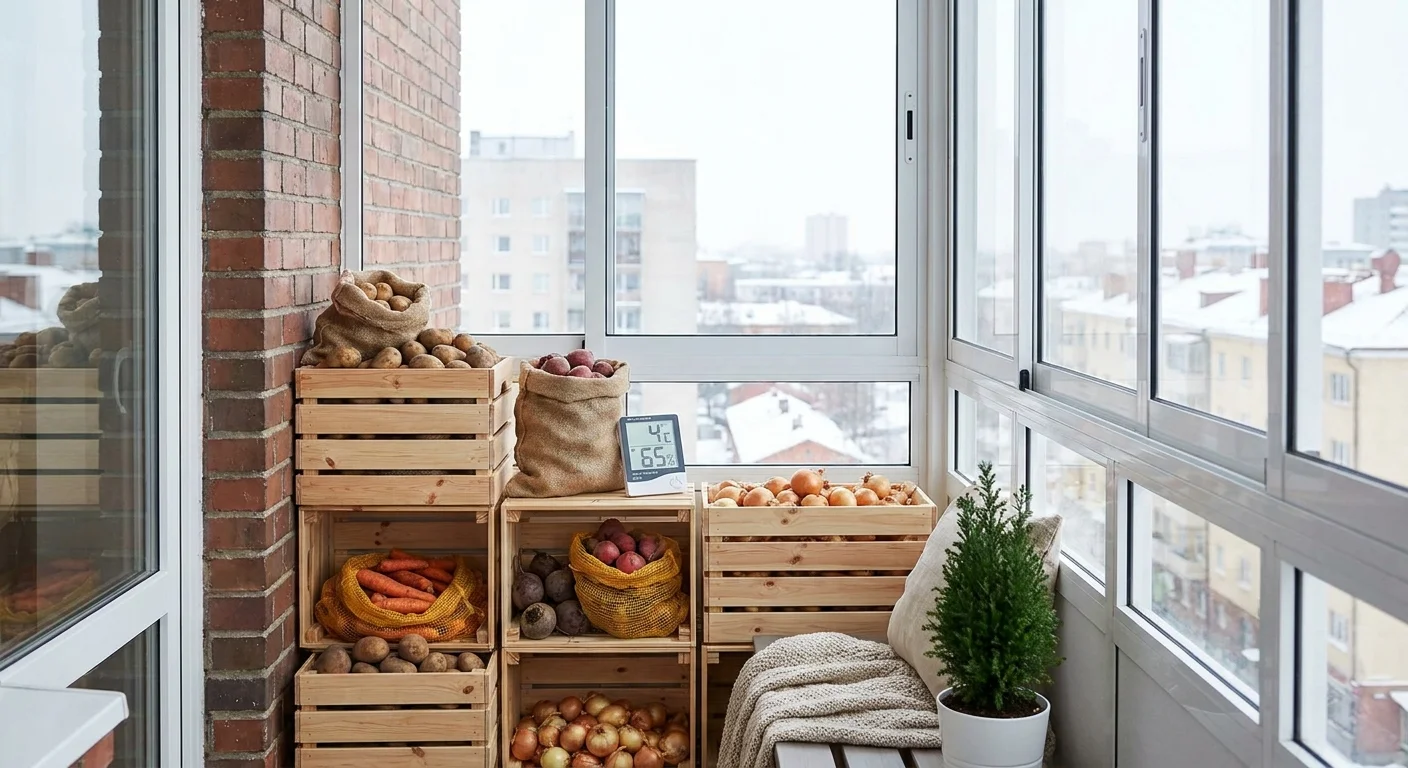
This is the best option for potatoes, beets, and carrots. Place a wooden or dense plastic box on a stand 5–10 cm high so the bottom doesn't freeze. The box is insulated with foam board, cardboard, or an old blanket, but be sure to leave small ventilation holes. In severe frosts, a thermal cover or a second larger box with insulation between the walls will help.
Pantry and Hallway
Dry onions store better at room temperature if there's no radiator or stove nearby. Mesh bags, woven baskets, boxes with holes, or cardboard boxes with slits are suitable. Don't pile onions higher than 20–25 cm: the lower bulbs will sweat.
Dark Cabinet or Box
If there's no balcony, potatoes can be kept in the coolest dark cabinet near the entrance door, but it's better to buy them in small batches of 10–15 kg. Carrots quickly wilt in such conditions, so it's worth storing them in a box, layering with slightly damp sand, hardwood sawdust, or wrapping a few pieces in paper. Humidity shouldn't turn into a wet environment: water droplets cause rot.
What to Buy for Vegetable Storage?
You don't need to equip a home warehouse like a farm storage facility. A few inexpensive items are enough to help maintain order and control conditions.
- Mesh bags for onions: provide air circulation and allow you to notice spoiled onions immediately.
- Wooden or plastic boxes with holes: suitable for potatoes, beets, and carrots.
- Opaque boxes with lids: protect potatoes from light; the lid shouldn't be airtight.
- Thermal cover or insulation: needed for the balcony box during frosty weeks.
- Hygrometer with thermometer: helps you not guess why vegetables spoil. An inexpensive device will show temperature and humidity on the balcony or in the pantry.
- Paper bags and cardboard: useful for separating small batches and protecting against condensation.
Don't store supplies in tied plastic bags. Condensation quickly collects inside, especially with temperature changes. It's the damp environment that often causes carrots and onions to be stored with big losses.
What to Do If Vegetables Start Spoiling?
Do a check-up once a month, and in the first 6–8 weeks after purchase, every two weeks. Sort through vegetables with your hands, not just look at the top layer. One rotten tuber can spoil the whole box.
- If potatoes have short sprouts, move the box to a cooler, darker place, remove the sprouts, and use the tubers in the coming weeks.
- If potatoes become soft, wet, or smell rotten, throw them out and check neighboring tubers. Wash the box and dry it completely.
- If onions are damp, spread them in a single layer on paper for 2–3 days in a dry room, then return them to mesh bags in small portions.
- If carrots are wilting, move them to a box with slightly damp sand or wrap them in paper and transfer to a cooler place.
- If beets have frozen, don't leave them for storage: after thawing, cook borscht, roast them, or freeze them ready-made.
The most profitable purchase of vegetables for winter is not the maximum, but the calculated one. Make a list of crops, distribute the volume across storage places, and plan the date of the first check-up. For this, you can create a family list in Pickt: add the number of bags, note who buys boxes or a thermal cover, and avoid duplicate purchases. A little preparation in autumn will preserve both vegetables and money until spring.