Shopping List vs. Impulsive Spending: How Much You Overpay
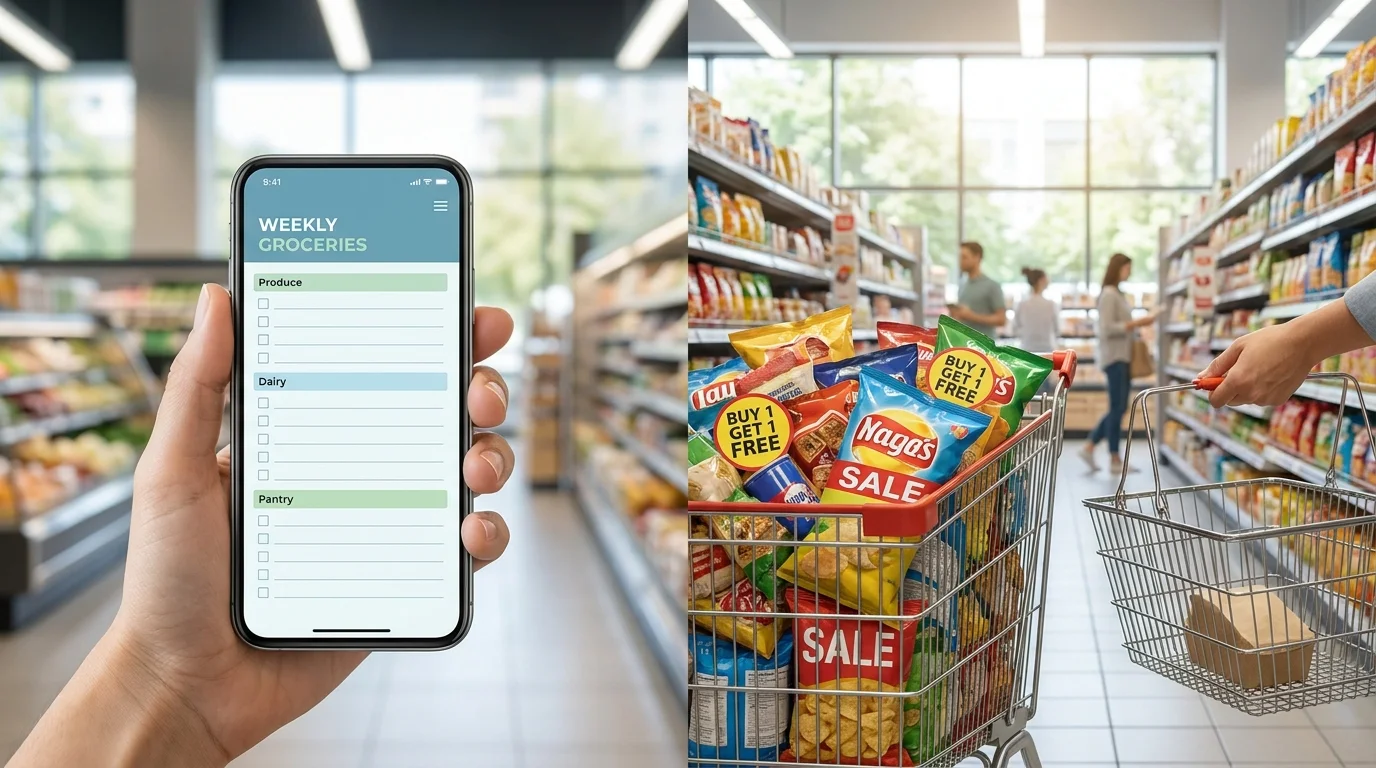
In short, in the battle between a shopping list and impulsive spending, the list almost always wins: it reduces unnecessary purchases, saves time, and helps you stick to a budget. Impulsive spending is sometimes appropriate—for example, when you consciously allocate a 'fun fund' or try a new product. But for regular shopping (home, family, daily needs), a list is the simplest way to stop overpaying.
Below is a comparison based on numbers and habits: where the extra 5–30% in your bill comes from, how to spot it, and what to do on your next trip to the store.
Why Impulsive Purchases So Easily Inflate Your Bill
An impulsive purchase is a 'here and now' decision without a predetermined need. It is most often triggered by an external stimulus: a discount, bright display, smell of baked goods, a 'today only' offer, or simply fatigue after a workday.
The problem isn't one chocolate bar. The problem is accumulation: 2–3 small 'why not' items on each trip add up to a noticeable amount at the end of the month.
- The Discount Effect: Your brain registers the 'savings,' not that the purchase wasn't needed.
- The Hunger Effect: A hungry shopper is more likely to buy extras and choose more caloric/expensive items.
- The Fatigue Effect: The more decisions you've already made that day, the easier it is to agree to 'quick' purchases.
- The 'Just in Case' Effect: Especially common with non-perishable goods and household chemicals.
The related query 'how to stop buying unnecessary things at the store' almost always comes down to one thing: reducing the number of decisions made on the spot. A list does exactly that.
How Much You Overpay Without a List: Benchmarks and a Quick Calculation
Only tracking gives an exact figure, but there are practical benchmarks. In real life, 'extras' usually look like 1–5 unplanned items per trip. Even if each is inexpensive, the monthly total is significant.
Quick overpayment calculation:
- Recall your average bill (e.g., $30) and shopping frequency (e.g., twice a week).
- Estimate the share of impulsive purchases: a conservative estimate is 5–10%, a common one is 15–25%.
- Multiply: $30 × 8 trips × 10% = $24 per month 'on autopilot.'
If you have a family and larger shopping trips, the overpayment grows proportionally. And if some impulsive purchases are later thrown away (expired, disliked, duplicate), that's a double loss: money + waste.
The related queries 'how to save on groceries' and 'how to make a shopping list' converge on one point: planning reduces unnecessary items and cuts down on food waste.
Comparison: Shopping List vs. Impulsive Spending (Table)
To make it easier to choose an approach, let's compare two scenarios across clear criteria. The table is useful on its own—you can open it before going to the store and check yourself.
| Criterion | Shopping with a List | Impulsive Purchases |
|---|---|---|
| Final Bill | More stable, usually lower due to fewer 'extras' | Often higher due to unplanned items |
| Time in Store | Faster: fewer decisions on the spot | Longer: more wandering and comparing |
| Risk of Buying Duplicates | Low, especially with a shared list | High: 'I think we ran out at home' |
| Food Waste | Less: you buy for specific meals/plans | More: you buy 'just in case' |
| Budget Control | High: you see what and why you're buying | Low: spending creeps up unnoticed |
| Emotions and 'Joy' | Can be built in: a separate 'treat/new item' line | Lots of spontaneous joy, but often with guilt |
| Suitable for Family/Roommates | Yes: easier to divide purchases and avoid repeats | Difficult: everyone buys their own, resulting in chaos |
How a Shopping List Reduces Impulsive Spending: 5 Practical Mechanisms
A list is not a 'ban on pleasure,' but a tool that solves part of the problem in advance. Each mechanism below works individually, and together they significantly reduce overpayment.
- Intention Lock-In: When an item is written down, you are less susceptible to random triggers.
- Choice Limitation: Fewer comparisons mean less fatigue, which means fewer spontaneous 'add-ons.'
- Duplicate Protection: A list is external memory. It reduces 'just in case' purchases.
- Meal Plan Linkage: A list based on 3–5 meals for the week drastically reduces 'mystery' products.
- Shared Synchronization: If you're not shopping alone, a shared list eliminates chaos and repeat purchases.
A shared list that updates in real-time works best: one person adds milk, another sees it and doesn't buy a second carton. The free mini-app Pickt in Telegram is great for this—shared shopping lists synced between family members, couples, or roommates (bot: @PicktBot, link: t.me/PicktBot/app).
How to 'Allow' Impulses Without Blowing Your Budget: The 90/10 Rule and a Buffer List
A complete ban on impulsive purchases often backfires: 'I broke down and bought a lot.' It's better to manage impulses than to fight them.
The 90/10 Approach: 90% of purchases from a list, 10% for spontaneous desires within a limit. The limit can be set by money (e.g., $5–10 per trip) or quantity (1–2 items).
The Buffer List: Add a separate 'treat/new item' line to your list and define its boundaries in advance. This turns an impulse into a plan, not a hole in your budget.
- If you crave sweets, plan for 1 dessert per week.
- If you're drawn to experiments, allow 1 new product instead of three.
- If a discount is 'too good to pass up,' only buy what you regularly use anyway.
This section is important for the query 'how to control food expenses': control is not about asceticism; it's about rules.
Mini-Guide: How to Make a List That Actually Works
A list doesn't have to be perfect. It needs to be short, clear, and convenient at the moment of purchase—otherwise, you'll stop using it.
Step 1. Start with a Weekly Base
Write down 10–15 staple items: grains, eggs, milk, vegetables, household basics. This is the framework that saves time and reduces the chance of 'suddenly running out.'
Step 2. Link It to 3–5 Meals
Choose a few simple dishes and list their ingredients. This way, you buy products 'in a set' rather than random items that don't come together for dinner.
Step 3. Organize by Department
Vegetables/fruits, dairy, meat/fish, pantry, frozen, household. The less you wander through the store, the fewer random temptations you face.
Step 4. Add an Impulse Limit
One 'treat' line or a spending limit—and you don't feel deprived, but you also don't overpay.
Step 5. Make the List Shared
If multiple people do the shopping, a shared list saves money on duplicates and forgotten items. Pickt makes it easy to manage and share such a list right in Telegram, with changes visible to everyone instantly.
What to Choose: Recommendations for Different Situations
Below is a practical choice without moralizing. The point isn't to 'never buy spontaneously,' but to stop overpaying where it doesn't bring you value.
- Family, shared budget, lots of shopping: Choose a shopping list (preferably shared). It reduces duplicates, helps with meal planning, and keeps expenses predictable.
- Living with a partner/roommates and shopping in turns: A list is essential, otherwise overpayment usually comes from repeat purchases and forgotten items.
- Single person, rare trips, small bill: A list is still beneficial, but you can allow 1–2 impulsive items within a limit.
- Traveling, unusual products, 'want to try': Impulses are okay, but keep a basic list (water, snacks, toiletries) to avoid overpaying on small things.
- You're emotionally burned out and shopping is a mood booster: Keep a 'fun fund,' but put the rest on a list. This way, the joy remains, and financial anxiety decreases.
Conclusion
In the comparison 'shopping list vs. impulsive spending,' the list almost always saves money, time, and nerves because it reduces on-the-spot decisions and protects against repeat purchases. Impulses can stay—but as a managed limit, not as a habit that quietly inflates your bill. Start simple: a basic list + 3–5 meals + one 'treat' line.
Frequently Asked Questions
Does a shopping list always save money?
Most of the time, yes, because it reduces unplanned items and duplicates. But savings are maximized if the list is linked to a meal plan and you don't shop hungry.
How do I remember to keep a list if we shop in turns?
A shared list that's always on hand helps. It's convenient when it's on your phone and synced between all participants—so everyone sees the current items and checkmarks.
What if I still feel drawn to spontaneous purchases?
Don't ban them completely: set a limit (e.g., $5–10 or 1–2 items) and add a separate 'treat' line to your list. This way, you control the amount without losing the feeling of freedom.
How can I quickly figure out how much I'm overpaying on impulses?
Take 3–5 recent receipts and mark items that weren't planned. Add up their cost and multiply by the number of shopping trips per month—you'll get an approximate price of your impulses.