How Much a Family Spends on Groceries in 2026: Figures and Norms
In 2026, an average family of 3 in Russia spends about 35,000–55,000 ₽ per month on groceries when shopping at supermarkets and partly at markets. The norm is usually considered to be in the range of 30–45% of the family budget (depending on the region and income). If your spending is noticeably higher, the problem is almost always frequent 'top-ups', deliveries, and waste.
Average Grocery Spending in 2026: Benchmarks by Family Composition
To understand if your spending is 'normal', it's important to compare yourself not to an abstract 'average family', but to a household of a similar size. In 2026, the difference between 1, 2, and 4 people is not just larger portions, but also a different set of purchases: snacks, dairy, fruit, school expenses.
Below are practical benchmarks for monthly grocery expenses (excluding restaurants). These are the ranges most commonly seen with a standard diet and 1–2 'expensive' categories (coffee, cheese, fish) in the basket.
- 1 adult: 12,000–22,000 ₽/month
- Couple (2 adults): 22,000–38,000 ₽/month
- Family of 2 adults + 1 child: 35,000–55,000 ₽/month
- Family of 2 adults + 2 children: 45,000–75,000 ₽/month
If your question is how much a family spends on groceries in 2026, then the 'key figure' for a typical family of three most often lies around 45,000 ₽/month with regular shopping trips 1–2 times a week and no daily deliveries.
Norms Table: Budgets by 'Economy / Standard / Comfort' Level
The same family size can spend twice as much for different reasons: the share of ready-made food, brand preferences, frequency of waste, the habit of buying 'in reserve'. To make the comparison fairer, use budget levels.
The table below shows benchmarks for 2026 for a family of 3 (2 adults + 1 child) by consumption level. These are not 'correct' amounts, but a convenient scale for self-checking.
| Level | Grocery Budget/Month | What's Usually Included | Red Flags for Overspending |
|---|---|---|---|
| Economy | 30,000–40,000 ₽ | Basic categories, home cooking, sales, seasonal vegetables | Frequent 'top-ups' of 300–700 ₽ almost every day |
| Standard | 40,000–55,000 ₽ | Balanced, 1–2 'expensive' items, sometimes convenience foods | Delivery 2–4 times a week, lots of snacks |
| Comfort | 55,000–75,000 ₽ | More fish/cheese/berries, branded products, ready-made food | Waste and discards of 3,000–8,000 ₽/month |
If you are in the 'comfort' level, that's not a problem in itself. The problem is when spending is high, but you feel like 'there's no food at home'. This is almost always a sign of chaotic shopping and duplicate items.
What Expenses Depend On: Region, Shopping Format, and 'Hidden' Categories
In 2026, spending is most strongly influenced not by 'whether you like meat', but by where and how you buy. The difference between planned shopping and spontaneous trips can be 15–30% of the budget, even with the same set of products.
Three main factors:
- Region and logistics: In large cities, the share of ready-made food and deliveries is higher, while in remote regions, fruits, fish, and imports are more expensive.
- Format: Hypermarkets/discount stores are usually 5–15% cheaper than 'corner stores' for a comparable basket.
- Basket structure: Cheeses, coffee, sweets, snacks, drinks, and ready-made food easily add 8,000–20,000 ₽/month for a family of 3.
A hidden category often not counted as 'groceries' is water, juices, soda, coffee to go. If 2 people in a family buy a 200 ₽ drink daily, that's about 12,000 ₽ per month. In the context of the question 'how much is spent on food per month', it is often these habits that provide the unexpected answer.
Consumption Norms: How Much Food a Family Needs Per Month (Practical Checklist)
Norms are useful not for strict gram counting, but to see imbalances: 'why do we buy 10 packs of cookies and forget about vegetables'. For a family of 3 over 4 weeks, you can aim for these ranges (considering home cooking).
- Vegetables and fruits: 35–55 kg/month total (closer to the upper limit in season).
- Meat/poultry: 6–10 kg/month (part can be replaced with legumes).
- Fish: 1.5–3 kg/month (if eaten 1–2 times a week).
- Dairy products: 18–30 l/kg/month (milk, kefir, yogurt, cottage cheese, cheese).
- Grains/pasta/bread: 6–12 kg/month (depends on activity and habits).
- Eggs: 30–60 pcs/month.
If you actually buy significantly more, but part of it spoils, that's a direct savings reserve. Even 5% waste on a budget of 50,000 ₽ is 2,500 ₽ per month or 30,000 ₽ per year.
How to Know If You're Spending Too Much: Quick Tests and Control Figures
When people search for how much a family spends on groceries in 2026, they usually want not an 'average temperature', but a clear marker: is it time to change something? Here are simple tests that almost always work.
Test 1: Share of Groceries in Income
If groceries take up more than 45–50% of your income, the budget is likely overloaded. The exception is temporary situations (mortgage, maternity leave, sharp income drop), but even then, it's useful to organize purchases.
Test 2: Frequency of 'Small' Purchases
If you go to the store almost daily 'for milk' and leave with a bag worth 800–1,500 ₽, the month easily balloons by 10,000–20,000 ₽ without any noticeable improvement in your diet.
Test 3: Repeated Purchases of the Same Items
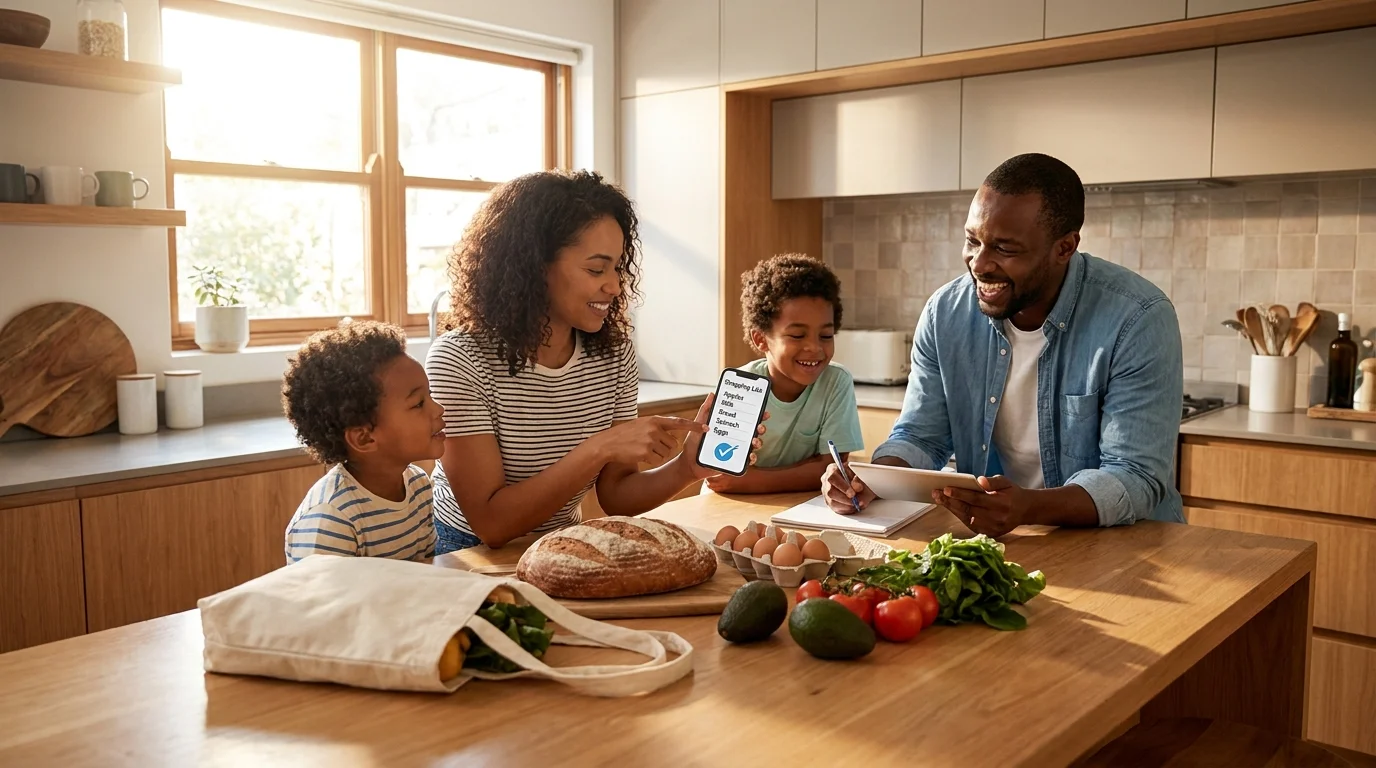
Duplicates are the main enemy of the family budget: there's already rice, oil, and cookies at home, but different family members buy them again. A shared list showing what's already been bought helps here. For example, in the free mini-app Pickt in Telegram (bot @PicktBot, link: t.me/PicktBot/app), the list syncs in real-time, and the chance of 'buying a second ketchup' noticeably decreases.
How to Reduce Spending by 10–20% in 2026 Without Strict Economy
It's better to start reducing expenses not with deprivation, but with a system. A realistic goal for 2026 is minus 10–20% over 4–6 weeks through planning and reducing waste, not by eating 'buckwheat every day'.
- Limit deliveries: Set a limit of 1 time per week. Delivery often increases the bill by 10–25% due to impulse items.
- Introduce a 'big shop': 1 time per week + 1 short top-up. This makes it easier to control the budget and menu.
- The 3-category rule: In each shop, always include vegetables/fruits, protein (meat/fish/legumes), and a basic 'filler' (grains/bread). This reduces snacking and chaos.
- Track waste: Once a week, note what you threw away and how much it cost. Aim to keep waste under 1,000–2,000 ₽/month for a family of 3.
- Replace 1–2 'expensive' items: For example, replace some cheese with cottage cheese, some sausage with baked chicken. The savings often amount to 3,000–7,000 ₽/month without feeling 'deprived'.
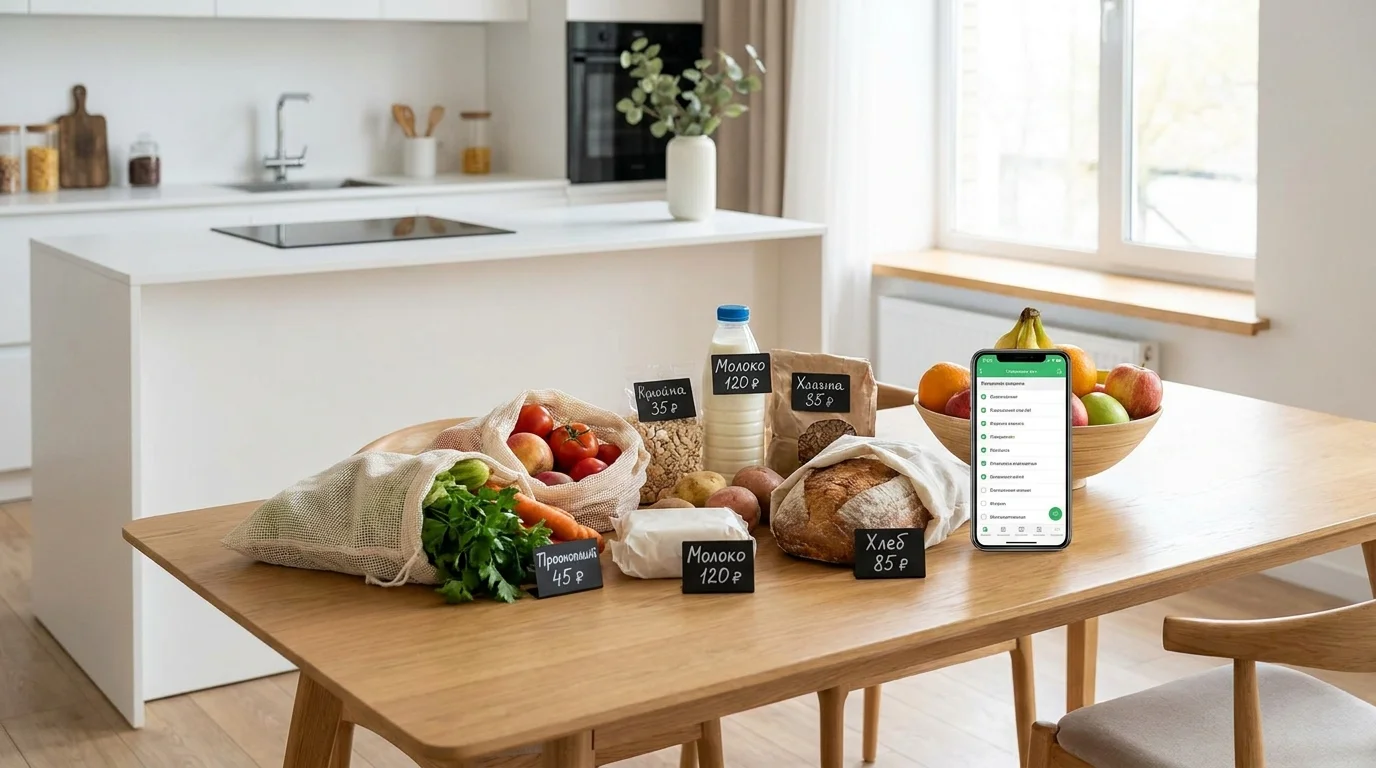
Technically, this is easier when the list is shared and updated instantly for everyone. In Pickt, it's convenient to divide the list by categories (vegetables, dairy, household) and mark purchases on the go, to avoid buying extra and arguing about 'who was supposed to get what'.
Conclusion
In short: in 2026, a family of 3 most often spends 35,000–55,000 ₽ per month on groceries, and a normal benchmark for the budget share is 30–45%. The biggest money leaks are daily 'top-ups', delivery, drinks/snacks, and waste. Get your shopping in order, and savings of 10–20% are usually achieved without stress or compromising your diet.
Frequently Asked Questions
How much is spent on groceries per month per person in 2026?
The benchmark is 12,000–22,000 ₽/month per adult with home cooking. In large cities and with frequent deliveries, the amount is more often closer to the upper limit.
What share of the budget for food is considered normal?
The range 30–45% of income is often used. If it consistently exceeds 50%, it's worth reconsidering the shopping format and eliminating impulse spending.
How can I quickly tell if we're overpaying, even without detailed tracking?
Check two signs: you go to the store almost every day and regularly throw away food. This alone usually means overspending by 10–30%.
What inflates the grocery budget the most in 2026?
Most often — delivery, ready-made food, drinks and snacks, as well as duplicate purchases within the family. A shared shopping list with 'bought' checkmarks helps eliminate duplicates and reduce chaos.