Winter Preserves Shopping List 2026: What to Buy for Canning
The winter preserves shopping list is a ready-made checklist for home canning: jars and lids, sugar and salt, vinegar and spices, sterilization tools, and freezer packaging. It is especially useful in the 2026 season, when vegetables and fruits are cheapest and tastiest, and it is convenient to make purchases in one 'basket' for a family, a couple, or with neighbors.
Below is a practical list covering the main types of preserves: jams and compotes, marinades and pickles, sauces and adjika, as well as freezing and drying. Check off items as you buy them and adjust according to your recipes.
1) Containers and Consumables: Jars, Lids, Labels
This section is the foundation. Even perfect vegetables won't save you if you lack the right lids or jars of the correct volume.
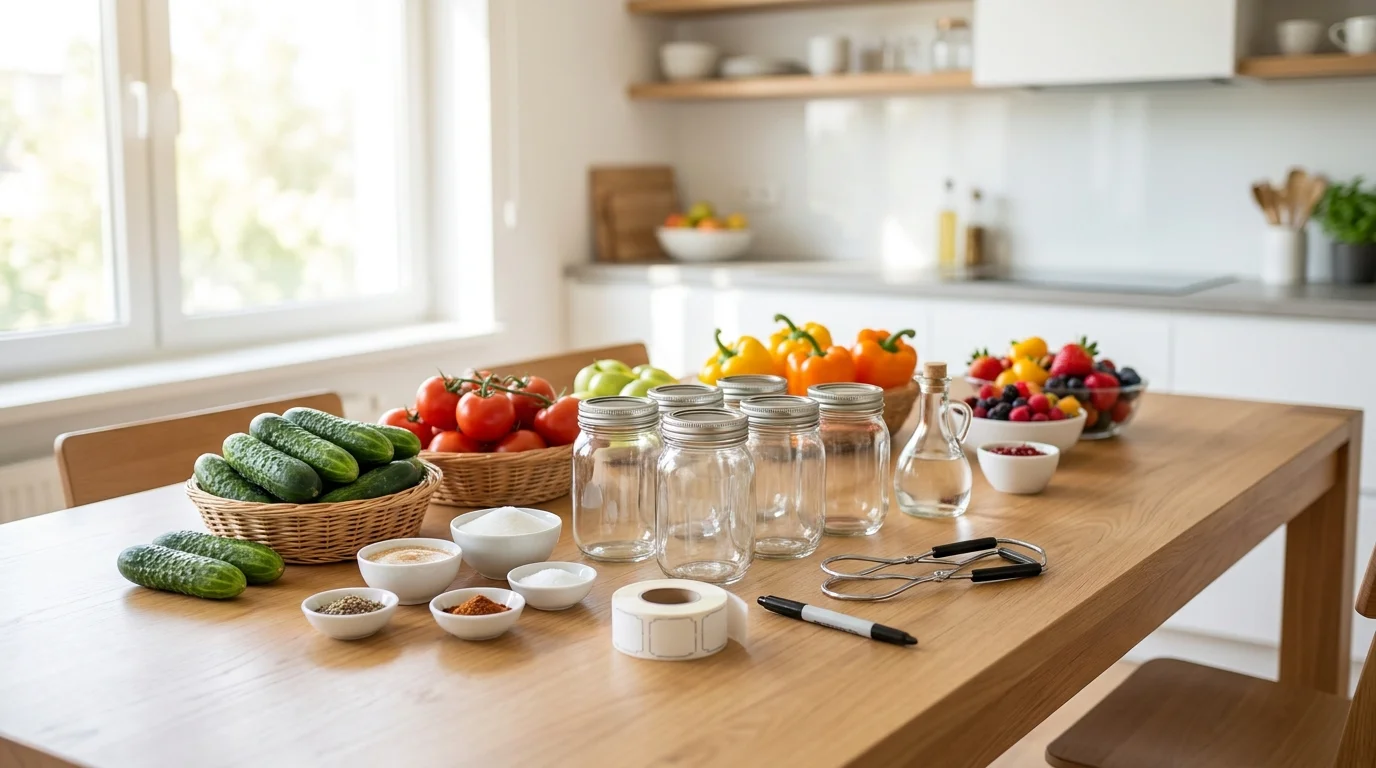
- Glass jars: 0.5 L (sauces, salads), 0.7–1 L (cucumbers/tomatoes), 1.5–3 L (compotes). Choose ones with a smooth neck and no chips.
- Lids: screw-on (Twist-Off) for corresponding jars and/or metal lids for sealing. Buy with a 10–15% surplus.
- Can sealer (if using regular lids): check the movement and pressure tightness in advance.
- Gaskets/seals (if you have reusable systems): replace each season.
- Labels or painter's tape + marker: to label 'what it is' and the date (e.g., 'Lecho 08.2026').
- Jar funnel: less spillage, cleaner neck.
- Jar tongs or oven mitts: safer to remove from pot/oven.
Time-saving tip: create a shared list 'Canning 2026' in the Pickt Telegram mini-app and distribute purchases among participants. This way, you won't buy three packs of lids and forget the funnel. You can open it via t.me/PicktBot/app.
2) Basic Canning Ingredients: Sugar, Salt, Vinegar
If you are looking for what to buy for winter preserves first, start with the universal 'basics.' They work for almost any recipe and do not depend on what is available at the market this week.
- Sugar: for jam, compotes, ketchup, lecho. It is convenient to buy a bag/pack with a surplus (often more is used than expected).
- Salt: coarse rock salt without additives — for pickling and marinades; fine salt — for sauces. Iodized salt is usually not used for classic canning.
- Vinegar: 9% (classic for marinades) and/or apple/wine vinegar (for a milder taste). Citric acid is also useful.
- Vegetable oil: refined for lecho, salads, caviar.
- Honey (optional): for unusual marinades and sauces.
- Gelfix/pectin (optional): if you want less sugar in jam and a more stable texture.
Mini-check before buying: estimate the approximate volume of preserves (e.g., 20 jars of 0.7 L) and calculate the consumption of sugar/salt according to your favorite recipes. This helps to create an accurate list of canning products, rather than 'by eye.'
3) Spices and Additives: The Flavor That Makes Your Preserves 'Yours'
This section can be read separately: if you already have jars and vinegar, it is the spices that turn a standard marinade into a signature one.
- Bay leaf, black peppercorns, allspice — a universal set.
- Cloves, cinnamon — for compotes, jam, marinades with a 'warm' note.
- Mustard (seeds/powder) — for cucumbers, zucchini, mixed pickles.
- Paprika, smoked paprika, coriander — for lecho, adjika, sauces.
- Garlic, dill umbels/seeds, currant/cherry leaves (in season) — for crunchy cucumbers and pickles.
- Hot pepper (fresh/dried) — for those who like it 'hotter.'
Practice: it is more profitable to buy spices in small packages, but fresh ones. Old spices lose their aroma and 'smear' the taste even of high-quality vegetables.
4) Vegetables, Fruits, and Berries: What to Buy in the 2026 Season
The main principle of seasonal preserves: buy at the peak of flavor and price, not 'when it appears in the store.' In 2026, this is especially relevant: even 1–2 weeks of seasonal difference noticeably affect the sugar content and density of the fruit.
Vegetables for Marinades, Salads, and Sauces
- Cucumbers: small, firm, same size — easier to pack and marinate more evenly.
- Tomatoes: plum tomatoes for sauces and whole-fruit canning; meaty ones for lecho and adjika.
- Bell peppers: for lecho, salads, freezing in pieces.
- Zucchini/pattypan squash: young ones for marinades and 'caviar.'
- Eggplants: for salads and appetizers (check they are not limp).
- Cabbage: white cabbage for sauerkraut, cauliflower for marinades.
- Carrots, onions: base for dressings, sauces, salads.
Fruits and Berries for Jam, Jams, and Compotes
- Apples: compotes, apple butter, fruit leather; some can be dried.
- Pears: compotes and jam (good with cinnamon).
- Plums: jam, sauces (including tkemali type).
- Apricots/peaches (depending on region): jam, compotes.
- Strawberries, raspberries, currants, cherries: jams, freezing, compotes.
How to choose: for whole-fruit canning, take firm fruits without cracks; for sauces, softer ones are fine, but without mold or fermentation. Immediately plan what will go into jars and what will be frozen: this saves time in the kitchen.
5) Tools and Safety: Sterilization, Thermometer, Cleanliness
If you are making preserves for the first time, this section is your 'anti-stress.' It helps to avoid the most common problems: bulging lids, cloudy brine, and leaks.
- Large pot or tank for sterilization: so that jars stand steadily and water covers them up to the shoulders.
- Rack/towel on the bottom: jars should not knock against the metal.
- Kitchen thermometer (optional but useful): for syrups, jams, and temperature control.
- Slotted spoon, ladle, measuring spoons: precision is important for marinades.
- Knives + cutting boards: a separate board for garlic/hot pepper to avoid transferring smells.
- Gloves: especially for hot pepper and beets.
- Baking soda/soda cleaner: for jars and lids (without strong fragrances).
Mini-rule: first prepare the containers and tools, and only then wash/cut the vegetables. This way, you do not keep the products extra time in the warmth and reduce the risk of spoilage.
6) For Freezing and Storage: Bags, Containers, Stock Organization
Winter preserves are not only jars. Freezing is often faster and preserves flavor, and proper storage helps not to 'lose' anything on the far shelves.
- Freezer bags with zip-lock: convenient for portioning and labeling.
- Containers (plastic/glass): for berries, purees, broths, sauces.
- Plastic wrap and aluminum foil: for airtightness and protection from drying out.
- Parchment paper: for freezing berries/dumplings 'loose' before packaging.
- Vacuum bags (optional): less 'freezer burn' and better shelf life.
- Boxes/crates for the pantry: group by type (compotes, cucumbers, sauces) and by year (2026).
Organization: label not only 'what' but also the volume/portion ('borscht base 300 g'). And so that everyone at home can see the current leftovers, it is convenient to keep a shared list for winter preserves in Pickt and mark what has already been done and what needs to be bought additionally.
Conclusion. A good list for winter preserves in 2026 is a combination of containers, basic ingredients, spices, seasonal vegetables/fruits, and tools for safe sterilization, plus freezer packaging. Put together a checklist in advance, stock up on 'long-lasting' items (lids, sugar, vinegar), and buy seasonal products at their peak. This way, you will save time, money, and get a stable result.
Frequently Asked Questions
- Question: Where should I start if I am making preserves for the first time?
Answer: Start with something simple: cucumbers/tomatoes in marinade and 1–2 types of jam. Buy 0.7–1 L jars, lids with a surplus, sugar, salt, vinegar, and basic spices (bay leaf, peppercorns). - Question: Which jars are more convenient — screw-on or for sealing?
Answer: Screw-on jars are easier to use at home and do not require a machine, but it is important that the jar and lid match in type. For sealing, lids are often cheaper and easier to find in season, but you need a working can sealer. - Question: How many lids should I buy for the season?
Answer: The number of planned jars plus 10–15% for defects/deformation and 'unexpected' batches of preserves. If you are making a lot, it is better to buy extra in advance while there is a selection. - Question: How to quickly put together a shared shopping list for canning for the family?
Answer: Break the checklist into sections (containers, ingredients, vegetables/fruits, tools) and assign responsibilities. It is convenient to keep such a list in the Telegram Mini App Pickt so that everything is synchronized in real time and no one buys the same thing twice.