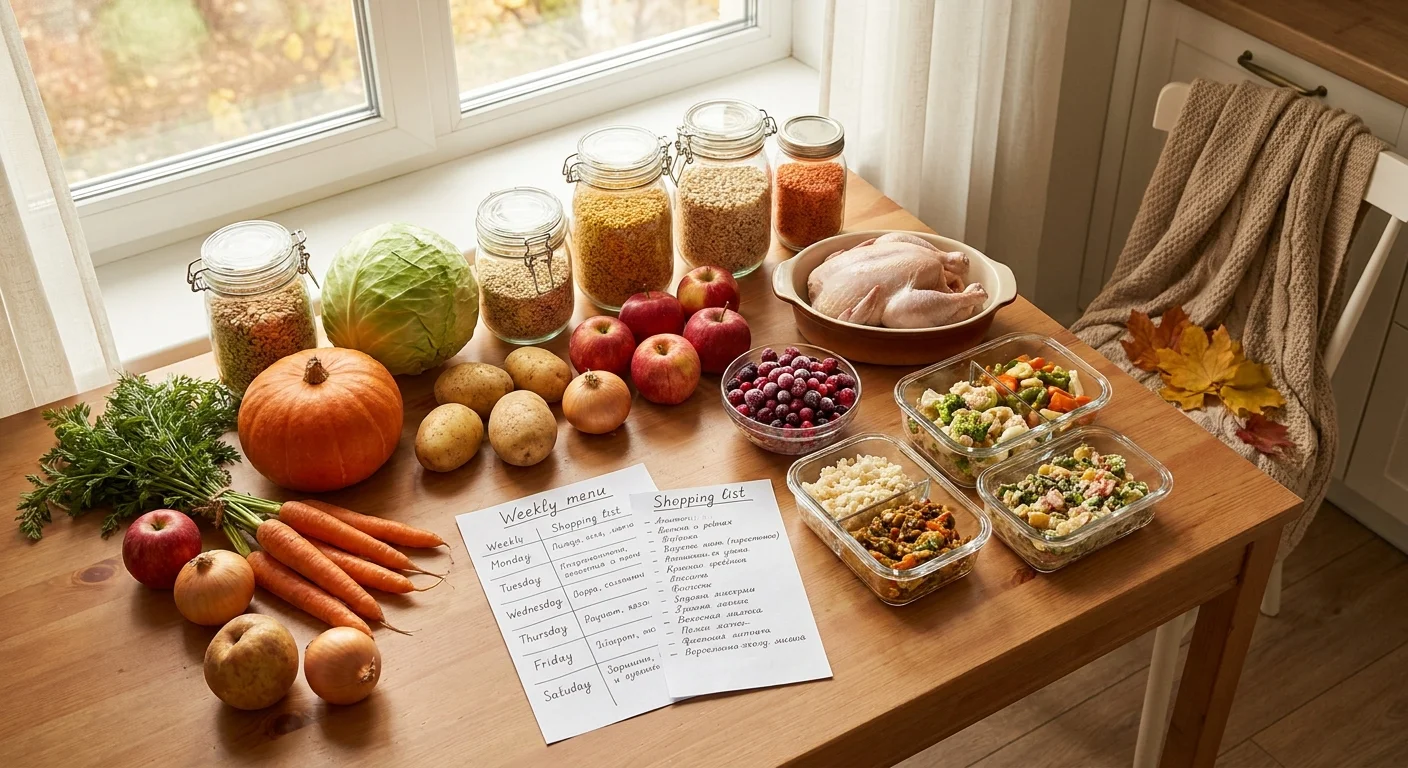
A family shared shopping list is not only for those living under the same roof. When loved ones are in different cities or countries, it solves even more problems: it helps remember medications for parents, gather purchases for a student, prepare things for a long-awaited meeting, and fairly split expenses.
Distance often turns simple household matters into long conversations: "Did you order yet?", "Do we still need tea?", "Did I transfer the money or was I just about to?" One clear list restores a sense of order and involvement in each other's lives. It doesn't matter if you live in different cities, your spouse is on a business trip, or adult children have moved to another country: you can plan purchases together.
Why a shared list if you live in different cities?
The main value of such a list is not in the items themselves, but in peace of mind. You see what your loved one really needs, can help in time, and don't waste energy on dozens of clarifying messages. A shared shopping list at a distance is especially useful when a decision needs to be made quickly, and there's no opportunity to discuss everything by voice.
- Meeting after separation. One relative is visiting and prepares in advance what is hard to buy or expensive to order in another city.
- Delivery to elderly parents. Parents add familiar products, household items, and medications, while children place an order at a nearby store or pharmacy.
- Support for a student. A child in a dormitory marks needed items, and parents help with groceries, school supplies, and seasonal clothing.
- Joint gift. Brothers, sisters, and friends add options, set a budget, and mark who has already bought their part.
It's most convenient to divide a family shopping list across different cities into clear sections: "For Mom," "For the Student," "For the Meeting," "Joint Gift," "Order with Delivery." Then each participant immediately understands which items concern them and which can simply be kept in view.
For example, in Pickt, shared shopping lists open directly in Telegram via a link: no separate app installation is needed. All participants see changes immediately, which is especially convenient for relatives in different countries and with different phones.
How to organize the list to avoid buying anything twice
Duplicates usually appear not from carelessness, but from the lack of a clear status for each purchase. One person saw a request for coffee and ordered a pack, another bought two more on the way to the store. As a result, there's a six-month supply at home, but the needed batteries are still missing.
To make a shared online shopping list work without confusion, agree on simple rules:
- write each item as specifically as possible: not "vitamins," but "vitamin D, 2000 IU, pack of 60 capsules";
- indicate quantity, preferred brand, or acceptable substitute;
- add a note about who the purchase is for;
- after placing an order, immediately set the status to "bought" or "ordered";
- if an item can't be found, write a comment rather than silently deleting it;
- for expensive purchases, add an approximate price and a link to the option.
It's useful to divide statuses into "need to buy," "in cart," "ordered," "bought," and "delivered." This is especially important when several people are involved in the purchase. A sister can order a gift, a brother can pay for delivery, and parents can receive the package. When the stages are visible to everyone, you don't have to find out where the order is.
How to agree on money so you don't have to count every time?
Financial arrangements are best discussed in advance, while the expenses are small and familiar. Then help doesn't turn into an awkward conversation, and purchases don't cause resentment over unspoken expectations.
Several models work for regular expenses. The first is a fixed monthly amount: for example, adult children send parents a certain budget for groceries and pharmacy. The second is reimbursement by receipts: one buys, the other returns their share after the order. The third is splitting categories: one person pays for delivery and household items, another for groceries or medications. For gifts, a common limit is often convenient, like "up to 8,000 rubles," with pre-agreed shares for participants.
In the list itself, it's useful to indicate the approximate cost and payment method next to expensive items: "Lena pays," "split three ways," "from the common family budget." After the purchase, you can add the actual amount and a short note about the transfer. This isn't strict bookkeeping, but a way to avoid keeping numbers in your head and revisiting the same question multiple times.
| Scenario | Who maintains the list | Who buys | How money is handled |
|---|---|---|---|
| Delivery to parents | Parents add what's needed, adult child checks | The one who can arrange delivery in their city | Fixed monthly budget or paid by children |
| Purchases for a student in another city | Student maintains sections "food," "household," "studies" | Student or parents via delivery | Weekly limit or reimbursement by receipts |
| Purchases for a meeting | The one who is visiting | Each buys items with their mark | Personal purchases separately, shared ones split equally |
| Joint gift | One coordinator | Coordinator places the order | Everyone transfers their agreed share before the purchase |
| Package from another country | Recipient forms wishes | The one who travels or sends the package | Cost of goods and shipping is recorded separately |
What to do about time zone and currency differences?
If the family lives in different countries, don't rely on instant responses. It's better to make the list asynchronous: everyone adds items at a convenient time, and urgent items are marked with a special icon or the word "important." For example, medication, a charger before a trip, or baby food shouldn't get lost among ordinary wishes.
For purchases in another currency, it's useful to record two amounts: the price in the local currency and the approximate equivalent in the currency of the payer. You don't need to calculate the exchange rate to the penny—just agree on the principle: by the bank rate on the day of payment, by the average rate of the week, or with slight rounding. It's also important to separately account for transfer fees, delivery, and customs duties.
When relatives are in different time zones, a list that doesn't require a synchronous call is especially convenient. In Pickt, changes are visible to all participants in Telegram: Mom can add the needed cream in the morning her time, and her daughter will see the entry in the evening and place the order when she's free.
A "bring from another country" list: let it accumulate for months
There are purchases that aren't needed today but will be very useful at the next meeting: familiar tea, local sweets, a book in your native language, a supply of contact lenses, children's clothes of a certain brand, cosmetics, or spices. For these, it's worth keeping a separate "Bring from Another Country" list and not mixing it with current groceries.
Such a list can accumulate for months. For each item, it's advisable to indicate its importance: "must-have," "if there's space," "only if the price is good." Add size, color, link, acceptable substitute, and a comment about whether the item can be carried in luggage. Before the trip, just go through the list, check relevance, and distribute items by suitcase weight.
Example of a ready "bring at the meeting" list
- Parents' favorite tea — 2 packs, if available in the brand store.
- AA batteries for the blood pressure monitor — pack of 12.
- Unscented hand cream — 2 tubes.
- A book for the grandson in Russian, ages 8–10.
- Spices for a family recipe: smoked paprika and dried dill.
- USB-C charging cable, 2 meters long.
- Chocolate and local sweets — as a gift for neighbors.
- Contact lenses — only after confirming the prescription.
- Printed photos for grandma — 20–30 pieces.
- A small souvenir from the city: a magnet or postcard.
A shared list as a small way to be close
A shopping list won't replace a meeting, a call, or a hug. But it helps express care in very concrete things: ordering Mom the right product in time, reminding a student about warm socks, bringing your spouse their favorite coffee from a trip. It's a simple family ritual that makes the distance less noticeable.
Start with one scenario that's relevant right now: deliveries to parents, preparations for a trip, or a joint gift. Create sections, assign responsibilities, mark what's bought, and agree on money in advance. In a few weeks, the shared list will become a familiar tool that keeps the family organized and attentive to each other, no matter where loved ones are.