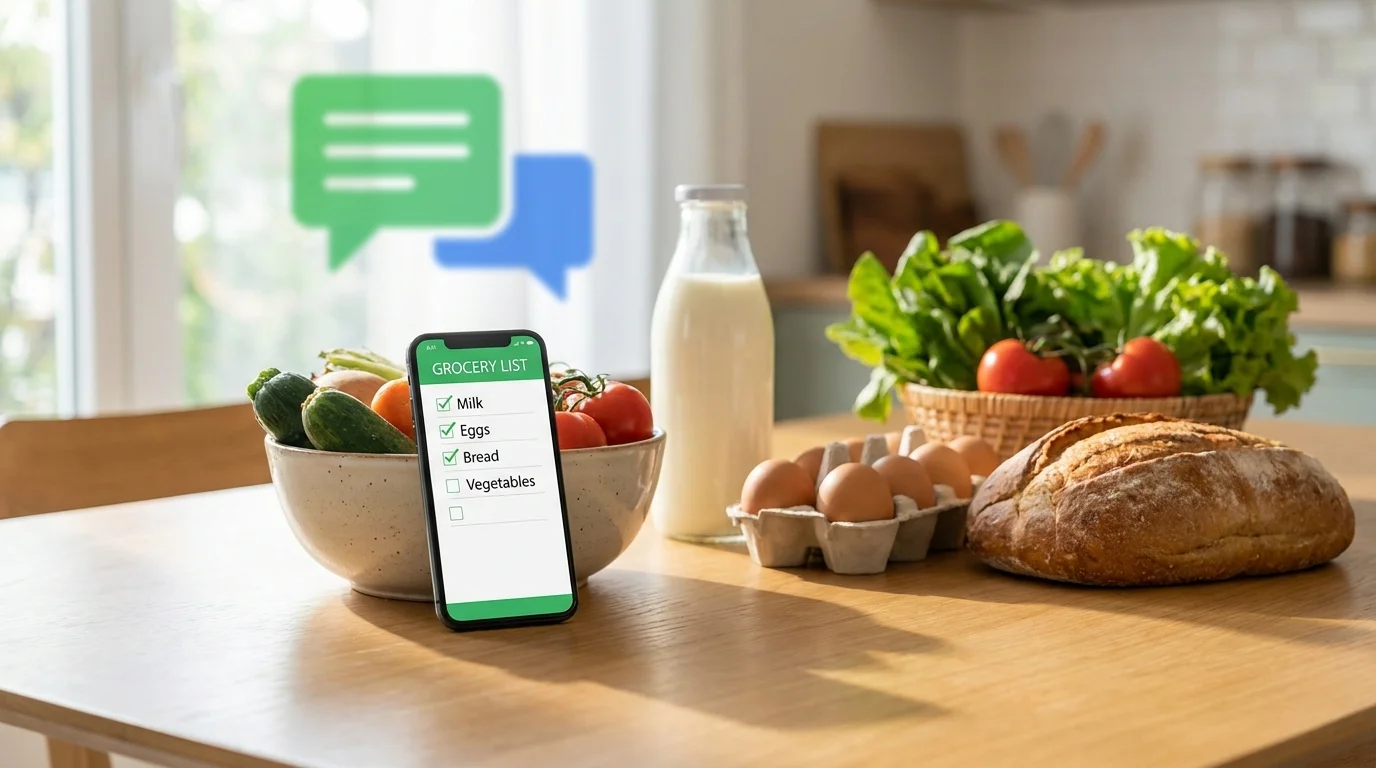

Household life rarely falls apart over a single pack of coffee or a missing tube of toothpaste. But it's precisely these small things that often build up irritation: one partner remembers that the eggs are running low at home, while the other has no idea. In the end, the familiar phrase rings out in the evening: "I told you we needed to buy it."
An even more classic scenario: you both stop by the store on your way home. One buys milk, but it was already in the fridge. Meanwhile, the dish soap—the very reason for the shopping trip—is forgotten again.
A shared grocery list for two doesn't make a relationship perfect, but it removes dozens of unnecessary sources of tension. You don't need to keep household tasks in your head, repeat them multiple times, or guess what's already been bought. It's enough to agree on a clear system and use it every day.
In this article, we'll look at why messaging doesn't replace a list, which format suits your couple, and how to build the habit without lengthy discussions.
Why Messages in a Messenger Don't Work
The first solution that comes to mind is to text your partner: "Buy bread, vegetables, and cat food." Sometimes it works. But as a permanent system, this approach quickly starts to fail.
The main problem with messages is that they get lost in the stream. After the list, work questions, memes, voice messages from relatives, or links to movies may come in. A few hours later, the needed request is far up in the chat, and it's inconvenient to search for it.
Messages also don't show relevance well. Suppose you wrote in the morning: "We need to buy rice." During the day, you stopped by the store and bought it. Your partner didn't see the update because there was no separate update—and in the evening, they bring home another package.
There's also an emotional side. When the list exists only in one person's head, they imperceptibly become the "household manager": remembering, reminding, checking, and worrying. The other partner may genuinely want to help but doesn't have access to the full picture.
A shared list shifts the conversation from "you should have remembered" to "let's see what's on our list." It's a small change in wording that noticeably reduces mutual grievances.
Three Ways to Keep a Shared Grocery List
There's no perfect method for all couples. The key is to choose an option that both will actually use, not one that looks nice only on the first day.
1. Paper List on the Kitchen
A sheet on the fridge, a notebook on the table, or a magnetic board is the simplest and most familiar method. It's especially convenient if you're often home at the same time and usually shop together.
The advantage of paper is that it's always in sight. When the tea runs out, you can immediately write "tea" without opening your phone or switching between apps. Such a list requires no registration, internet, or learning a new service.
But there's a significant downside: the paper list stays at home. If one of you is already at the store and the other notices the sugar is out, you can't add an item. It's also hard to know who has already bought groceries if partners shop at different stores or come home at different times.
Paper works as a supplementary option, but for an active lifestyle, synchronization is usually lacking.
2. Shared Note on Your Phone
Cloud notes seem like the logical next step. You can open them on your phone, edit them together, and organize items by category. Some couples use spreadsheets, others create one long note.
The advantage of notes is flexibility. You can add not only groceries but also household chemicals, medications, packing lists for trips, or gift ideas. If the service supports shared access, changes are usually visible to both.
There are downsides too. A note often turns into a long text where it's hard to quickly check off purchased items with one hand in the store. Old items stay at the bottom, new ones are added haphazardly, and accidental deletion can cause confusion. Moreover, not everyone finds it convenient to search for the right note among work notes, plans, and personal lists.
This method works if both partners like order in digital notes and are willing to maintain them regularly.
3. App with a Shared List
A dedicated app is the most convenient option for a couple that wants to make shopping a transparent part of daily life. In this format, you can quickly add items, mark them as purchased, and see changes in real time.
For example, in Pickt, you can create a shared list with a single link right in Telegram. No need to transfer items from chat to a note or remember who you've already sent access to. One person creates the list, the other opens the link—and both see the same items. If someone adds bananas or checks off laundry detergent, changes appear instantly.
The main advantage of an app is clarity. The list lives separately from the chat, so it doesn't get lost among messages. In the store, it's easy to check what still needs to be bought and immediately remove an item after purchase.
The honest downside is that you need to start a new habit. In the first few days, you might instinctively continue writing "buy bread" in the chat. But usually, one or two joint shopping trips are enough to appreciate how much easier it is to use a unified list.
How to Agree on List Rules
Even the most convenient tool won't help if the couple doesn't have simple agreements. The good news: you don't need strict regulations or long discussions. A few rules are enough to eliminate typical issues.
- The one who notices adds it. Coffee ran out, you opened the last pack of napkins, you saw an empty shelf in the bathroom—immediately add the item to the list. Don't put it off until evening and don't expect your partner to notice on their own.
- Be specific. Instead of "something for breakfast," it's better to write "oatmeal," "yogurt," or "whole grain bread." If taste, size, or brand matters, add a brief note.
- The one who puts the item in the cart checks it off. Don't wait for the checkout and don't leave marks for "later." This way, the other person immediately sees that the product is already taken and won't buy a duplicate at another store.
- Don't delete needed items without agreement. If an item seems unnecessary or expensive, it's better to discuss it rather than silently remove it from the list. This is especially important for shared plans and regular purchases.
- Separate urgent and planned items. Bread or medicine might be needed today, while spare light bulbs can wait for the next big shopping trip. Agree on how to mark urgent items—for example, by adding them to the top of the list.
- Check the list before leaving and before ordering delivery. This takes less than a minute but prevents forgotten items and extra trips.
- Clean the list regularly. Once a week or after a big shopping haul, review the remaining items. Remove outdated ones, clarify unclear ones, and keep only what's relevant.
It's important that the rules don't turn into control. The shared list isn't meant to track who did how much, but to make things easier for both. If someone forgets to check off a purchase, it's better to simply remind them of the agreement rather than turn a small thing into an argument.
Implementation Checklist for One Evening
You can set up a shared grocery list in literally 20 minutes. Don't wait for a new month, a move, or the "perfect moment"—start with the next shopping trip.
- Choose one format: paper, a shared note, or an app.
- If you choose Pickt, create a list and send your partner the link in Telegram.
- Add 10–15 relevant items that are needed at home right now.
- At least mentally divide items into groceries, household goods, and personal purchases.
- Agree: everyone adds what they notice, and the buyer immediately checks off the item.
- Define what counts as an urgent purchase and when you usually check the list.
- After the first joint or separate shopping trip, discuss what was inconvenient and simplify the rules a bit.
Don't aim to create a perfect system right away. The list can be short, without categories or complex notations. The main thing is that it's shared, clear, and always accessible to both.
Over time, the shared list becomes more than just a list of products. It's a calm way to care for each other: notice, add, buy, don't forget. And instead of the phrase "Why didn't you tell me?", a different one appears more often at home: "I already checked it off, everything's bought."