Wholesale vs. Individual: When Buying in Bulk Is Worth It
In short: bulk buying is beneficial for products with a long shelf life, stable consumption, and a clear unit price, especially when you are sure to use the entire volume. Buying individually wins when there is a risk of spoilage, no storage space, you want variety, or the 'bulk' price doesn't offer real savings. In the 'wholesale vs. individual' debate, the right choice depends on timing, frequency of use, and whether you can split the purchase.
Wholesale vs. Individual: Comparison by Key Criteria
To avoid making a decision 'by eye,' compare not the packages but the cost and risks. Below are the criteria that make it easiest to see where the savings are real and where they are illusory.
Comparison Table
| Criterion | Wholesale / Large Package | Individual / Small Package |
|---|---|---|
| Price per unit (kg/l/piece) | Usually lower, but not always | Usually higher, but promotions happen |
| Risk of spoilage/expiration | Higher (if you don't use it in time) | Lower |
| Storage needs | Requires space and containers | Minimal |
| Choice flexibility (flavor/brand/size) | Lower: 'bought it — use it' | Higher: can change |
| Frequency of store trips | Fewer trips | More trips |
| Cash flow (one-time expense) | Higher: pay more upfront | Lower: pay gradually |
| Suitable for shared purchases | Great if you can split it | Not always worth splitting |
How to Calculate Real Savings: Unit Price and 'Cost of Losses'
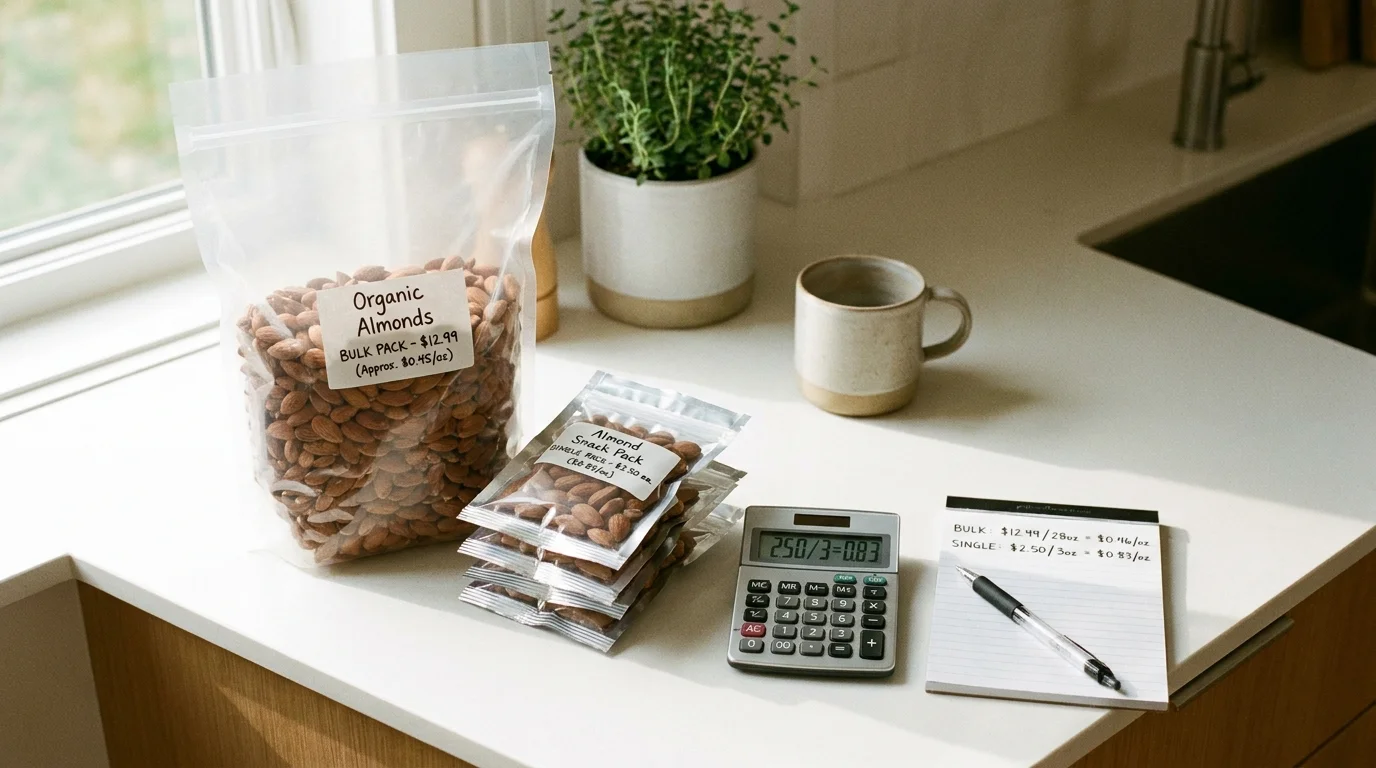
The main mistake in the 'wholesale vs. individual' topic is comparing price tags on the package rather than the price per unit. Always convert to a common base: RUB/kg, RUB/l, RUB/piece, or RUB/serving.
Quick Formula
Price per unit = Package price / Quantity (in kg, l, pieces).
Then add what is usually forgotten: losses from spoilage, expiration, and 'got tired of it — threw it away.'
How to Account for Losses
Real price = Package price / (Quantity × Usage rate).
If you only use 70% of a large package, divide not by 100% but by 70%. This often instantly turns a 'profitable bulk' into an overpayment.
- Example: 1 kg of cheese for 1200 RUB seems cheaper than 200 g for 280 RUB. But if you actually eat 600 g and 400 g dries out, the real price = 1200 / 0.6 = 2000 RUB/kg — more expensive than buying individually.
- Counterexample: 5 liters of dish soap for 900 RUB vs. 1 liter for 250 RUB. If you use it all and have space, bulk almost always wins.
When Bulk Is Truly Profitable: 6 Typical Situations
Bulk works best where demand is predictable and storage is simple. These rules apply to 'buying large packages,' purchases at discount stores, and shared purchases with neighbors.
- Long shelf life. Grains, pasta, canned goods, household chemicals, toilet paper, trash bags.
- Stable consumption. If you use a product every week (coffee, long-life milk, pet food), a large package usually pays off.
- Minimal risk of spoilage after opening. Powders, dishwasher tablets, sugar, flour (under normal storage).
- Storage space available. A cupboard, pantry, or containers are part of the economy. Without them, bulk turns into chaos and losses.
- Strong volume discount. Guideline: savings of 10–15% per unit are noticeable, but only if there are no losses.
- Can be shared with someone. For couples/families/neighbors, bulk is especially profitable: you get the wholesale price without the risk of 'not finishing it.'
Practical tip: keep a list of 'bulk favorites' — 10–20 items you only buy in large packages. It's convenient when such a list is shared: for example, in the free mini-app Pickt on Telegram, you can keep a shared shopping list and sync it in real-time between family members or neighbors (bot @PicktBot, link: t.me/PicktBot/app).
When It's Better to Buy Individually: 6 Signals 'Don't Buy a Large Volume'
Buying individually is not 'more expensive' but 'more flexible and safer.' Especially for perishables, new products, and anything that depends on mood.
- Perishables and short freshness after opening. Dairy products, fresh bread, salads, deli meats, berries.
- You're not sure you'll like it. A new sauce, a 'trial' grain, an unusual tea — better a small volume.
- You rarely use the product. Spices, exotic ingredients, rare cleaning supplies.
- You need variety. Yogurts, snacks, fruits: buying individually helps waste less and enjoy more.
- No storage space. If the package gets in the way, you pay not only with money but also with discomfort.
- The bulk price is not better. Sometimes a 'family package' is more expensive per gram due to marketing. Always check the unit price.
Important nuance: buying individually often wins during promotions. If you see a discount on a small format, compare RUB/kg — sometimes it's the best option without the obligation to 'finish it.'
Product Categories: Where Bulk Usually Wins vs. Individual
This section can be used as a cheat sheet. It helps quickly decide whether it's worth spending time on calculations.
Usually Profitable in Bulk
- Household chemicals and consumables: detergent, capsules, fabric softener, sponges, napkins, paper, bags.
- Cooking staples: rice, buckwheat, pasta, flour, sugar, vegetable oil (if consumption is stable).
- Frozen foods: vegetable mixes, dumplings, fish/meat (if you have a freezer and know how to portion).
- Pet food and litter: with a stable brand and no allergies.
Usually Better to Buy Individually
- Fresh vegetables and fruits: better to buy more often and less to avoid waste.
- Short-shelf-life dairy: buy based on a 2–4 day plan.
- Bread and pastries: a large package often means staleness and waste.
- Delicacies and 'mood' products: cheeses, desserts, snacks — buying individually gives control.
Gray Zone (Depends on Habits)
- Coffee/tea: bulk is profitable if you drink daily and store it airtight.
- Cheeses and sausages: bulk only with proper storage and a clear usage plan.
- Oatmeal, muesli: a large package is profitable if you eat it regularly and the product doesn't go stale.
Shared Purchases: How to Split Bulk Without Conflicts and Losses
Shared purchases are one of the best answers to the question 'when is buying in bulk profitable.' You get the wholesale price but reduce the risk of expiration because the volume is distributed among several people.
Rules That Save Money and Nerves
- Agree on the brand and format in advance. 'Any detergent' and 'only this detergent' are different budgets.
- Divide by a clear unit. Not 'by eye,' but by pieces, grams, or fractions of the package.
- Account for containers. Containers/bags for splitting are a small thing, but without them, part of the benefit is lost.
- Record who takes what. This reduces the risk of buying too much and helps avoid forgetting important items.
Shared lists work well here: when several people add items and mark what's bought, there are fewer duplicates and 'oops, I also got that.' In Pickt, it's convenient to keep such a list for a family or apartment — everything syncs in real-time, and purchases are marked immediately.
What to Choose: Practical Recommendations for Different Cases
Below are ready-made scenarios. Choose the one closest to your reality, and you'll get a clear answer in the 'wholesale vs. individual' logic.
If You Live Alone
- Bulk: household chemicals, paper, basic grains, frozen foods in portions.
- Individual: dairy, bread, fresh vegetables/fruits, snacks and desserts.
If You Are a Couple
- Bulk: almost all consumables, coffee/tea (if you drink daily), grains, oil, some frozen foods.
- Individual: 'mood' products, perishables, anything that quickly gets boring.
If You Have a Family with Children
- Bulk: diapers/wipes (if applicable), grains, pasta, long-life yogurts, household chemicals, pet food.
- Individual: berries, pastries, ready-made meals, products with unpredictable demand.
If You Share Purchases with Neighbors
- Bulk: everything that can be divided 'by pieces' (paper, capsules, bags) and items easy to repack (grains, sugar).
- Individual: perishables and products with different flavors.
If the Goal Is to Minimize the Bill
- First, compare the unit price.
- Then, estimate the usage rate (how much you will actually eat/use).
- Buy in bulk only those items where savings remain even after accounting for losses and storage.
Final guideline: choose bulk when you are confident in consumption and storage; choose individual when freshness, flexibility, and no waste are more important.
Frequently Asked Questions
How to quickly tell if a 'family package' is really cheaper?
Compare RUB/kg (or RUB/l, RUB/piece) on the price tag. If the difference is less than 5–7% and there is a risk of not using the entire volume, it's usually wiser to buy individually.
What minimum 'volume discount' justifies buying in bulk?
Usually from 10–15% per unit, if the product doesn't spoil and you are sure to use it. For perishables, even 20% may not pay off due to losses.
What if bulk is profitable but there's no storage space?
Either choose a smaller format or split the purchase with friends/neighbors. Sometimes it's enough to buy only compact items in bulk (capsules, concentrates) and buy bulky items individually.
How to avoid buying too much when buying in bulk?
Keep a list of 'bulk staples' and don't expand it impulsively. It's more convenient when the list is shared and visible to all participants — this makes it easier to avoid duplicates and extra packages.