How to Plan Weekly Dinners When You Have No Time: A Quick 30-Minute Plan
To figure out how to plan weekly dinners when you have no time, just follow 6 steps in about 30 minutes: choose your week format, build a menu skeleton, repeat basic dishes, make a universal prep, compile a shopping list, and distribute tasks within the family. This approach eliminates the daily 'what to cook?' question and reduces impulse purchases.
Below is a practical step-by-step guide. Each step can be done individually, but together they deliver consistent results from the very first week.
Step 1: Determine a Realistic Week Format (5 minutes)
This step answers the key question: how many dinners do you actually cook? Not 'how it should be,' but how it works in your life.
Open your calendar and mark evenings with late work, workouts, kids' activities, or meetings.
Decide how many 'home-cooked' dinners there will be: typically 3–5. The rest are quick options (quality pre-made meals, delivery, leftovers, or a 'mix-and-match' dinner).
Choose a complexity rule: on weekdays, max 30 minutes of active time; on one day, a 'long' dish taking 60–90 minutes (if desired).
Quick tip: If you're looking for how to quickly plan a weekly menu, start with 4 dinners + 2 quick ones + 1 day for 'leftovers/free choice.'
Step 2: Build a Menu Skeleton: 7 Dinners by Template (7 minutes)
A menu skeleton isn't specific recipes but categories of dishes. It removes the burden of choice and helps you plan meals for the week without stress.
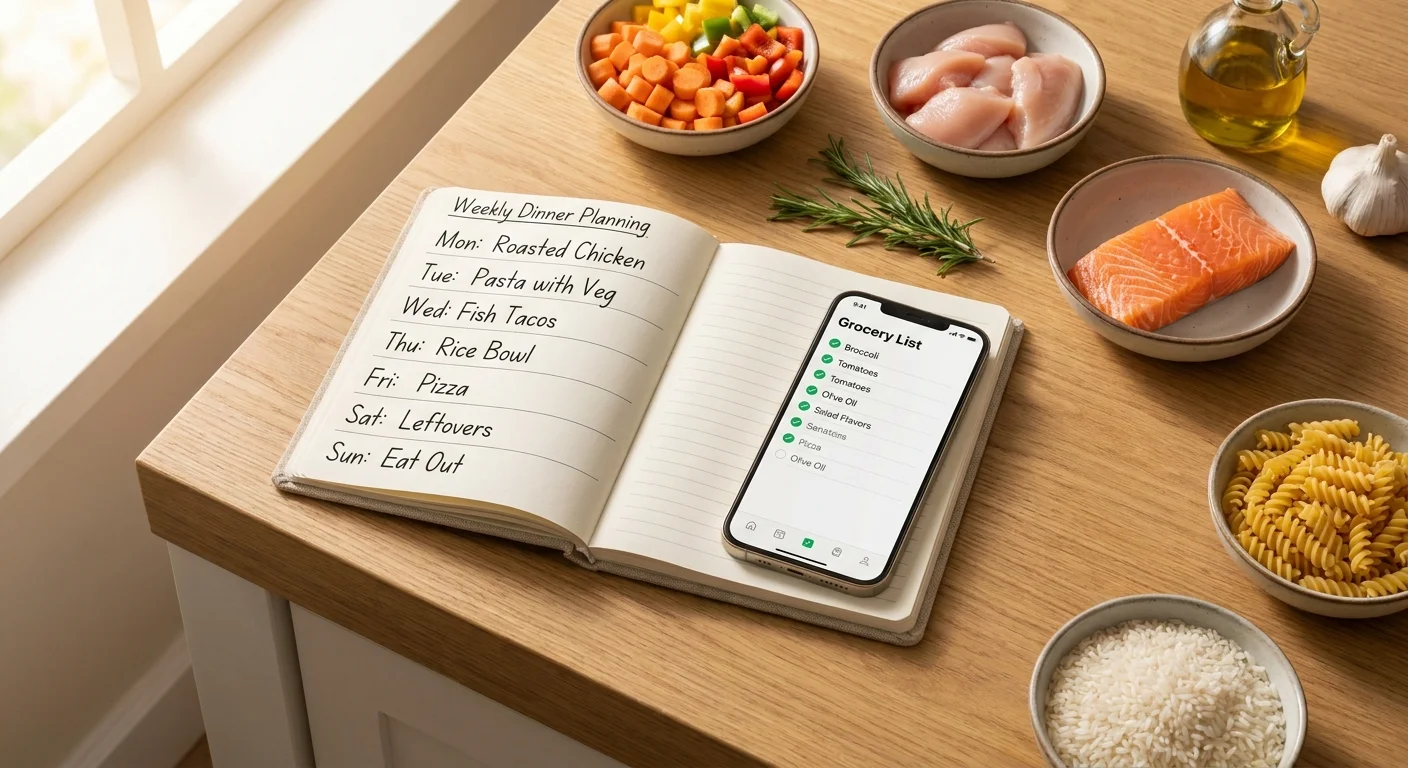
Take a sheet of paper or a note and assign days by type:
Mon: Poultry + vegetables (chicken/turkey, salad or roasted veggies).
Tue: Pasta/noodles + sauce + herbs.
Wed: Fish + side (rice/bulgur/potatoes) + vegetables.
Thu: Soup or stew (cooked 'for tomorrow').
Fri: 'Mix-and-match' dinner (cheese, eggs, veggies, hummus, bread, fruit).
Sat: Meat/legumes + side (can be more elaborate).
Sun: Leftovers + salad/omelet or homemade pizza from what's available.
Now fill in specifics, but keep it simple: 1–2 options per category are enough. This is the answer to 'how to plan weekly dinners when you have no time': you choose from pre-set 'shelves,' not an endless list of recipes.
Step 3: Use the '2×3' Principle: Two Proteins and Three Sides for the Week (5 minutes)
The fastest way to plan dinners is to reduce ingredient variety while keeping flavor diversity. The '2×3' principle means: 2 main protein sources + 3 sides/bases.
How It Works in Practice
Protein 1: Chicken (thigh/fillet/ground) — for 2–3 dinners.
Protein 2: Fish or legumes (salmon/hake/tuna/lentils/chickpeas) — for 2 dinners.
Sides/Bases (3): Rice/bulgur, pasta, potatoes, or a vegetable mix.
Then vary sauces and spices so dishes don't feel the same: teriyaki, tomato sauce, yogurt-garlic sauce, lemon+olive oil, curry paste.
Plus: This makes it easier to compile a weekly dinner grocery list — it becomes short and repeatable, meaning fewer forgotten items.
Step 4: Plan One 'Big Prep' and Two 'Small Preps' (8 minutes)
When time is tight, it's not the 'perfect menu' that wins, but preps. They turn dinner into a construction kit.
One Big Prep (for 2–3 dinners)
Sheet-pan roasted vegetables (carrots, zucchini, bell peppers, onions) or a large pot of soup.
Two Small Preps (10–15 minutes each)
Sauce: Yogurt+lemon+garlic+herbs or a quick tomato sauce.
Base: Cook grains for 2 days or boil pasta 'al dente' and store in a container.
This gives you 'quick weekly dinners' without cooking from scratch every day. For example: roasted vegetables + chicken today, the same veggies + hummus/fish tomorrow, and the day after — in a grain salad.
Step 5: Compile a Shopping List by Blocks and Delegate (3–5 minutes)
For planning to work, the shopping list should be organized by blocks, not by dishes. This speeds up basket collection and reduces the risk of missing items.
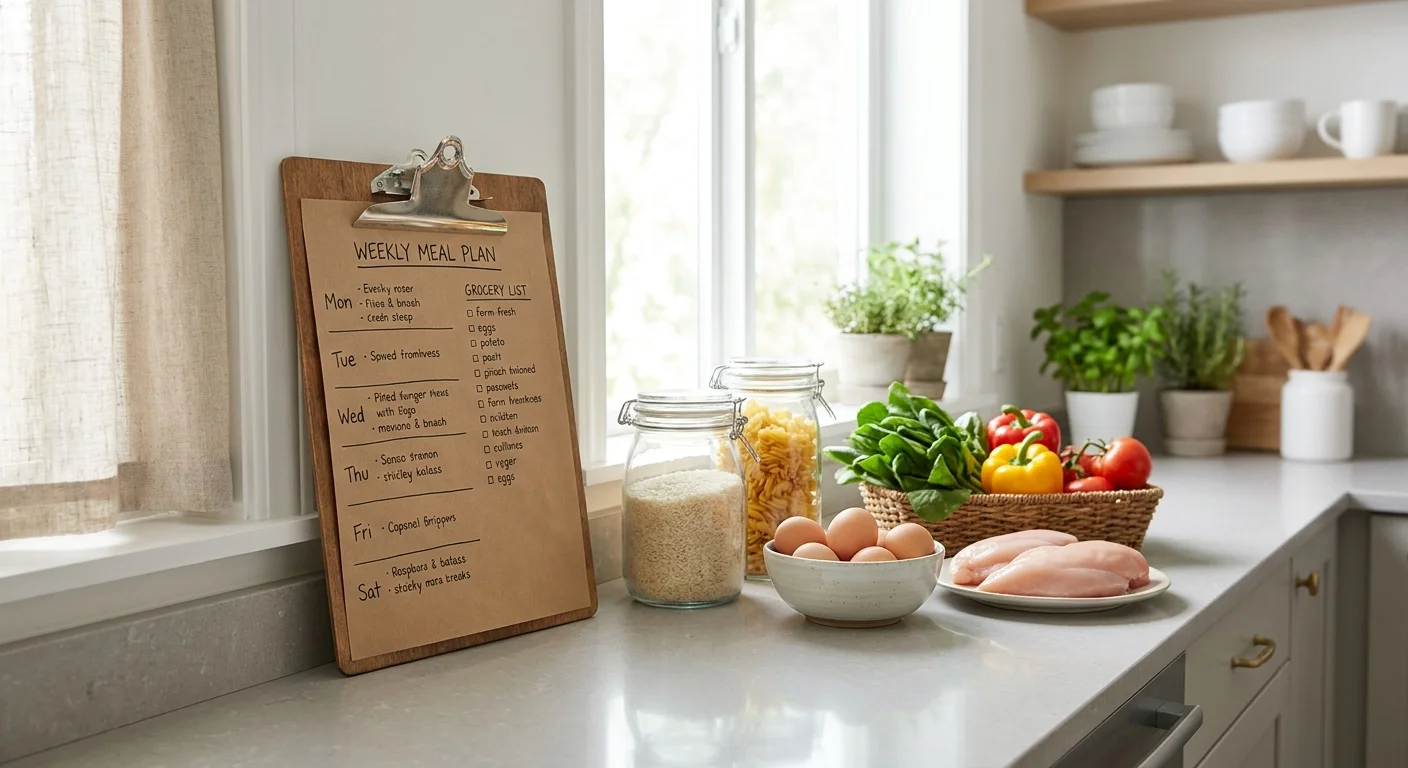
Dinner Shopping List Template
Proteins: Chicken/fish/eggs/tofu/chickpeas.
Vegetables and herbs: 2–3 'for salad,' 3–4 'for roasting,' plus herbs.
Sides: Rice/bulgur/pasta/potatoes.
Sauces and add-ons: Canned tomatoes, yogurt, lemons, soy sauce, spices.
Quick staples: Frozen vegetables, canned tuna/beans, lavash bread.
If you don't live alone, split the list by 'who gets what.' It's convenient to keep it shared to avoid duplicate purchases. For example, in the free mini-app Pickt on Telegram, you can create a shared list with real-time sync and mark items as bought — especially useful when different family members go to the store. Link: t.me/PicktBot/app.
Step 6: Set a 'Plan B' for 15 Minutes and a Substitution Rule (2 minutes)
Planning fails not because of laziness, but due to unexpected evenings. So decide in advance what to do when dinner 'doesn't happen.'
List of 15-minute dinners: Omelet+salad, pasta with tuna, buckwheat+veggies+egg, lavash roll with chicken/hummus, frozen veggies in a pan + ready protein.
Substitution rule: If the fish isn't thawed, swap days; if you didn't have time to make soup, do a 'mix-and-match' dinner and move soup to the weekend.
One-skip rule: If you skip a day, don't 'catch up' with a complex dish; just return to the plan from the next dinner.
This is key to organizing weekly dinners when your schedule fluctuates: you don't break the system over one hiccup.
Step 7 (Optional): Create a 'Menu Constructor' of 10 Repeatable Dinners (5 minutes once a month)
To never start from scratch again, compile a list of 10 dinners your family definitely eats. This is your personal 'catalog.'
Oven-baked chicken + salad
Pasta with tomato sauce + cheese
Pan-fried fish + rice + vegetables
Lentils/chickpeas in curry sauce + bulgur
Cream soup + toast
Omelet/shakshuka
Meatballs/patties + potatoes
Stir-fry with frozen vegetables + chicken
Homemade pizza on lavash
Bowl salad: grains + vegetables + protein + sauce
Then simply rotate this set, changing sauces and sides. If you keep a shared shopping list, add the 'base' and adjust for the week — in Pickt, it's easy to do collaboratively so no one buys extras.
Conclusion. Planning weekly dinners when time is short is possible if you eliminate extra decisions: set the week format, build a menu skeleton, limit ingredients, do one prep, and keep a plan B. In practice, this takes about 30 minutes once a week and saves hours on weekdays — both in time and stress.
Frequently Asked Questions
How many dishes should I plan if I have very little time?
Just 3–4 'real' dinners, 2 quick 15-minute dinners, and 1 day for leftovers/free choice. This is more sustainable than trying to cook 7 different dishes.
How to quickly plan a weekly menu when family members have different tastes?
Plan a 'base' (protein+side+vegetables) and handle differences with add-ons: a spicier sauce for one, no onions for another, more sides for someone else. This way, you cook one dish but assemble different plates.
What if ingredients spoil and the plan falls through?
Place perishable items at the start of the week (fish, herbs, berries) and stable ones at the end (frozen goods, grains, canned items). Also keep an 'emergency kit': frozen vegetables, eggs, pasta, tuna/beans.
How can I reduce trips to the store?
Compile a shopping list by blocks and buy for 5–7 days, leaving room for 1–2 fresh top-ups (bread, herbs). A shared list showing what's already bought helps avoid duplicates and forgotten items.