
Kitchen Organization: What to Store Where So Order Maintains Itself
Order in the kitchen isn't about perfect jars and endless rearranging. It's about a clear system: every item has a 'home,' and accessing what you need takes seconds. Then cooking goes faster, and cleaning stops being annoying.
Good storage organization is built on the logic of actions: where you cook, there should be the tools; where you wash, there should be the supplies and sponges; where you eat, there should be the serving dishes. Below is a practical 'what to store where' scheme and kitchen life hacks that work even in a small kitchen.
1) Divide the Kitchen into Zones and Store 'Along the Route'
The most common cause of chaos is items placed 'beautifully' but not where they are used. Start with zoning: storage should follow your route from the refrigerator to the work surface, then to the stove and sink.
Basic zones are usually: food storage, prep area, cooking area, washing area, serving area. In each zone, keep only what you really need, and put the rest away further.
- Food storage zone: refrigerator, freezer, cabinet with grains, spices, supplies.
- Prep zone: work surface, knives, cutting boards, bowls, grater, measuring spoons.
- Cooking zone: stove, pots, pans, spatulas, oil, salt, frequently used seasonings.
- Washing zone: cleaning supplies, sponges, towels, waste bin, drying area.
- Serving zone: plates, utensils, glasses, napkins, tea/coffee.
Kitchen life hack: if you take two steps 'the wrong way' for the same item every time — that's a sign the item is stored outside its zone.
2) What to Store in Upper Cabinets, Lower Cabinets, and on the Countertop
For order to be maintained in the kitchen, distribute items by frequency of use and weight. Light and rarely used — higher up. Heavy and daily used — lower and closer.
Upper cabinets are best for things that don't require constant access: glasses, holiday dishes, baking pans, napkin supplies. On the lower shelves of upper cabinets, keep what you use every day: mugs, tea, coffee.
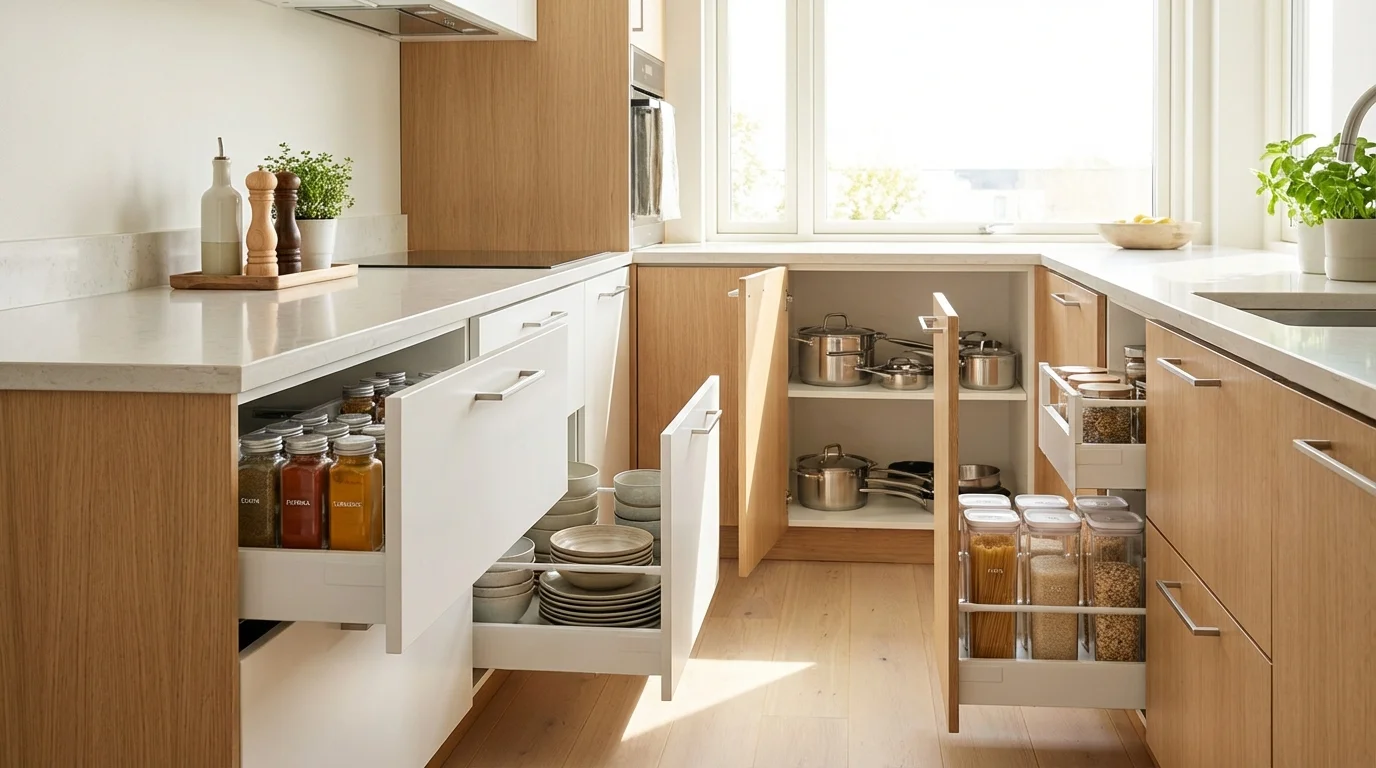
Lower cabinets are the place for heavy and bulky items: pots, pans, bowls, appliances (if you use them often). If you have pull-out drawers, that's ideal: it's easier to maintain storage organization and see everything at once.
The countertop should remain as clear as possible. Leave 2–4 items you use daily (e.g., kettle, coffee machine, bread board). The less visual clutter, the easier it is to maintain order in the kitchen.
Kitchen life hack: assemble a 'daily set' (salt, pepper, oil, favorite seasonings) on a small tray. Wiping down the countertop will become faster, and items won't spread out.
3) Food: How to Arrange It So Nothing Gets Lost or Spoils
Food storage organization solves two problems: you quickly find what you need and throw away less. The main principle is grouping and transparency: similar items are stored together, and the contents are visible at a glance.
Grains, pasta, flour store nearby and by category. If you transfer to jars — label them. If you leave them in packaging — use containers or boxes so bags don't fall apart.
Spices are best kept closer to the stove, but not above it, to avoid overheating. A convenient option is a narrow shelf, a pull-out organizer, or a box in a drawer with dividers.
Canned goods, sauces, oils logically go together in one cabinet. Put opened items in front. Reserves — in the back or on a top shelf.
The refrigerator also loves a system. Arrange by zones: ready-to-eat food, dairy products, meat/fish, vegetables/fruit, sauces. This makes it easier to monitor expiration dates and plan meals.
- 'First in, first out' rule: put new products in the back, old ones in the front.
- One shelf — one category: less chance of forgetting about a jar of sauce or cottage cheese.
- Container for 'snacks': yogurts, cheese sticks, sliced items — all in one place, especially convenient for families.
Kitchen life hack: create a small 'use within the next 2 days' basket. Put short-shelf-life products there — and they'll stop getting lost in the depths.
4) Dishes and Utensils: Where to Store Them to Cook Faster
Dishes should be stored not 'by type,' but by scenario. For example, if you often have breakfast, gather everything for breakfast together: plates, bowls, mugs, spoons, tea/coffee.
Plates and bowls are convenient to keep closer to the table or serving area. If space is limited, stack them, but not too high, so you don't have to strain to reach them.
Utensils are best distributed in a drawer with a tray. Frequently used ones (forks, spoons, knives) — in the most accessible sections. Rare ones (corkscrew, peeler, thermometer) — in a separate section or a small box.
Pots and pans logically go near the stove. Lids — vertically in a holder or in a narrow compartment, so you don't have to solve a 'puzzle' every time.
Cutting boards and baking sheets are best stored vertically: they don't take up a whole shelf and are quick to grab. This is one of the simplest kitchen life hacks that immediately adds order.
A mini-rule for a sustainable system: if an item is used less than once a month, it shouldn't occupy the 'front line' (the most convenient shelves and drawers).
5) Quick Checklist: How to Tidy Up in 60 Minutes and Maintain It
To prevent storage organization from turning into a major overhaul, take short steps. First, remove the excess, then secure storage locations, and only then buy organizers.
60-Minute Checklist
- 10 minutes: clear the countertop, leave only daily-use appliances.
- 15 minutes: sort through one 'problem' drawer and separate the contents by category.
- 15 minutes: group food in the cabinet (grains/baking/canned goods/snacks).
- 10 minutes: create a 'use within the next 2 days' shelf in the refrigerator.
- 10 minutes: label 3–5 of the most important containers or shelves (at least with paper sticky notes).
To maintain order in the kitchen, two habits are enough. First — return an item to its place immediately after use. Second — do a 'quick review' of supplies once a week to understand what's running out.
Kitchen life hack: keep a 'spare set' of consumables (bags, foil, parchment, sponges) in one place. When everything is gathered together, you buy extras less often and replenish what's needed faster.
Conclusion. Order in the kitchen is maintained not by willpower, but by clear logic: store by zones, keep only what's needed in sight, group food and utensils by scenarios. Start with one drawer or one shelf — and the system will quickly 'pull' the rest along.
And to ensure supplies are replenished without duplicates and forgotten purchases, it's convenient to keep a shared list for the home. In Pickt — a free mini-app in Telegram for shared shopping lists with real-time sync — you can quickly mark what's run out, right while cooking: t.me/PicktBot/app.